Most driveways do not need a bigger machine. They need a better setup. I have pulled up to jobs where the homeowner had a brand new washer still in the box and a stiff factory hose that kinked twice before the wand even got wet, and I have pulled up to jobs where a five year old electric unit cleaned a two car driveway in 35 minutes because everything upstream of the nozzle was right. The difference was never the sticker on the box. It was pressure washer setup.
I run a mobile detailing business out of Tampa. Cars, boats, hulls, driveways, decks, and one moldy fence that keeps coming back no matter how many times I kill it. Twelve years of that work taught me the same lesson over and over: setup is the job. The actual cleaning is the easy part.
Here is the order I set up in, the mistakes that cost people their afternoon, and the two pieces of gear that fix the most common complaints before you ever pull the trigger.
Why you should trust me
I have owned three pressure washers and worked with a lot more. The electric one handles light work, the gas one handles boats and serious concrete, and the cheap one I bought to review died inside a month. That last one taught me more than the other two combined.
I do not judge a washer by the number on the box. Every unit I recommend gets looked at for real flow rate, detergent draw, hose and wand quality, and duty cycle before I say a word about it. PSI without GPM is a lie. Pressure is how the machine feels. Flow is what actually moves dirt off concrete. If you take one thing from this article, take that.
How I judge a setup before the water goes on
Four things, in this order.
Flow rate first. Gallons per minute is the work. A machine pushing 1.8 GPM at 2,000 PSI will out-clean a machine rated 3,000 PSI at 1.2 GPM on a driveway every single time. When you read a listing, find the GPM number before you look at anything else.
Detergent draw second. If a washer cannot pull soap out of a bottle on its own, it is a hose with a trigger. Car washing, siding, and anything with organic growth on it depends on detergent doing the work while you wait. A foam cannon plus a real soap bottle changes the job completely.
Hose and wand third. The factory hose is the part that makes people hate their pressure washer. Short, stiff, kinks at every corner. A proper hose is not glamorous, but it is the difference between a job you finish and a job you abandon.
Duty cycle fourth. Cheap electrics overheat and need breaks. Gas runs all day but it is loud and heavy. Know which one you bought and plan the job around it.
The two pieces below are where I would put money first, because they solve the two most common complaints: not enough reach and not enough soap.
The two pieces of gear that fix most setups
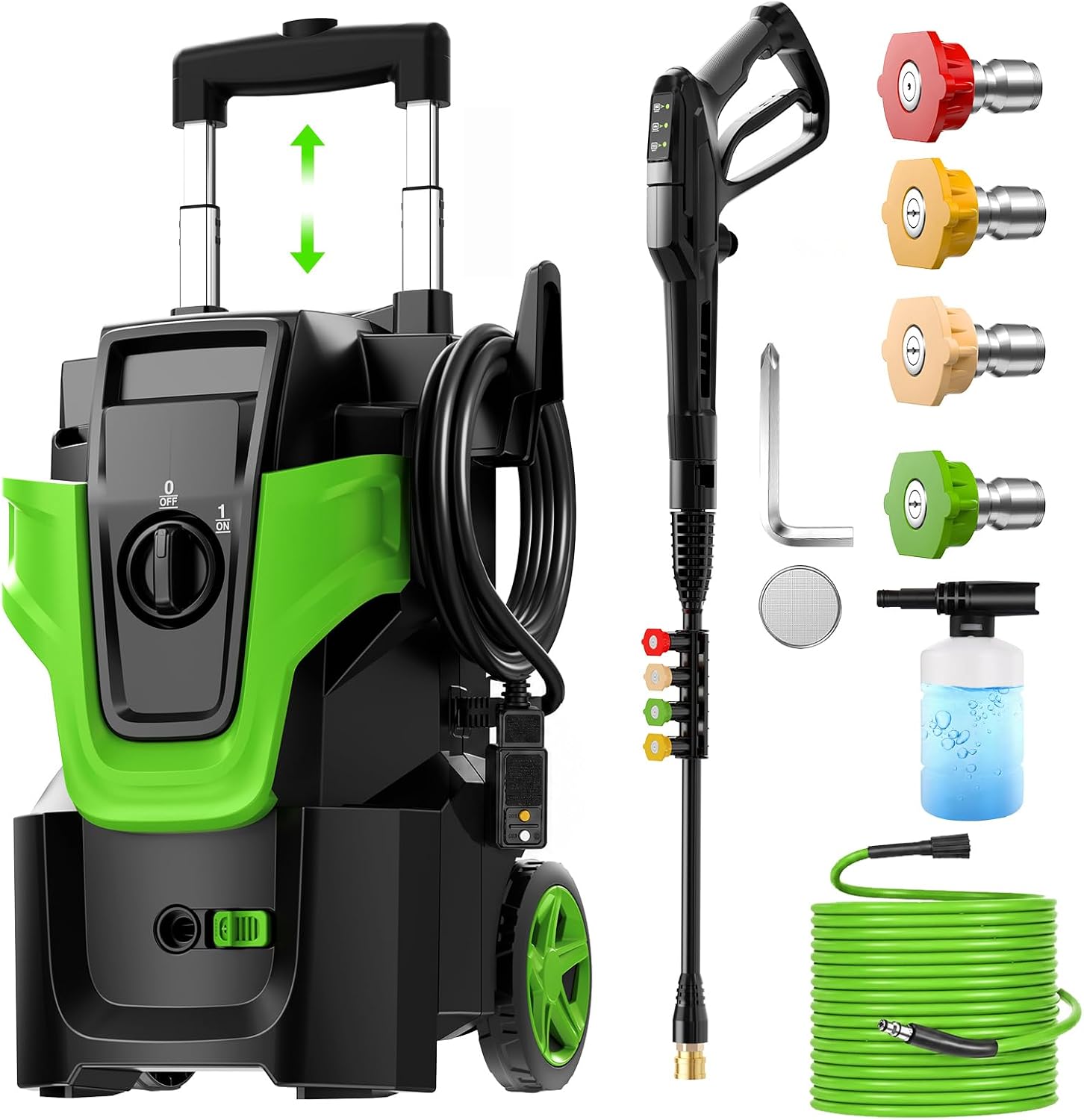
The machine: Heavy Duty MAX5000 PSI Pressure Washer, 3-Speed Adjustable Power Washer with 2-Stage Pull Rod, 4 Nozzles, Foam Cannon & 500ml Soap Bottle for Car, Home & Outdoor Cleaning,Green
 Visit on Amazon →
What matters here is the package, not the number in the model name. It arrives with four nozzles, a foam cannon, and a 500ml soap bottle, which is the entire setup in one box. You are not hunting for a cannon two weeks later because the detergent bottle that came with your old unit clogged and died.
The three speed settings are the useful part for a homeowner. Drop down for car paint and trim, step up for concrete and siding. The two stage pull rod sounds like a spec sheet detail until you have dragged a unit around a driveway for an hour, and then it is the handle you are grateful for. Check current Amazon price.
Flaws but not dealbreakers: Included nozzles are usually the weakest link in any all-in-one kit. If a fan pattern starts spitting instead of spraying evenly, replace the nozzle before you blame the machine. Also confirm the GPM figure and the inlet and outlet fitting sizes on the listing, because flow rate is what determines how fast the job goes.
Who it is for: Homeowners who need to wash a car, a patio, siding, and a driveway a few times a year and do not want to buy the accessories separately.
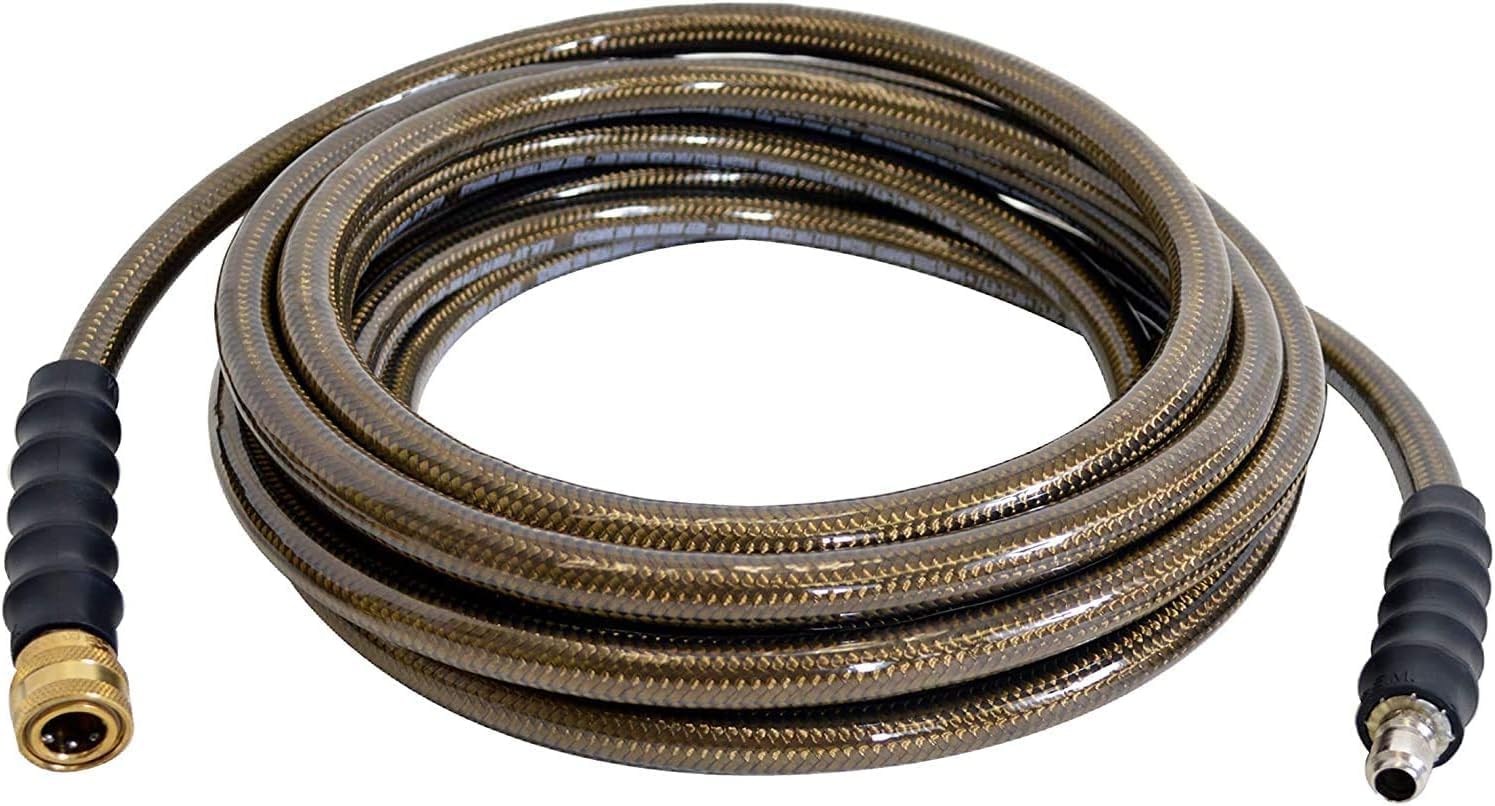
The hose: Simpson 50ft, 3/8" 4500 PSI Monster Cold Water Pressure Washer Hose, 41028
 Visit on Amazon →
Fifty feet of hose is the single biggest quality of life upgrade on a pressure washer, and it is the one people skip. It keeps the machine parked at the spigot while you reach the far end of a two car driveway, which means you are not dragging a wet unit through wet concrete and you are not stopping to move it three times.
Three eighths inch is the standard inner diameter on most residential machines, and the 4500 PSI rating gives you headroom over anything a homeowner unit will ever produce. Check current Amazon price.
Flaws but not dealbreakers: This is a cold water hose, so do not pair it with a hot water machine. Check your washer's outlet fitting and coupler type before ordering, because adapters are cheap but a return is annoying. And know that a longer hose run costs you a little pressure at the wand, which is another reason to match the nozzle to the surface instead of guessing.
Who it is for: Anyone whose factory hose kinks every five feet, or whose driveway is longer than the hose that came in the box.
The setup, step by step
Step one: water supply. Garden hose on, spigot fully open, no kinks, no splitters leaking pressure. A pressure washer can only push the water it is given. If your spigot is half open or your hose is pinched under a tire, no machine on the market will save the job.
Step two: check the inlet screen. Most machines have a small mesh filter where the garden hose connects. Pull it, rinse it, put it back. A clogged screen starves the pump and makes a good washer behave like a bad one.
Step three: flush the hose before you connect the gun. Run water through the hose and the machine's inlet for a few seconds with the gun off. This pushes trapped air out of the line. Air in the system is what causes that pulsing, sputtering first minute that makes people think their pump is failing.
Step four: pick the nozzle before you pull the trigger. This is where most damage happens. The tightest nozzle is for stripping paint and rust, not for concrete you care about. A mid angle is your general purpose concrete and siding nozzle. The widest fan is for rinsing and for washing cars, because it spreads the pressure over more surface. The soap nozzle goes on the detergent line and nowhere else. If you only remember one rule, remember that the nozzle is the machine.
Step five: set up your detergent. Fill the soap bottle, connect the foam cannon, and test the draw before you start. If the machine cannot pull soap, stop and fix it now rather than halfway through a car. Apply detergent low and let it dwell, but never let it dry on the surface. Soap that dries is soap you have to scrub.
Step six: test on a hidden spot. Every surface is different. Weathered wood, soft concrete, and old paint all react differently. Pick a corner nobody looks at, hit it for ten seconds, and look at what you did. Adjust distance and nozzle before you commit to the whole job.
Step seven: work in passes, top to bottom. Overlap each pass by about a third so you do not leave stripes. Keep the wand moving. Standing still in one spot etches concrete and strips paint, and it is the fastest way to turn a cleaning job into a repair job.
Step eight: rinse, then deal with the water. Rinse from the top down and push the dirty water away from where you already cleaned. If you are washing a car, dry it with a towel or a blower immediately, because hard water spots in Tampa sun set in minutes.
Step nine: break it down. Drain the hose, coil it loose, run the detergent line clear with clean water, and store the nozzles somewhere you will find them. A detergent system left full of soap is a detergent system that clogs, and a clogged soap line is the number one reason people decide their washer is broken.
Where most setups fail
Trusting the PSI number. Marketing hides weak flow. If the listing will not tell you the GPM, that is your answer.
Kinked, short hoses. The factory hose is a placeholder. Replace it and half your frustration disappears.
Clogged detergent systems. Flush the soap line with clean water after every job. Every single one.
Wrong nozzle for the surface. Too tight on wood etches the grain. Too tight on paint takes the paint. Too wide on concrete means you are rinsing dirt around instead of removing it.
Ignoring duty cycle. Electric units need cool-down breaks. Run one for an hour straight in Florida heat and you will meet its thermal cutoff.
Running a gas engine indoors or in a garage. Carbon monoxide does not care how short the job is. Wheel it outside, every time.
Spraying where water should not go. Electrical outlets, light fixtures, window seals, and the gap under siding. Water finds those places and it does not leave on its own.
What this all costs
The math on pressure washer setup is not about the sticker price of the machine. It is about cost per job over the years you own it. A unit that ships with nozzles, a foam cannon, and a soap bottle saves you the accessory purchases that usually follow a bare machine purchase. A hose that does not kink saves you the afternoon you would have spent fighting it, which is worth more than the hose.
Check current Amazon price on both pieces and compare them against what you would spend buying the same items separately. If you already own a washer that works, a hose upgrade is the cheapest improvement available to you. If you are starting from nothing, buying the setup in one box is the shortest path to a driveway that looks new.
Questions I get on setup
Do I need more PSI to clean a driveway? Usually no. Flow rate, the right nozzle, and detergent dwell time do the cleaning. A machine with honest gallons per minute and a matched nozzle will beat a higher PSI unit with weak flow, and it will do it without etching the concrete.
Why does my hose keep kinking? Short factory hoses are stiff, and they kink because they are coiled tight and dragged around sharp corners. Uncoil a longer hose fully before you start, keep it out of the sun when you store it, and coil it loose when you are done.
Can I use a pressure washer on my car? Yes, with the widest nozzle and some distance. Keep the wand moving, use the foam cannon to let detergent do the work, and never put a tight nozzle near paint, trim, or a wheel bearing.
How long should an electric washer run? Follow the manual's duty cycle. If you feel the housing getting hot or the unit cuts out, let it cool. Planning the job in sections is easier than standing around waiting for a thermal reset.
The bottom line
Setup is not the boring part before the real work. It is the real work. Water supply, hose, nozzle, detergent, then technique, in that order, every time. Get the flow right, give yourself enough hose to work without dragging the machine, match the nozzle to the surface, and let the soap sit long enough to do its job.
Do that and a mid-range electric unit will make your driveway look new. Skip it and the most expensive machine at the store will still leave you standing in a puddle, wondering why the concrete looks the same as when you started.