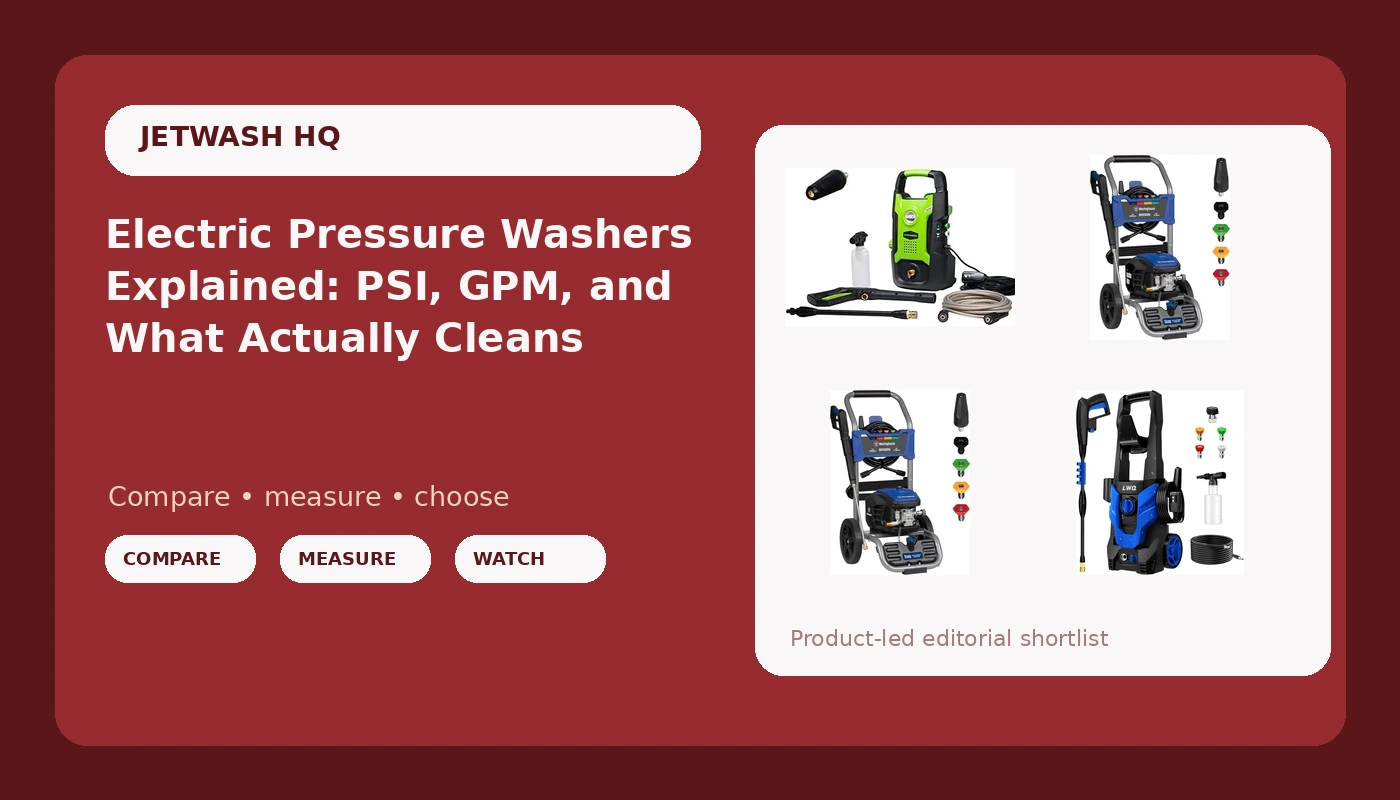
Choosing an electric pressure washer usually starts with the biggest number printed on the box, and that is the first mistake. PSI tells you how hard the water hits. GPM tells you how much water is doing the work. A unit with a thin, high-pressure stream will lose to a lower-pressure unit that moves more volume, because cleaning is a function of flow, chemistry, and the nozzle in front of the water. The four machines below cover the realistic range of what homeowners actually buy: a compact hand-carry, a mid-size unit, a high-flow model, and a budget machine with a foam cannon. This explainer covers what each one is for and how to decide before you spend.
Related: How to Choose a Surface Cleaner for a Driveway →
Quick answer
Buy for flow rate and nozzle quality, not peak PSI. Among these four, the Westinghouse WPX3400e carries the highest rated flow at 2.0 max GPM with a brushless motor, which suits concrete, siding, and long fence lines. The Westinghouse WPX3000e sits just under it at 1.76 max GPM with an induction motor. The Greenworks GPW1501 is a 1500 PSI, 1.2 GPM upright hand-carry built for cars, furniture, and small patios. The budget pressure washer with the foam cannon is the light-duty pick for car washing and touch-up work. Match flow to the size of the job and you avoid overspending on capability you will not use.
Four useful options
| Model | Best fit | What stands out |
|---|---|---|
| Westinghouse WPX3400e Electric Pressure Washer | Large flatwork, siding, and full-property jobs | 3400 max PSI and 2.0 max GPM, brushless motor, onboard soap tank, 5 nozzle set |
| Westinghouse WPX3000e Electric Pressure Washer | Most driveways, decks, and fences | 3000 max PSI and 1.76 max GPM, induction motor, onboard soap tank, 5 nozzle set |
| Greenworks GPW1501 1500 PSI 1.2 GPM Pressure Washer | Cars, patio furniture, and tight storage | Upright hand-carry body, turbo nozzle included, 1500 PSI at 1.2 GPM |
| Pressure Washer with 4 Quick Connect Nozzles and Foam Cannon | Budget car washing and light cleaning | Four quick connect nozzles, foam cannon included |
The highest-flow pick: Westinghouse WPX3400e Electric Pressure Washer
This is the highest flow rate in the group, and flow is what lets you move across a driveway instead of parking on one stain. The trade-off is everything that comes with more capacity: a heavier body, a bigger footprint in the garage, and a stronger pull on your outdoor spigot. On a long fence line or a two-car slab, that trade is worth making. On a balcony or a single car, it is more machine than the job needs. A brushless motor also removes the carbon brushes that wear on conventional motors, which matters if you plan to run the unit often.
The middleweight pick: Westinghouse WPX3000e Electric Pressure Washer
Induction motors are the quiet, long-running design used in shop equipment, and they generally tolerate longer sessions than the universal motors found in cheap units. The 1.76 max GPM rating puts this within reach of the higher-flow model without stepping all the way up, which is why it fits the average driveway and a season of deck cleaning. The catch is the same as any electric in this class: it still depends on your spigot keeping up, and it will not strip a failed paint job the way a gas unit can. For maintenance cleaning rather than restoration, that is the right compromise.
The compact pick: Greenworks GPW1501 1500 PSI 1.2 GPM Pressure Washer
The hand-carry format is the whole point here: it hangs on a wall, lifts with one hand, and does not demand a parking space. The 1.2 GPM rating is the honest limitation. That is enough flow to rinse a car, knock pollen off siding, and clean patio furniture, and it is not enough to make quick work of a 40-foot concrete driveway. A turbo nozzle helps by concentrating the stream into a rotating pattern, which recovers some cleaning speed on flat surfaces. If your jobs are small and your storage is smaller, this is the shape you want.
The budget pick: Pressure Washer with 4 Quick Connect Nozzles and Foam Cannon
The foam cannon is the interesting part of this package. Pre-soaking a car with foam loosens road film before you touch it, which reduces the chance of dragging grit across the paint. Four quick connect nozzles give you the spread you need for rinsing and the narrower pattern for tires and wheel wells. What you are not buying here is flow, so treat this as a light-duty machine: cars, patio furniture, a walkway, a fence panel. Expect to move slowly on large concrete, and expect to want a better hose and wand before long.
Prices and availability may change. Product images, names, and retailer links are matched to verified listings. No current price, rating, stock status, or measured result is stated here without current evidence.
Why GPM matters more than PSI
Cleaning power is not one number. Pressure is how fast the water leaves the nozzle, and flow is how much water leaves it per minute. A narrow, high-pressure stream carves a clean line through grime and leaves everything beside it untouched. More flow wets a wider band, carries the loosened dirt away, and lets you work at a walking pace. That is why a unit rated at 2.0 GPM covers ground faster than a unit rated at 1.2 GPM, even when the second one advertises a similar PSI figure.
There is a practical ceiling, and it is your plumbing. Every electric washer draws from a garden spigot, and a spigot that is already feeding a sprinkler or a long run of old hose will starve the machine. Starved pumps cavitate, lose pressure, and wear out early. Before you buy based on a spec sheet, check that the spigot you plan to use delivers a steady, unrestricted stream.
Nozzles, detergent draw, and duty cycle
The nozzle is the cheapest performance upgrade you will ever make. Most sets use a color code: a wide white or green tip for rinsing and siding, a yellow or red tip for concrete and stripping, and a black tip for soap. A turbo nozzle spins a zero-degree stream into a cone, which cleans flat work faster than a fan tip at the same pressure. Match the tip to the surface, keep the wand moving, and you will get more out of a modest machine than a careless operator gets out of an expensive one.
Detergent draw is the second thing people discover too late. A washer that cannot pull soap from a tank or a siphon tube is just a hose with a trigger, and you end up spraying a bucket-mixed cleaner by hand. An onboard soap tank lets you switch from cleaning to rinsing without breaking your rhythm, which matters on cars and siding where dwell time does a lot of the work. Duty cycle is the third limit: cheap universal motors need breaks, while induction and brushless designs generally run longer before heat becomes a problem.
- Measure the job: square footage of concrete, siding height, and how many vehicles you wash per month.
- Check your spigot for steady, unrestricted flow before trusting any GPM rating.
- Pick the flow rate that matches the job, not the PSI number that matches the marketing.
- Confirm the nozzle set, wand, and hose are worth keeping, since replacements add up fast.
- Decide whether you need detergent draw, then choose between a compact, mid-size, or high-flow body.
Practical guidance for real jobs
- Wash top to bottom and work in sections so dirty water never runs over clean surface.
- Pre-soak with detergent and give it dwell time, then rinse, rather than scrubbing with pressure alone.
- Keep the nozzle a consistent distance from the surface, because a tip held too close etches wood and strips paint.
- Never point a pressure washer at windows, vents, or electrical fixtures, and never wash a car with a zero-degree tip.
- Store the unit indoors with the pump drained, and coil the hose without kinks, since a kinked hose is the most common reason a good washer feels weak.
Which option should you choose?
Choose the Westinghouse WPX3400e Electric Pressure Washer when you are cleaning large concrete areas, long fence lines, or full siding, and you want the highest rated flow in this group with a brushless motor. Choose the Westinghouse WPX3000e Electric Pressure Washer when you want most of that capability for a normal driveway-and-deck routine, with an induction motor and an onboard soap tank. Choose the Greenworks GPW1501 1500 PSI 1.2 GPM Pressure Washer when storage space and portability matter more than speed, and your jobs are cars, furniture, and small patios. Choose the Pressure Washer with 4 Quick Connect Nozzles and Foam Cannon when you want an inexpensive entry point for car washing and light cleaning, and you accept that large concrete will take patience.
One caveat applies to all four: rated PSI and GPM describe the machine under ideal supply conditions, not the result you will see at the end of a worn hose on a shared spigot. Nothing here has been measured on your property, and no price, rating, or stock status is stated in this article.
The bottom line
Flow rate decides how fast you finish, nozzle choice decides how clean the result looks, and detergent draw decides how much scrubbing you avoid. If your property has real flatwork, the higher-flow Westinghouse models are the ones built for it, with the 3400e at the top of the group and the 3000e as the more moderate option. If your work is cars and small surfaces, the compact Greenworks and the budget foam cannon package will do the job without taking over your garage. Read the GPM first, pick the nozzle second, and let the PSI number be the last thing you check.