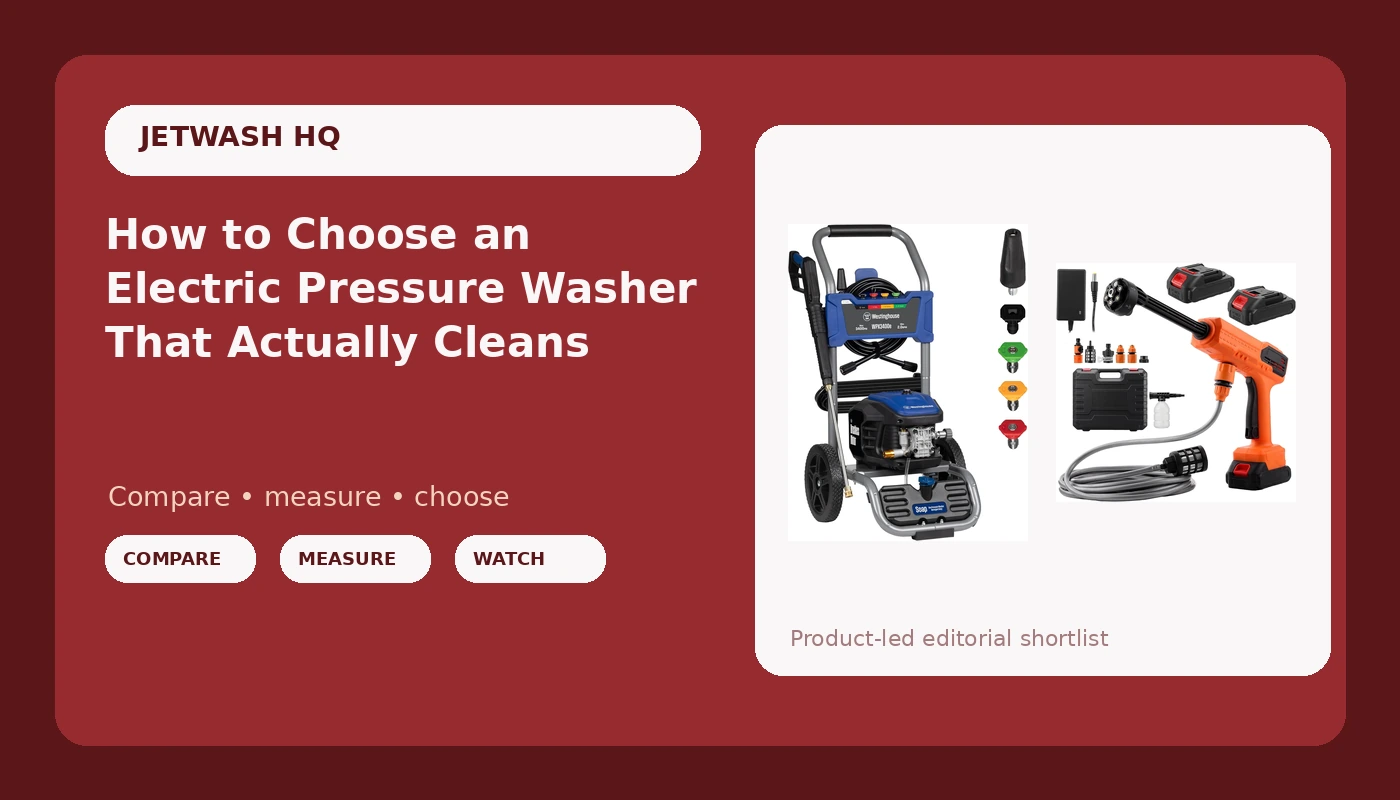
Most people shopping for an electric pressure washer start with the PSI number on the box, and that is the first mistake. PSI is how hard the water hits. GPM is how much water is doing the work, and flow is what actually lifts dirt off concrete. A 3,000 PSI machine pushing 1.2 gallons a minute loses to a 2,000 PSI machine pushing 1.8 gallons a minute on a driveway, every single time.
I have been detailing cars and boats out of a van in Tampa for 12 years. I have washed more driveways, decks, pool cages, and boat hulls than I can count, and I own three pressure washers: the electric one for light work, the gas one for the serious jobs, and the cheap one I bought to review that died inside a month. That dead machine taught me more about shopping than the other two combined.
This guide is not a spec sheet recital. It is the process I use to decide whether a machine is worth buying, and then the workflow that gets a driveway or a car clean without wrecking the surface underneath.
Why you should trust me
Twelve years of mobile detailing means I have burned through hoses, clogged detergent injectors, and replaced wands that felt like toys in my hand. I have pressure washed a client's moldy fence that keeps coming back, stripped years of grime off a two-car driveway in July humidity, and washed boats where the wrong nozzle angle meant a gel coat repair bill.
What I care about is boring and practical. Real flow rate. A detergent system that draws instead of dribbling. A hose that does not kink every five feet. A wand that does not flex when you lean into it. If a machine gets those four things right, it works. If it gets them wrong, no PSI number on the box will save it.
How I sized up the machines in this guide
Every pressure washer gets the same four questions from me.
First, what is the real flow rate, not the peak PSI? Flow rate is the cleaning, pressure is the feeling. Anything under 1.5 GPM is going to spend more time waiting for the water to do its job than actually cleaning.
Second, does it draw detergent properly? A washer that cannot pull soap is a hose with a trigger. You can still clean with it, but you are doing all the chemistry work by hand and you will notice.
Third, are the hose and the wand worth keeping? A stiff, kinking hose is a daily annoyance you will resent, and a wand that feels like a toy will make every job feel longer than it is.
Fourth, would I use it for a full driveway without cursing? That is the test. A machine that only works for fifteen minutes at a time is a machine that ends up in a closet.
The two machines below sit at opposite ends of that scale, and both are honest about what they are. I am judging them on the specs and the design decisions the manufacturer published, not on a staged driveway photo.
The machines worth starting with
One is a full-size corded electric that handles the jobs most homeowners actually have. The other is a handheld cordless that solves a completely different problem.
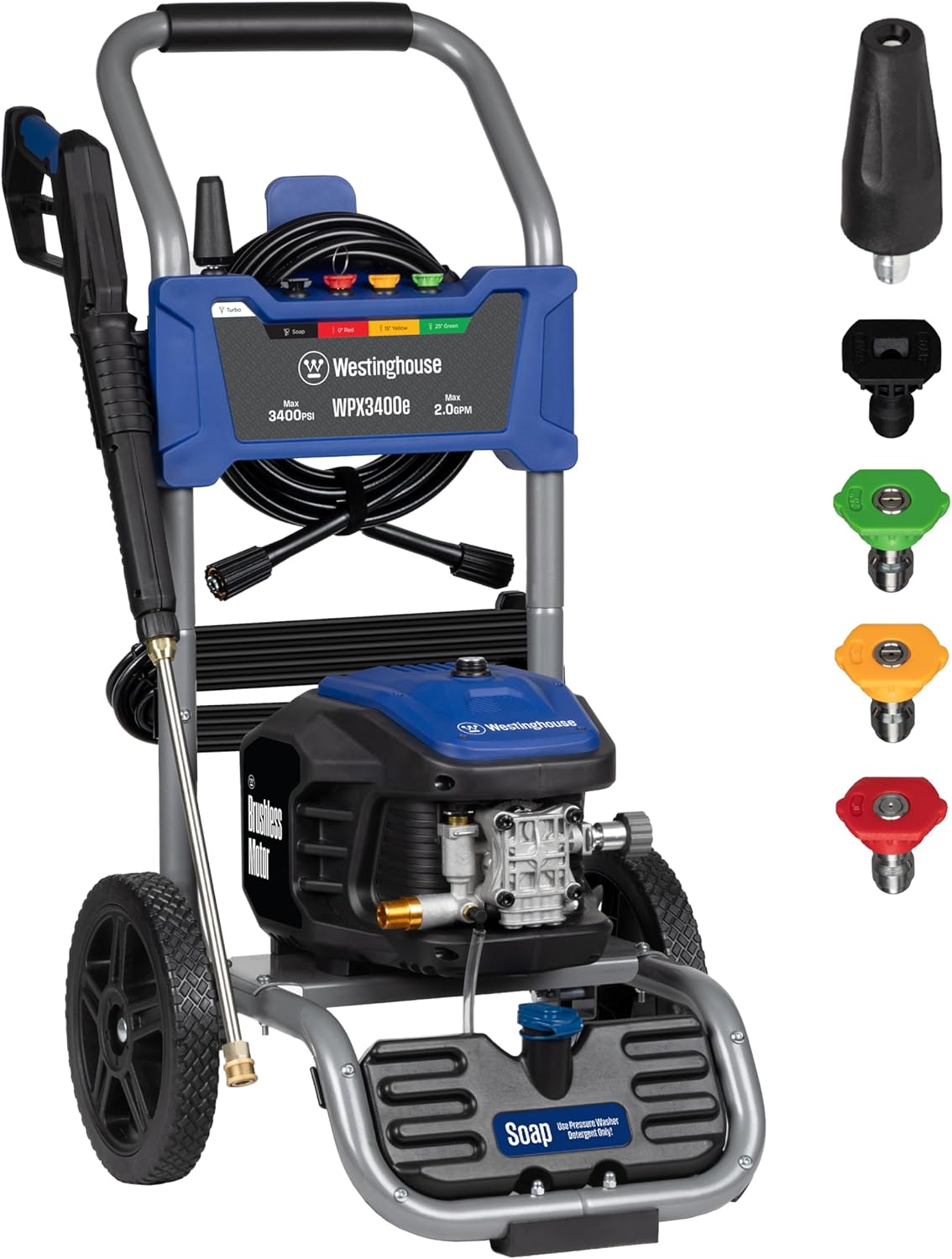
Our pick: Westinghouse WPX3400e Electric Pressure Washer, 3400 Max PSI and 2.0 Max GPM, Brushless Motor, Onboard Soap Tank, Spray Gun and Wand, 5 Nozzle Set, for Cars/Fences/Driveways/Homes/Patios/Furniture
 Visit on Amazon →
Two things on this spec sheet matter more than everything else. The first is 2.0 max GPM. That is a real flow rate for a homeowner machine, and paired with the 3400 max PSI rating it lands in the class that can strip a two-car driveway without you standing there all afternoon. The second is the brushless motor. Brushless means fewer wear parts and a longer duty cycle, and duty cycle is where cheap electric washers fail. The failure mode is almost never pressure. It is heat. A brushed motor in a plastic housing will thermal out on you halfway down the driveway, and then you are standing there with a wet hose waiting for it to cool.
The onboard soap tank is the feature I would pay for. Having detergent on the machine means you are not babysitting a bucket or fighting a siphon tube that keeps falling out of the jug. The five nozzle set covers the jobs you actually have: a wide fan for rinsing and for cars, a narrower one for concrete, and the soap nozzle for the detergent pass.
Flaws but not dealbreakers: It is corded, so you need an outlet and a hose bib within reach, and you are managing a power cord and a high pressure hose at the same time. It is also heavier than a handheld, which matters if you are carrying it up a flight of stairs or over a pool cage. And 3400 PSI is far more than a car's clear coat wants, so you will be running the wider nozzles and keeping your distance, not chasing the highest number the machine can produce.
Anyone with a driveway, a fence, and a car or two in the driveway will get their money's worth out of this one.
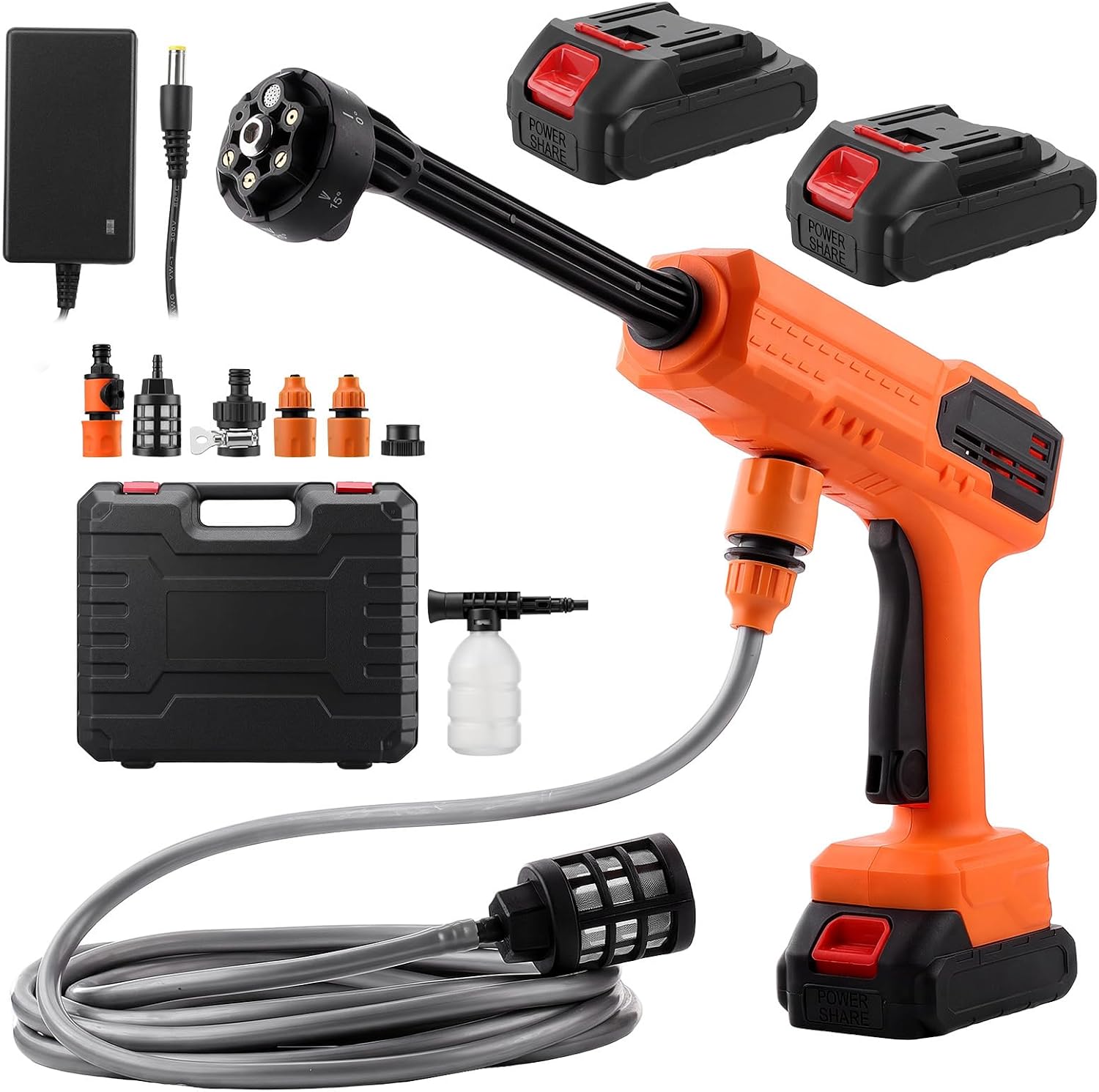
Budget pick: Cordless Pressure Washer Handheld Portable,2x6.5Ah Batteries,1080PSI
 Visit on Amazon →
1080 PSI and two 6.5Ah batteries in a handheld body. This is not a driveway machine and it is not pretending to be one. What it is good at is every job where dragging out a cord and a hose is more work than the cleaning itself: wheels and wheel wells, patio furniture, a balcony railing, mud off a mountain bike, the kid's playhouse, the dog's water station. If you live in an apartment or a condo with no hose bib, this category is the only one that works for you at all, since handheld cordless units are designed to pull from a bucket or a bottle rather than a spigot.
Two batteries is the right call. A single battery in a handheld means you clean for fifteen minutes and then sit and wait for a charge, which is exactly how these machines end up buried behind the beach chairs. Check current Amazon price.
Flaws but not dealbreakers: Expect a narrow stream and a small onboard supply, so plan on refilling more than once. You are also not getting the flow rate needed to flush grit out of deep concrete pores, and battery packs do not love being stored in a hot garage at full charge. Charge them to about half if the machine is going to sit for the summer.
Anyone who needs spot cleaning, apartment dwellers, and anyone with a second car they want to rinse weekly will be happy with this one.
What to check before you buy
Flow rate first, always. Look at the GPM number before you look at the PSI number. Under 1.5 GPM is a compromise you will feel on every job.
Detergent draw. Find out how the machine pulls soap. An onboard tank is the easiest system to live with. A siphon tube into a jug works but falls out. No soap system at all means you are pre-treating by hand.
Hose quality. A stiff hose that kinks is the single most common complaint I hear from homeowners. If a machine has a soft, flexible hose, that is worth more than 200 extra PSI.
Wand and gun feel. A wand with play in the connection will spray at an angle you did not choose. A gun with a stiff trigger will make your hand cramp on a long job.
Duty cycle. How long can the unit run before it needs to cool? Gas wins here, no argument. Among electrics, brushless motors and better cooling run longer.
Nozzle set. You need at minimum a wide fan for rinsing, a mid fan for concrete, and a soap nozzle. Color coding is standard: white for the widest, then green, then yellow, then red for the pencil stream.
Power source. Corded for volume, cordless for reach. There is no machine that is best at both.
The actual washing workflow
This is the part that decides whether the job looks professional or looks like someone with a hose.
Step one: clear and pre-rinse. Move the cars, sweep the loose debris, and pre-rinse the whole surface top to bottom. Loose grit is what scratches paint and streaks concrete. Do not skip this because you are in a hurry.
Step two: pick the right nozzle. For concrete and brick, a 25 degree nozzle at a consistent distance. For cars and painted surfaces, a 40 degree nozzle and more distance than you think you need. Never put a pencil stream on paint, wood, or a car. That is how you carve a line into a clear coat or a deck board.
Step three: apply detergent bottom to top. Start at the lowest point and work up, so the soap does not run down over dry surface and leave streaks. Let it dwell. The chemistry needs time to break down the grime. Thirty seconds of dwell beats a second pass with more pressure.
Step four: agitate the bad spots. Tire crud, oil spots, and mildew on a fence line need a brush or a stiff broom. Pressure alone will not lift everything, and scrubbing is faster than blasting the same square foot five times.
Step five: rinse top to bottom. Rinse the way water wants to run. Work from the top down and push the dirty water off the edge of the surface instead of chasing it around.
Step six: use a surface cleaner on flat work. This is the single best upgrade you can buy for a driveway or a patio. A spinning bar attachment cleans flat surfaces evenly, without the zebra stripes you get from a wand, and it does it in a fraction of the time.
Step seven: mind the overlap. Keep the nozzle moving and overlap your passes by about half. Holding still in one spot etches concrete and strips paint. Slow and steady beats fast and close.
Step eight: final rinse and let it dry. Rinse the whole area once more, including the surrounding walls and the garage door, because soap residue leaves a film. Then let it dry before you judge the result. Concrete lightens as it dries.
Where this goes wrong
The number one mistake is treating pressure like the answer to every stain. Pressure removes dirt. It does not remove oil, rust, or mildew that has rooted into a surface. Those need detergent and dwell time, and sometimes a second application.
The second mistake is getting too close to wood, siding, and paint. A pressure washer will strip a deck to bare wood in seconds, and it will force water behind vinyl siding where it does not belong. Back off, use a wider nozzle, and let the flow do the work.
The third is washing in direct sun. Soap dries on the surface before it can lift anything, and you end up with streaks that look like permanent stains. Work in the shade or work in sections.
The two questions I get most
Is 2.0 GPM enough to clean a concrete driveway? Yes. A 2.0 GPM machine with a 25 degree nozzle and a surface cleaner will strip a typical driveway. Flow rate, not the PSI number, decides how fast the dirt leaves the concrete.
Do I need corded or cordless? Cordless for spot work like wheels, patio furniture, and balconies. Corded electric for driveways, fences, and full car washes, because a corded unit holds its flow rate for as long as you need it.
What I left out and why
I did not include a gas machine in this guide, because gas is for a different buyer. If you are washing a boat or a two-car driveway every week, gas gives you the duty cycle and the flow that no electric at this level can match, and you pay for it in noise, weight, and maintenance. If you wash a car and a patio a few times a year, gas is money and hassle you do not need.
I also left out the sub-1.5 GPM electrics that fill the bottom of the search results. Some of them are fine for rinsing a chair. None of them will clean a driveway, and the marketing on those listings is exactly the PSI theater that makes people buy the wrong machine.
What this all costs
Think in tiers instead of numbers. The cordless handheld tier buys you reach and convenience, and it handles spot work. The corded electric tier buys you flow and duty cycle, and it handles driveways, fences, and full car washes. The gas tier buys you unlimited runtime, and it costs you your hearing and your Saturday.
The hidden cost in all three is accessories, and it is where your money goes furthest. A surface cleaner, a better hose, and a set of quick-connect nozzles will change how a machine performs more than a jump of a few hundred PSI will. Budget for the attachments, not just the box.
Check current Amazon price on both machines before you decide, and be honest about the job you actually have. The right answer is usually the boring one: enough flow, a soap system that works, and a hose you do not hate. Buy that machine and you will use it. Buy the one with the biggest number on the box and you will be writing a review about how it died in a month.