I have been detailing cars and boats out of a van in Tampa for 12 years, which means I have spent more hours holding a pressure washer wand than most people spend behind the wheel. I own three machines: the electric one for light work, the gas one for the serious jobs, and a cheap one I bought to see what the fuss was about that died inside a month. So when someone asks me to settle gas vs cordless pressure washers, I do not start with the number printed largest on the box. I start with gallons per minute, because flow is what actually lifts dirt off concrete and gelcoat, and pressure is mostly how the machine feels while it does it.
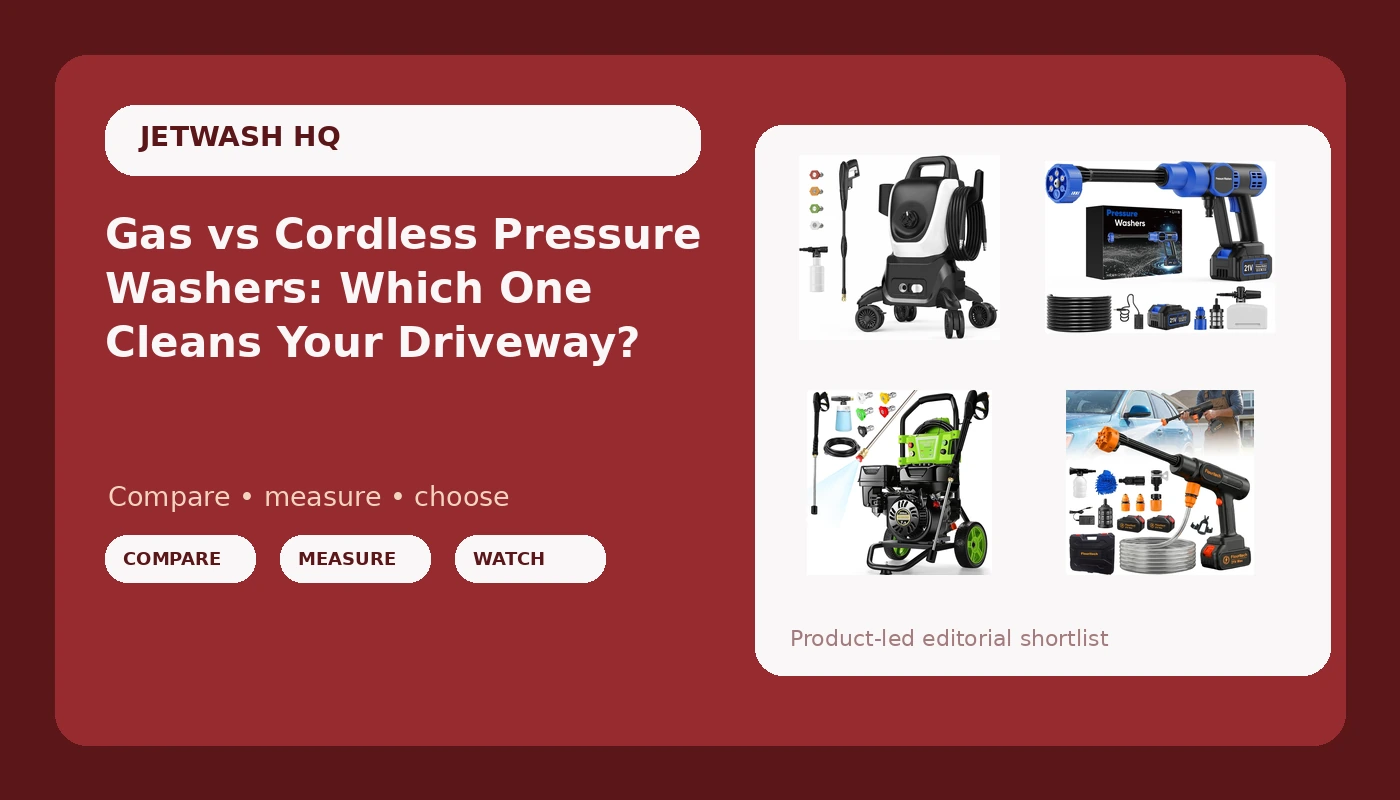
The four machines below are the ones I would put in front of a homeowner shopping in 2026. Two run on gasoline or a wall outlet and two run on batteries, and the gap between them is less about brand loyalty and more about what you are actually washing. A two-car driveway and a boat hull are different jobs. A patio and a muddy truck are different jobs. Match the machine to the job and you will be happy for years. Mismatch it and you will be shopping again by spring.
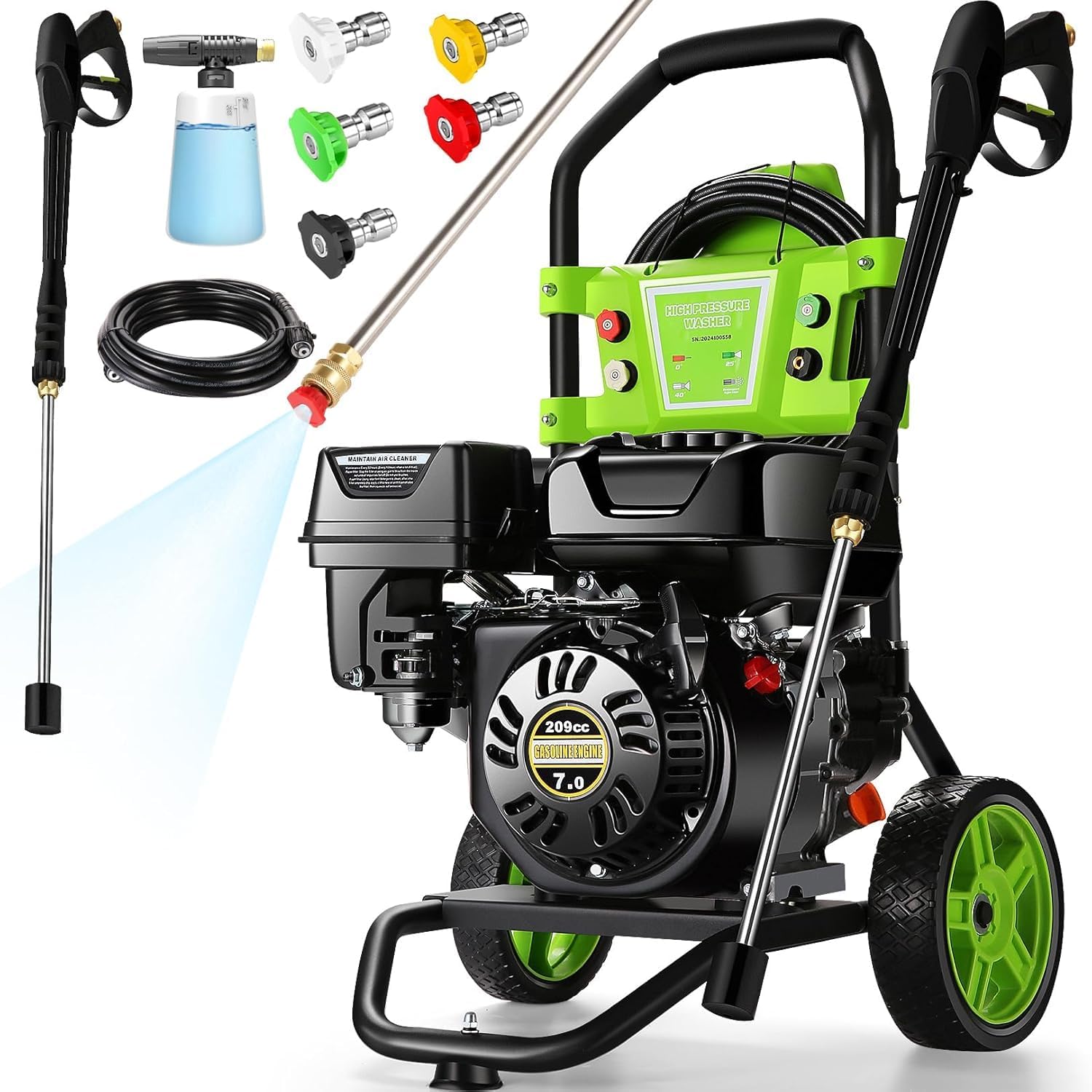
4200PSI Gas Pressure Washer, 7HP Engine Portable Power Washer with Wheels
The 7HP engine and 4200 PSI ceiling are built for the jobs that fight back: concrete, fences, boat bottoms, anything that needs run time measured in hours rather than minutes
Gas means fuel, oil, exhaust, noise, and winterizing. No published flow rate to check against the pressure claim
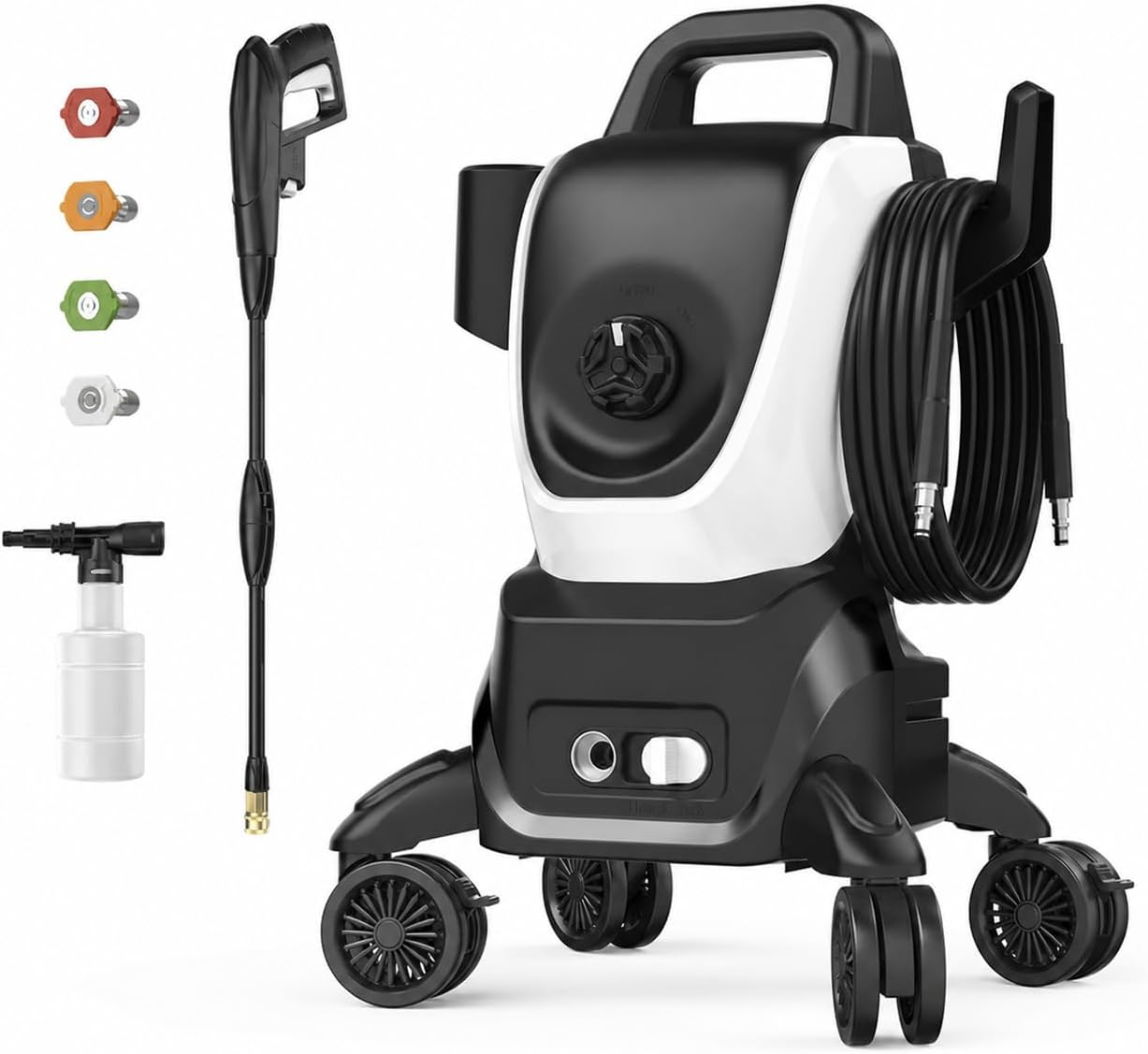
Pressure Washer, 3800 Max PSI, 2.4 GPM, 4-Wheel Mobility, Foam Cannon
The only machine here that publishes a real flow number, 2.4 GPM, and it ships with a foam cannon and four-wheel mobility
Still needs an outlet and a cord, and 3800 is a max rating, not a working number
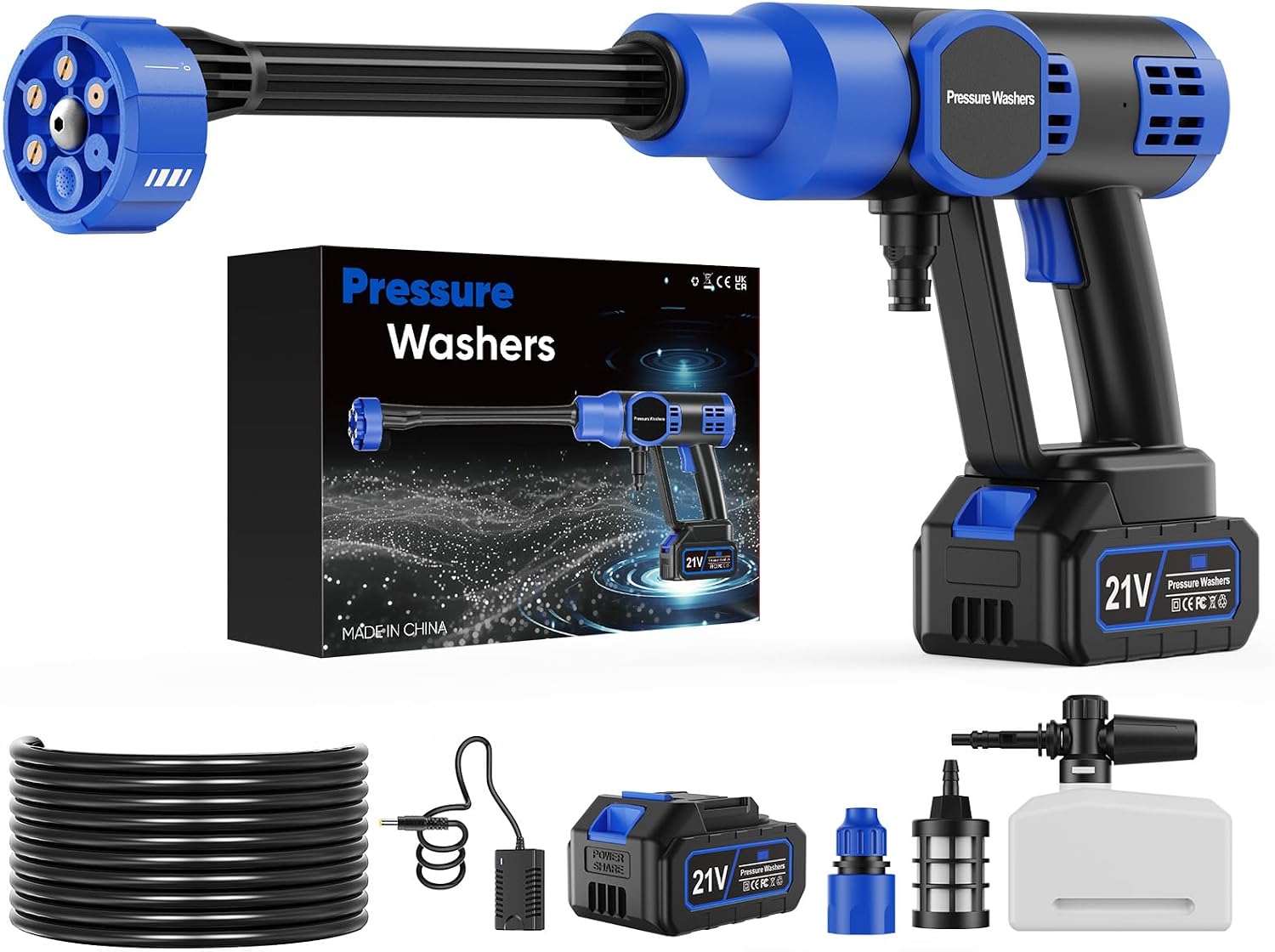
5000 PSI Cordless Pressure Washer with 4.0Ah Battery
No cord, no fuel, and a 4.0Ah battery that makes it genuinely usable away from an outlet
A 5000 PSI headline with no flow rate published is the exact marketing pattern I distrust. Battery runtime is the real limit
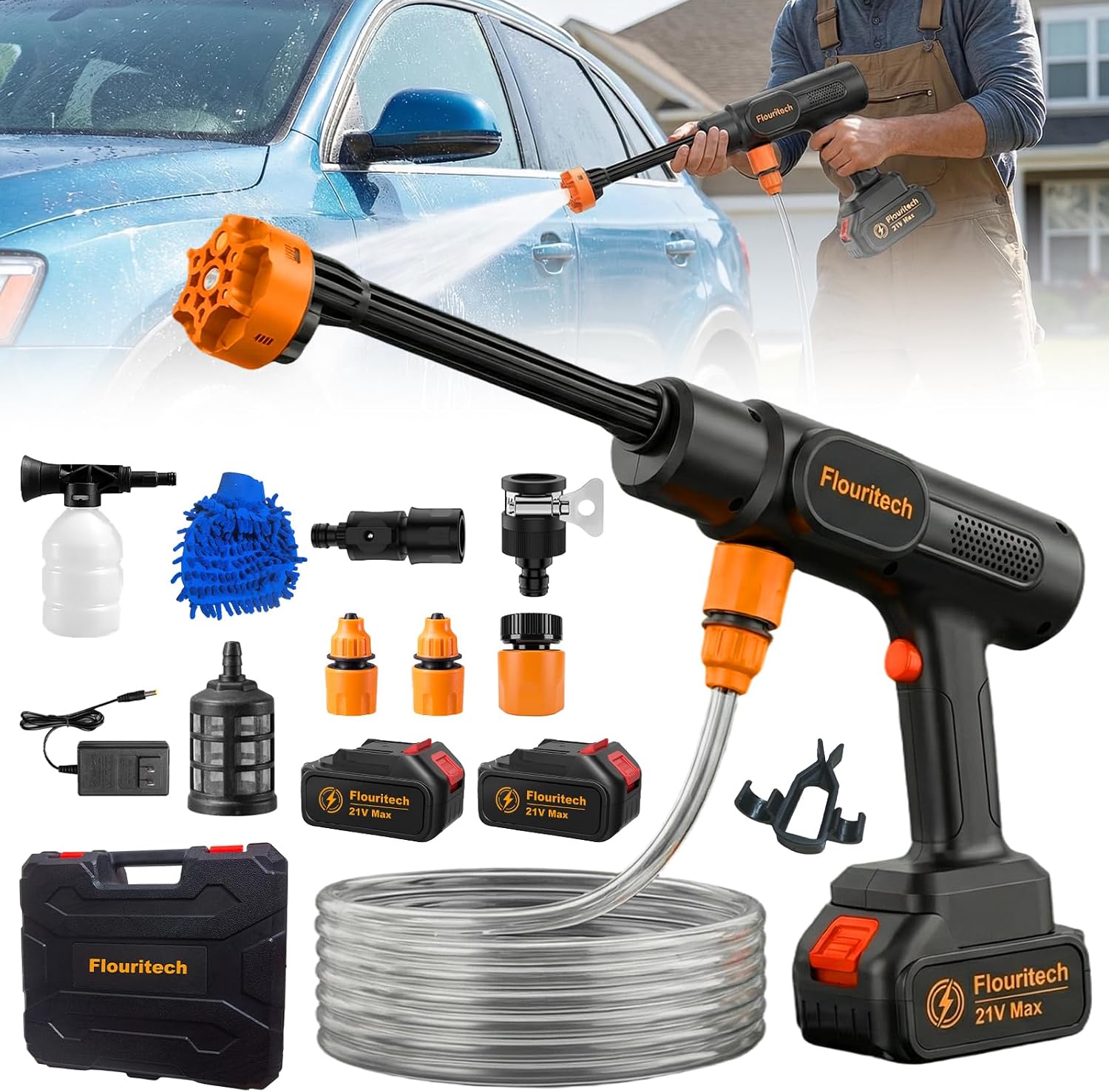
Cordless Pressure Washer, 1200 PSI Portable Power Washer with 6-in-1 Nozzle
The lightest, simplest option here, and the 6-in-1 nozzle covers car washing, patio furniture, and bikes without a toolbox
1200 PSI is light duty by design. It will not strip a driveway or touch a fence
Prices and availability were captured from Amazon Creators API and may change.
How I judge a pressure washer before I recommend it
My process is short and it has not changed in a decade. First, what is the real flow rate, not the peak pressure? Second, does it draw detergent properly, or is the soap function a plastic bottle bolted to the side as an afterthought? Third, are the hose and the wand worth keeping, or will I be ordering replacements in a month? Fourth, could I run this thing across a full driveway without cursing at it?
That last question is the one most buyers skip, and it is the one that decides whether a machine earns its space in your garage. A washer that cleans beautifully for eight minutes and then needs a two-hour charge is not a tool, it is a toy with good manners.
Why GPM beats PSI every time
Pressure, measured in PSI, is how hard the water hits the surface. Flow, measured in GPM, is how much water hits the surface. Cleaning happens when water carries dirt away, and a narrow, high-pressure stream that moves almost no volume mostly just polishes the dirt into place. This is why a 2.4 GPM machine at a moderate pressure will out-clean a 5000 PSI machine with a weak flow rate on a concrete driveway, every single time.
The practical problem is that PSI sells and GPM does not. It is a bigger number, it sounds more impressive, and it is the one on the front of the box in the largest font. Of the four machines here, only one, the 3800 Max PSI unit, publishes its flow rate at 2.4 GPM. That alone tells me the manufacturer is comfortable being measured.
Gas: the 7HP machine for the jobs that fight back
The 4200PSI Gas Pressure Washer with the 7HP engine is the machine for the work I get paid for. Seven horsepower and a 4200 PSI ceiling mean it can run a surface cleaner attachment across a two-car driveway without stalling out, and it can stay running for the length of a job instead of the length of a battery. The wheels matter more than they sound like they should, because a gas washer is heavy, and dragging one around a corner by the frame gets old fast.
What you give up is everything about convenience. Gas means fuel you have to buy, oil you have to check, an engine you have to winterize, exhaust you should not breathe in a closed garage, and a noise level your neighbors will hear through a closed window. If you wash a boat, a long driveway, or a rental property every couple of weeks, that trade is worth it. If you wash your car twice a month, it is not.
Corded electric: the 2.4 GPM workhorse with the foam cannon
The Pressure Washer with 3800 Max PSI and 2.4 GPM is the machine I would hand to most homeowners, and it is the only one in this group I can rank on flow with any confidence. A published 2.4 GPM puts it in the range where a surface cleaner actually works the way it is supposed to, and it ships with a foam cannon, which is a bigger deal than the spec sheet suggests.
Four-wheel mobility is the other quiet win. A corded electric washer does not have to be carried, and a machine that rolls on four wheels instead of two will get used more often because setting it up is not a chore. The catch is the cord and the outlet. You are tethered to a wall, and if your driveway is more than fifty feet from an exterior outlet, you are buying an extension cord rated for the load.
Cordless with a 4.0Ah battery: convenience with a clock on it
The 5000 PSI Cordless Pressure Washer with a 4.0Ah Battery is the most interesting and the most frustrating entry here. No cord means you can take it to the back fence, up a ladder, or out to a dock, and a 4.0Ah battery is a serious pack rather than the toy cell that comes with cheap cordless units. For spot work, tire cleaning, and quick rinse-downs, that freedom is real and it is worth paying for.
The frustration is the 5000 PSI headline with no published flow rate. I have watched this pattern for years: a big pressure number, no volume number, and a battery that determines how long the job actually lasts. A 4.0Ah pack will do a car and a set of wheels comfortably. It will not do a driveway, and it will not do it at 5000 PSI for more than a moment. Buy it for the portability, not the number.
The 1200 PSI cordless: the light-duty pick most people actually need
The Cordless Pressure Washer with 1200 PSI and a 6-in-1 nozzle is the smallest machine here, and for a lot of households it is the correct one. Twelve hundred PSI is gentle enough that you can wash a car, a set of patio cushions, a mountain bike, or a set of outdoor steps without worrying about stripping paint or etching a surface. The 6-in-1 nozzle means the pressure selection lives in one place instead of a bag of color-coded tips you will lose by August.
Where it loses is anything structural. Do not buy this to clean a concrete driveway or strip a fence. Twelve hundred PSI will wet those surfaces and move the loose dirt, and then you will spend the afternoon wondering why the job is not done. That is not a flaw in the machine, it is a flaw in the expectation. Match it to light work and it is the easiest machine on this list to live with.
Detergent draw, foam cannons, and the soap question
A pressure washer that cannot draw its own detergent is a hose with a trigger. Soap is what breaks the bond between dirt and surface so the water can carry it away, and if you are spraying plain water on a greasy engine bay or a moldy fence, you are doing the job twice.
This is why the foam cannon bundled with the 3800 Max PSI machine matters. A foam cannon lays down a thick, clinging layer of soap that sits on the surface and works, instead of a thin mist that runs off in three seconds. If you wash cars, that accessory alone changes the experience. On the gas machine, budget for a cannon separately, because soap injection on a gas unit is usually a small siphon tube that works fine but is not the same thing.
Hose, wand, and nozzle quality
This is the part nobody puts on the box and everybody regrets ignoring. A stiff hose that kinks every five feet will ruin an otherwise good machine, because you spend the whole job walking back to untwist it. A wand that feels like a toy flexes under pressure and makes precise work, like cleaning around a window seal, almost impossible. A nozzle that clogs or sprays a crooked pattern leaves streaks on concrete that you then have to chase.
When you unbox any of these, check three things before you judge the machine: does the hose kink when you loop it, does the wand flex when you squeeze the trigger, and does the nozzle spray a clean, even fan. If any of those fail, the fix is cheap and worth doing immediately. A fifteen dollar nozzle upgrade has rescued more mediocre washers than any other part I know.
Duty cycle: what each power source can sustain
Duty cycle is how long a machine can run before it needs a break, and it is the spec that separates the categories here more than pressure ever will. The gas unit will run until it is out of fuel. The corded electric will run as long as the outlet holds, though most consumer electrics want a breather after a long stretch. The cordless machines run until the battery says stop, and then you wait.
That means the honest ranking for a big job is gas, then corded electric, then cordless, and the honest ranking for a small job is exactly reversed. Nobody wants to haul a gas machine out of the shed to rinse a bicycle. Nobody wants to clean a two-car driveway with a battery that quits halfway.
The trade-offs, summarized
Buy the gas machine if the job is big, recurring, and far from an outlet. Buy the 2.4 GPM corded electric if you want the best all-around balance of real flow, mobility, and a foam cannon out of the box. Buy the 4.0Ah cordless if portability is the whole point and you understand the battery is the limit. Buy the 1200 PSI cordless if your list is cars, furniture, bikes, and small patios, and you would rather not deal with cords or fuel at all.
What I would avoid is buying on the PSI number alone. It is the easiest mistake to make and the most expensive one to correct, because the machine that disappoints you is the one you stop using.
Who should buy which
For a typical suburban house with a car, a patio, and a fence that needs attention once a year, the 2.4 GPM machine with the foam cannon is the pick, because published flow plus four-wheel mobility plus a bundled cannon is a combination the others cannot match on paper. For a detailer, a boat owner, or anyone with a long driveway, the 7HP gas unit is the one that will not quit on you mid-job. For apartment dwellers, renters, and anyone washing a car in a parking lot with no outlet in sight, the 4.0Ah cordless earns its place. And for the household that wants one small machine for light jobs and no fuss, the 1200 PSI cordless with the 6-in-1 nozzle is the easiest to justify.
If you are still torn between the two cordless options, ask yourself one question: how far is the nearest outlet? If the answer is "too far," pay for the battery. If the answer is "right there," buy the flow.
What I am watching next
I am keeping an eye on battery runtime claims across the cordless category, because that is where the honest numbers are thinnest. A 4.0Ah pack is a real pack, and I want to see more manufacturers publish minutes of run time at a given nozzle rather than a pressure figure with no volume behind it. Until that changes, I will keep ranking on flow, nozzle quality, and whether a machine draws its own soap. Those three things decide whether a pressure washer gets used or gets stored.
Bottom line: the 2.4 GPM corded machine is the best all-around buy for most homes, the 7HP gas unit is the one for heavy recurring work, and the two cordless models are convenience purchases that make sense the moment you stop pretending a battery will replace an engine.
Visit on Amazon → for the gas machine, Visit on Amazon → for the 2.4 GPM corded unit, Visit on Amazon → for the 4.0Ah cordless model, and Visit on Amazon → for the 1200 PSI cordless pick.