Most people buy a gas pressure washer by reading a single number on the box. That number is PSI, and on its own it tells you almost nothing about how the machine will actually clean a driveway, a fence, or a truck. A gas pressure washer setup is a system: an engine turning a pump, a pump moving a volume of water, a nozzle deciding how that water leaves the wand, and a detergent system deciding whether you are cleaning with chemistry or just with water. Get the whole system right and a mid-priced machine outworks an expensive one. Get it wrong and you will spend a Saturday making a very loud wet mess.
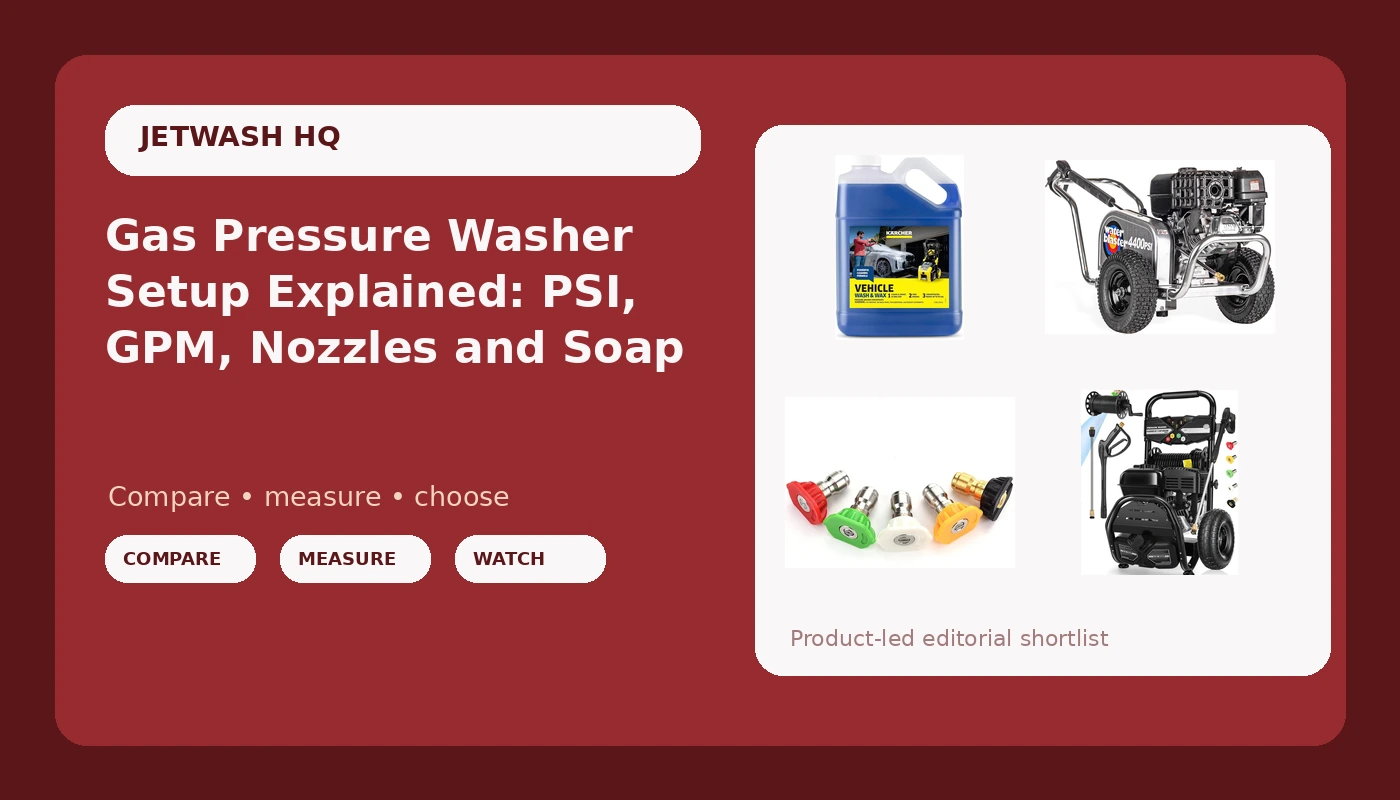
This is an explainer, not a spec sheet recital. It walks through flow ratings, nozzle math, and the soap side of the job, using four products that cover the machine, the tip set, and the detergent.
Related: Pressure Washer Nozzle Guide: Matching Tips to Surfaces →
Quick answer
Start with flow, not pressure. A gas washer rated at 4.0 GPM moves several times the water of a typical electric unit, and moving water is what carries dirt off a surface. Next, match the nozzle to the job, because the tip orifice controls both the impact and how much of that flow the pump can actually deliver. Then decide how soap gets onto the surface, either through the machine's own detergent draw or by pre-treating and rinsing. The four options below cover the machine itself, a nozzle set, and a detergent made for pressure washer use.
Four useful options
| Model | Best fit | What stands out |
|---|---|---|
| 4200PSI Gas Pressure Washer 4.0GPM Gas Power Washer 212CC Powered Washing Machine Commercial High Pressure Washer with 32ft Hose&5 Nozzles for Patio Garden Yard Vehicle,EPA/CARB/ETL (Dark Black) | First gas washer for driveways, patios, and vehicles | 4.0 GPM flow rating, 32 ft hose, five nozzles included, EPA/CARB/ETL listed |
| Simpson Water Blaster 4400 PSI Gas Pressure Washer, 4.0 GPM, CRX 420 Engine | Frequent, heavy jobs where engine quality matters | 4,400 PSI rating with 4.0 GPM and the CRX 420 engine |
| Tool Daily Pressure Washer Nozzle Tips Multiple Degrees, 1/4 Inch, 2.5 GPM | Anyone who wants the correct spray for each surface | Multiple degree tips on a 1/4 inch quick connect, rated 2.5 GPM |
| KÄRCHER Vehicle Wash and Wax, Pressure Washer Detergent | Vehicle washing and light surface cleaning | Detergent concentrate formulated for pressure washer use |
The machine: 4200PSI Gas Pressure Washer 4.0GPM Gas Power Washer 212CC Powered Washing Machine Commercial High Pressure Washer with 32ft Hose&5 Nozzles for Patio Garden Yard Vehicle,EPA/CARB/ETL (Dark Black)
The trade-off with any gas unit is the overhead. You are buying fuel, oil, spark plugs, and noise, plus a machine heavy enough that you will not casually carry it up a flight of stairs. What you get back is flow and duty cycle: a gas pump can run for hours where a cheap electric unit has to cool down. The 4,200 PSI figure is more pressure than paint, wood, or clear coat wants, so in practice the five included nozzles matter more than the peak number. Wide-angle tips for paint and siding, a narrower tip for concrete, and the machine behaves like two different tools.
The step-up: Simpson Water Blaster 4400 PSI Gas Pressure Washer, 4.0 GPM, CRX 420 Engine
Here is the honest math. This unit and the previous one list the same 4.0 GPM, which means the water volume doing the cleaning is comparable. The difference is the pressure ceiling and the engine, and the price gap between them is steep. That gap buys you a machine intended to survive constant work: a fleet truck, a weekend rental, a contractor who runs it five days a week. If you wash your own driveway and your own car, you are paying for durability you will not stress. If you wash for money, the durability is the point.
The nozzle set: Tool Daily Pressure Washer Nozzle Tips Multiple Degrees, 1/4 Inch, 2.5 GPM
One detail deserves a straight explanation. This set is rated at 2.5 GPM, while both gas machines above list 4.0 GPM. Nozzle ratings describe the flow the tip is sized for. Run a tip sized for lower flow on a higher-flow pump and you restrict the water, which raises pressure at the tip and can make the machine surge. That is not a reason to avoid a spare set, it is a reason to check tip sizing against your pump before you assume any 1/4 inch tip is interchangeable. Keep the tips you actually use, replace the ones you lose, and never run a zero-degree tip on anything you care about.
The soap: KÄRCHER Vehicle Wash and Wax, Pressure Washer Detergent
Detergent only helps if the machine can draw it. Many gas washers inject soap downstream of the pump through a siphon tube and a metering valve, which means the soap never passes through the pump and the wand pressure drops when you switch to the soap setting. That is normal. What is not normal is a siphon tube that clogs with dried concentrate, which is why you flush the system with clean water after every soap job. This concentrate is built for car paint and light surfaces, not for stripping a concrete slab, so pair it with the right job.
Prices and availability may change. Product images, names, and retailer links are matched to verified listings. No current price, rating, stock status, or measured result is stated here without current evidence.
Why flow rate does the cleaning
Pressure is force concentrated into a small area. Flow is volume delivered over time. Cleaning a surface is mostly a volume job: water gets under the dirt, lifts it, and carries it away. That is why a 4.0 GPM machine and a 1.5 GPM machine can share a PSI rating and behave nothing alike. The high-flow unit rinses a driveway in a fraction of the passes, and passes are where your Saturday goes.
Flow also explains why surface cleaners work so well. A rotating bar spreads the same water across a wider path, so the impact per square inch drops while the total work per minute goes up. On flat concrete, that trade is almost always worth it. On a fence or a car, it is not, because the surface cannot take the volume or the angle.
There is a supply-side catch. A pump rated at 4.0 GPM needs a water source that can feed it. A weak spigot, a long skinny garden hose, or a shared outdoor line will starve the pump, and a starved pump cavitates. That sounds like a rough, pulsing idle and it shortens pump life. Check your tap's flow before you blame the machine.
Nozzle degree, orifice, and detergent draw
Two numbers describe a nozzle: the spray angle in degrees and the orifice size. The angle decides the footprint. The orifice decides how much water gets through and how hard it hits. Change the orifice and you change the load on the pump, which is why a mismatched tip can make a good machine feel broken.
Angle choices are straightforward. Zero degrees is a pencil jet for a stubborn stain on concrete and nothing else. Fifteen degrees strips heavy growth off hard surfaces. Twenty-five degrees is the general-purpose workhorse. Forty degrees is for rinsing, siding, and anything soft. A soap tip produces a low-pressure fan so detergent can be applied without blasting it off the wall.
Detergent draw comes in two flavors. Upstream injection pushes soap through the pump, which cleans well but puts chemistry through the seals. Downstream injection siphons soap after the pump, which is gentler on the machine and drops pressure at the wand. Either way, soap needs dwell time. Spray it on, let it sit, then rinse. Soap applied and immediately rinsed is money down the drain.
- Measure the job first: how many square feet, and what material. Concrete, wood, and paint all want different treatment.
- Read the GPM before the PSI. Flow decides speed, pressure decides risk.
- Match tips to surfaces, and keep a forty-degree tip and a soap tip within reach at all times.
- Confirm the machine draws detergent, then test the siphon with plain water before you load it with concentrate.
- Check the hose and wand quality. A hose that kinks every few feet will cost you more patience than a weak pump ever will.
Practical guidance before you buy
- Never use a zero-degree tip on vehicle paint, wood, or composite decking, no matter how tempting the stain looks.
- Pre-soak, dwell, then rinse. Detergent that sits for a few minutes does more than detergent sprayed and chased immediately.
- Flush the detergent system with clean water after every soap job so the siphon tube does not clog with dried concentrate.
- Verify your outdoor tap can feed the pump. A 4.0 GPM machine on a starved line is a machine that will not last.
- Store gas units with stabilized fuel and drain the pump if a freeze is coming, because cracked pump housings are not a warranty conversation you win.
Which option should you choose?
Choose the 4200PSI Gas Pressure Washer 4.0GPM Gas Power Washer 212CC Powered Washing Machine Commercial High Pressure Washer with 32ft Hose&5 Nozzles for Patio Garden Yard Vehicle,EPA/CARB/ETL (Dark Black) when you want gas flow and duty cycle without paying for commercial-grade engine durability, and you are fine with a heavy machine that needs fuel and maintenance. Choose the Simpson Water Blaster 4400 PSI Gas Pressure Washer, 4.0 GPM, CRX 420 Engine when the machine will run constantly on paying jobs and the higher pressure ceiling and engine quality justify the price gap. Choose the Tool Daily Pressure Washer Nozzle Tips Multiple Degrees, 1/4 Inch, 2.5 GPM when you want a spare tip assortment so the wrong angle is never the reason a surface gets damaged, and you are willing to check sizing against your pump. Choose the KÄRCHER Vehicle Wash and Wax, Pressure Washer Detergent when your main job is vehicles and light surfaces and you want a concentrate made for a pressure washer's soap system.
A caveat worth stating plainly: none of this replaces your machine's manual. Detergent compatibility, maximum inlet pressure, and approved nozzle sizes vary by pump, and the ratings listed here come from the product listings rather than from a test bench. Confirm what your specific unit supports before you run it hard.
The bottom line
Flow rate, nozzle match, and detergent draw decide how a gas pressure washer performs, and the PSI number on the box decides almost nothing on its own. The 4.0 GPM machines here move real water; the tip set is how you aim it; the detergent is how you let chemistry do part of the work. Buy the machine that matches how often you actually clean, then spend the small money on tips and soap. That combination beats a bigger washer with the wrong nozzle every single time.