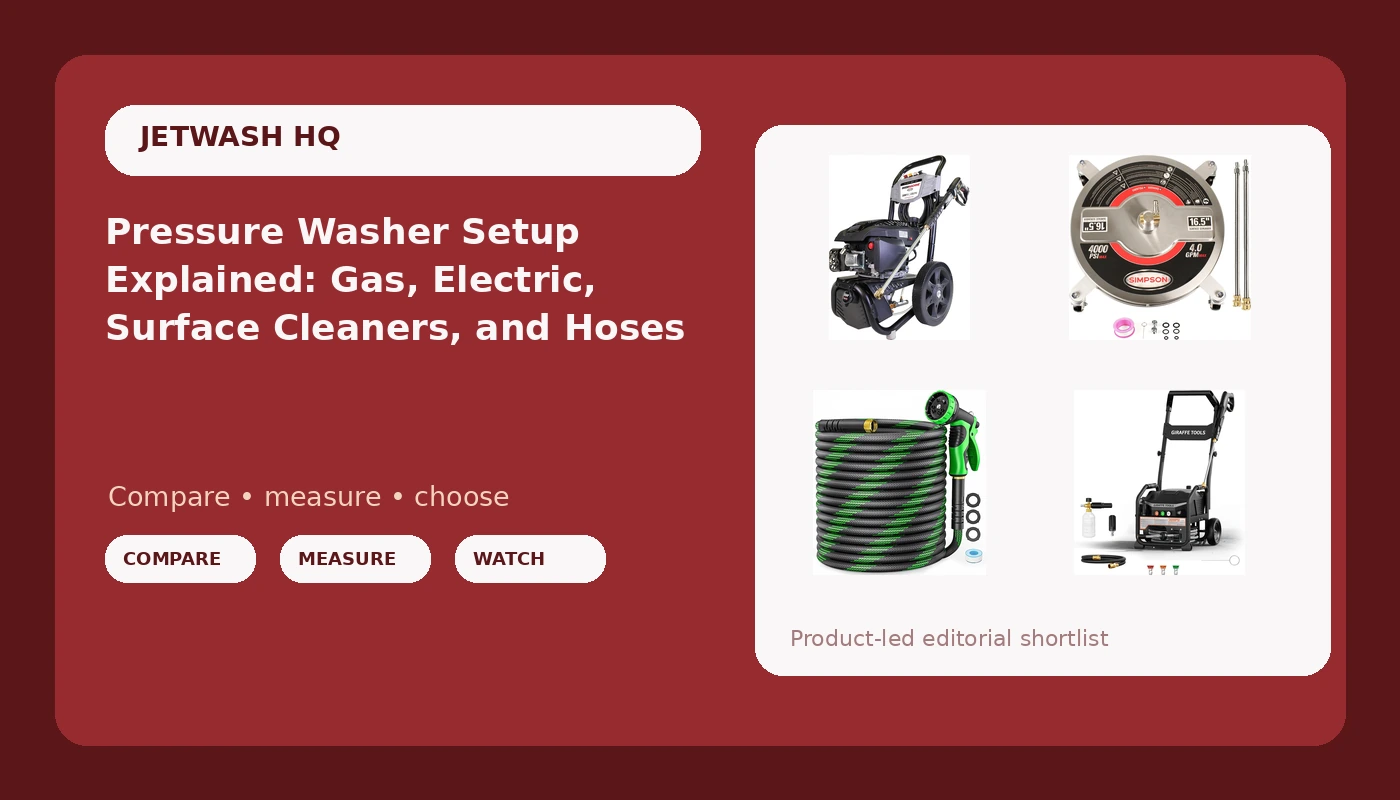
A pressure washer setup is never one purchase. It is four parts working together: the machine that makes the flow, the nozzle that shapes it, the surface cleaner that spreads it across flat ground, and the hose that feeds or finishes the job. The weakest part sets the ceiling for everything else, and that is the piece the shelf at the hardware store never explains. People walk in, see a big PSI number on the box, buy it, and then spend a Saturday finding out that the wand feels like a toy, the hose folds over every few feet, and the concrete still wears that gray film when they are done.
I clean driveways, decks, boats, and cars for a living around Tampa, and I have watched plenty of people buy the wrong part first. So here is the whole setup explained in plain terms, plus four current options that cover the four different jobs a rig actually does: a wheeled all-in-one unit, a gas machine with real flow, a surface cleaner attachment, and the hose that handles everything downstream.
Related: Electric vs Gas Pressure Washers: Which One Actually Cleans Better →
Quick answer
Match the machine to the job, then match the flow rate to the machine. A gas unit with a stated 2.5 GPM has the volume for repeated heavy work like a full driveway or a boat hull. A wheeled all-in-one with an onboard 50-foot hose is the easier tool for cars, siding, and patios, because there is no separate hose to buy, drag, or store. A 16.5-inch surface cleaner turns either machine into a proper flat-work tool that cleans in even passes instead of wand stripes. And a non-expandable hose with a multi-function nozzle covers rinsing, soap, and every garden job the pressure washer never touches.
Four useful options
| Model | Best fit | What stands out |
|---|---|---|
| Giraffe Tools Crossfalls Pressure Washer Max with Wheels, 50FT Hose | All-in-one cleaning at home | Wheels and an onboard 50-foot hose in one unit |
| Simpson Clean Machine 3200 PSI Gas Pressure Washer, 2.5 GPM, Turbo Nozzle | Repeated heavy jobs | Gas power with a stated 2.5 GPM and a turbo nozzle included |
| Simpson 16.5" Stainless Steel Pressure Washer Surface Cleaner, 80625 | Driveways, patios, and other flat surfaces | 16.5-inch stainless steel housing built for flat work |
| Non-Expandable Garden Hose 50 FT | Rinsing, soap, and garden duty | Non-expandable 50-foot hose with a 10-function nozzle |
The all-in-one wheeled unit: Giraffe Tools Crossfalls Pressure Washer Max with Wheels, 50FT Hose
The case for an all-in-one is simple: fewer parts to match and fewer parts to lose. Most people buying a pressure washer are not cleaning for a living. They are washing two cars, a patio, some siding, and the grill a few times a year. For that pattern, a wheeled unit with its own hose removes friction at every step. There is no adapter to hunt down, no hose that turns out to be too short, and no separate storage problem in the garage. The trade-off is that an integrated unit is what it is. You cannot swap in a longer or softer hose without giving up the tidy storage, and the machine's flow rate is the flow rate. If your jobs are heavy and repeated, read the next section before you decide.
The gas workhorse: Simpson Clean Machine 3200 PSI Gas Pressure Washer, 2.5 GPM, Turbo Nozzle
Gas buys you two things: flow and endurance. Flow is the one that matters. A stated 2.5 GPM moves a real volume of water, which is what rinses loosened dirt off concrete instead of just pushing it around. Endurance matters on the days when the driveway, the walkway, and the fence all need doing in one session, because a gas engine runs continuously while small electric units have to cool down between long passes. The cost is noise, fuel, exhaust, and maintenance. You are not running a gas machine inside a garage, and you are not sneaking it out at seven in the morning without the neighbors noticing. That is the honest trade, and it is why the choice between this and an all-in-one comes down to how often you clean and how big the surfaces are.
The flat-surface upgrade: Simpson 16.5" Stainless Steel Pressure Washer Surface Cleaner, 80625
If you own a pressure washer and you are still cleaning concrete with a wand, this is the single best upgrade you can make. A surface cleaner rides on a skirt, traps the spray under the housing, and spins it in a circle, so the water does the work evenly instead of in one hot line. The result is faster passes and no zebra stripes. Two caveats worth knowing before you buy one. First, surface cleaners want flow. A low-GPM machine will spin a large cleaner weakly, and the cleaning will feel slow and uneven. Second, they are for flat, hard surfaces. You do not use one on a wood deck where the grain can lift, and you do not use one on gravel or loose material. For concrete, pavers, and stone, though, it changes the job from a chore into a process.
The hose that does everything else: Non-Expandable Garden Hose 50 FT
Every setup has a second hose, and most people figure that out the hard way. You need a garden hose to rinse soap off a car after the pressure washer has done its pass, to fill a bucket or a foam cannon, to water the plants, and to wash the dog. A non-expandable hose is the right choice for anything feeding a pressure washer or a sprayer, because expanding hoses are designed around household water pressure and behave unpredictably when they are part of a pressurized system. The 10-function nozzle is the other half of the value here. One nozzle replaces the pile of mismatched spray heads rattling around the garage, and you get a gentle setting for plants and a sharper one for blasting mud off a wheel well.
Prices and availability may change. Product images, names, and retailer links are matched to verified listings. No current price, rating, stock status, or measured result is stated here without current evidence.
PSI is how it feels, GPM is what cleans
PSI is pressure at the nozzle exit. It is how hard the water hits the surface. GPM is volume, the gallons delivered per minute, and it is how much water is available to carry the dirt away once the pressure has loosened it. Cleaning is water in motion plus chemistry plus time, and the motion part is mostly volume. Two machines can carry the same PSI rating and finish a driveway at completely different speeds because one moves twice the water.
That is why the PSI number on the box is the least useful thing on the label. It is a bigger, flashier number, and it sells. Read the GPM first. A machine that cannot deliver around 1.5 GPM or more will leave you standing there waiting for the water to do a job it cannot do, no matter what the pressure gauge says.
Three other specs decide whether a setup feels professional or frustrating. Duty cycle is how long the unit can run before it needs to cool, and it is the reason a cheap electric washer quits halfway through a driveway. Detergent draw is the soap injection system, and a washer that cannot pull soap out of a tank is a rinse tool with a trigger. Nozzle quality is the last one. The right 25-degree nozzle on an average machine beats the wrong 0-degree nozzle on an expensive one every single time.
How the four pieces of a setup fit together
Think of the machine as the flow source. Everything else either shapes that flow or handles what the flow cannot do.
The surface cleaner is the flat-work tool. It takes the same flow your machine makes and distributes it across a spinning bar under a shroud, which is why it cleans so evenly.
The pressure hose and wand are the reach and control layer. A stiff hose that kinks every few feet is a daily annoyance, and a wand that feels like a toy will make you avoid using a machine you paid good money for.
The garden hose is the support layer. It rinses, it fills, it feeds, and it handles the jobs where pressure would be the wrong answer entirely. Buy these four parts as a system and the whole thing works. Buy them one at a time without thinking about the others and you end up with a garage full of mismatched fittings.
Five decisions that set up the whole rig
- Measure the job before you measure the machine. Count the square feet of concrete, the number of vehicles, and how often you actually clean.
- Read the flow rate first. GPM tells you how fast the work goes. PSI tells you how it feels.
- Confirm the machine can draw detergent. Soap injection is what separates a washer from a wet hose.
- Decide whether flat work matters. If you have a driveway or a patio, budget for a surface cleaner from the start.
- Budget for the hose and the wand, not just the box. The parts you touch every time you clean are the parts that decide whether you enjoy it.
What to check before you buy
- Look at the nozzle set and confirm replacement nozzles are easy to find in the sizes you use most.
- Check hose material and length. A short, stiff hose will annoy you more than a small gap in pressure ever will.
- Confirm the unit has somewhere to store its own hose and wand, because storage is what keeps a setup usable.
- Make sure the detergent tank or siphon tube can be removed and rinsed, or it will clog and stay clogged.
- Think about weight and storage before you buy. A machine that is hard to move is a machine that stays in the corner.
Which option should you choose?
Choose the Giraffe Tools Crossfalls Pressure Washer Max with Wheels, 50FT Hose when you want one wheeled unit that arrives with its hose and covers cars, siding, and patios without a shopping list of extras. Choose the Simpson Clean Machine 3200 PSI Gas Pressure Washer, 2.5 GPM, Turbo Nozzle when the work is heavy and repeated, with a stated 2.5 GPM and a turbo nozzle for set-in grime. Choose the Simpson 16.5" Stainless Steel Pressure Washer Surface Cleaner, 80625 when you already own a washer and the flat surfaces are the part of the job you dread. Choose the Non-Expandable Garden Hose 50 FT when you need the rinse, soap, and garden duties covered by one hose and one multi-function nozzle.
One caveat worth stating plainly: this guidance is based on the listed specifications and on how these categories of equipment behave on real jobs, not on timed tests of these specific units. Flow rate, nozzle choice, and surface type will change your results more than any single spec sheet line.
The bottom line
A pressure washer setup works as a system, and the system fails at its weakest part. Get the flow rate right, make sure the machine can draw soap, put a surface cleaner on the flat work, and keep a decent non-expandable hose for everything else. Do that and a mid-range machine will out-clean an expensive one that was bought by the PSI number alone. Start with the job you actually have, then buy the four pieces that fit it.