Related: Pressure Washer GPM vs PSI: Why the Number on the Box Lies
I run a mobile detailing business out of Tampa. Twelve years of that means my pressure washer setup gets pointed at everything from a daily driver with tar on the rockers to a center console hull that has been sitting in the Florida sun since last season. Somewhere in there you learn that the spec sheet on the box is written for people who do not clean for a living.
Here is the short version of everything I know. PSI is how the machine feels. GPM is the work. A 1500 PSI unit with a real nozzle and honest flow will out-clean a 3000 PSI unit that trickles. The nozzle is the machine. And the hose and the wand decide whether you enjoy the job or resent it every time you drag the thing out of the garage.
This guide covers the setup I would actually put together for a homeowner: two electric units at very different price points, the hose upgrade that fixes the most common daily complaint, and the small engine part that saves a job day when you are running a generator on a site with no outlet.
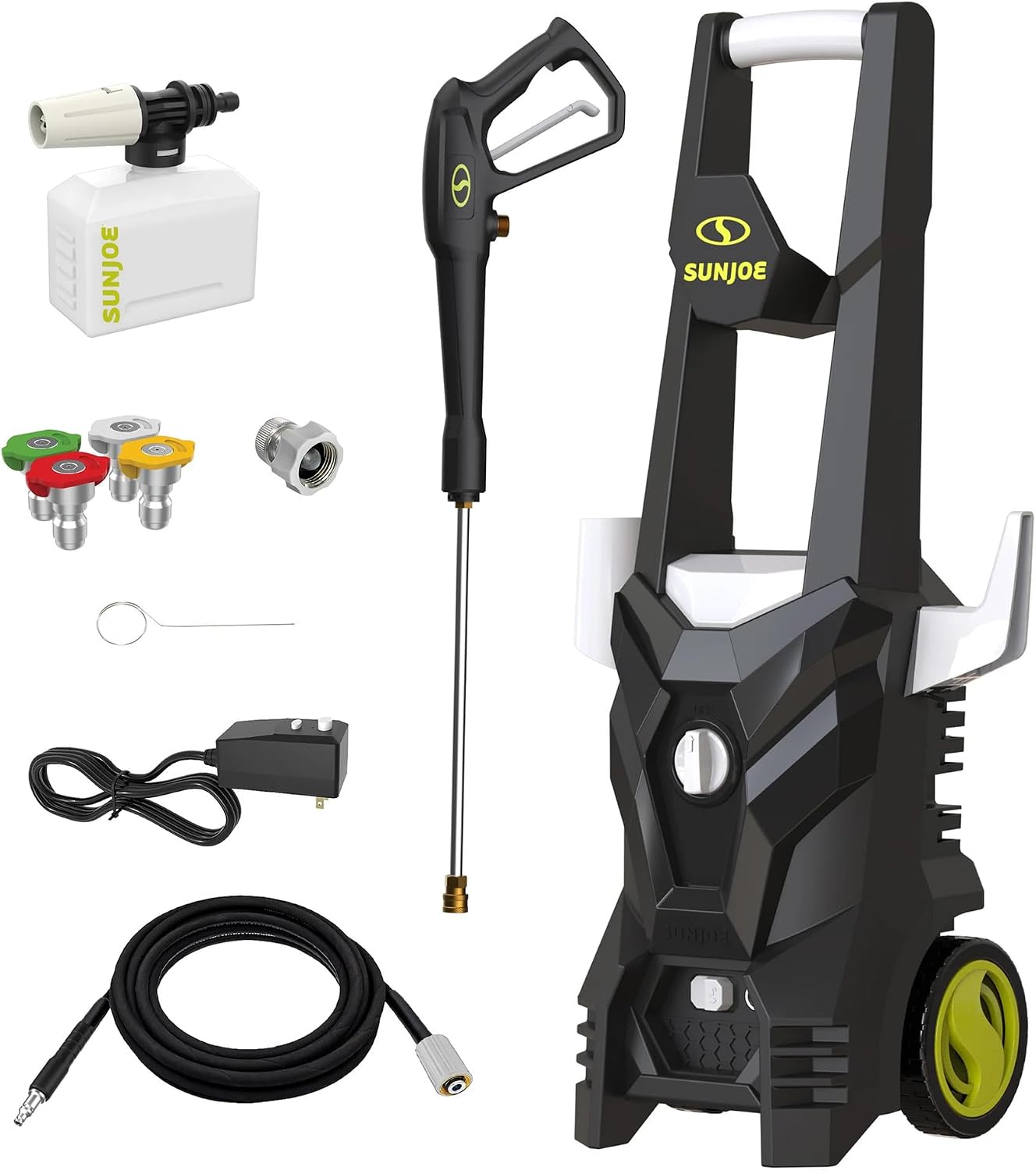
Best for Most Driveways: Sun Joe SPX100-GO
The SPX100-GO is a 13-amp electric with four nozzles and a foam cannon, and the foam cannon is the part I care about. Soap is what lifts road film, bug guts, and patio grime. Water alone just pushes it around the concrete. A machine that gives you a way to lay foam down lets you work in the right order, pre-soak, dwell, rinse, instead of blasting dry dirt into your paint.
Four nozzles cover the spread you need: a wide fan for rinsing, a narrower fan for concrete and siding, and something tighter for the stubborn spots. You will use the wide one 80 percent of the time. That is normal and it is fine.
Where this machine belongs: cars, patios, fences, deck furniture, gutters, the grill. Where it does not: a two-car driveway with a decade of black organic staining. That is a flow problem, not a pressure problem, and no electric at this size solves it. I would rather tell you that now than have you find out on a Saturday morning.
One general rule about budget electrics: the money goes into the motor, and the wand is where corners get cut. If yours feels like a toy, a stiffer replacement wand is a cheap fix, and it changes the whole experience of the machine.
Best Budget Pick: Greenworks GPW1501
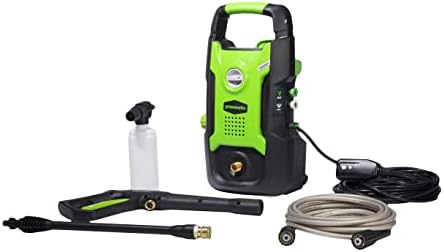
The GPW1501 is rated 1500 PSI at 1.2 GPM, it is an upright hand-carry design, and it ships with a turbo nozzle.
The upright hand-carry shape is underrated. It stores on a shelf, you grab it with one hand, and you do not have to bend over and drag it out of a corner. For a homeowner who washes a car twice a month and a patio twice a year, that shape is the difference between using the machine and leaving it in the garage.
The turbo nozzle is the real feature. It spins a pencil jet in a tight circle, so you get the bite of a narrow stream with the coverage of a fan. On a budget machine, that is the single attachment that makes the unit punch above its class.
Now the honest part. At 1.2 GPM this is a modest machine, and my rule of thumb is that below 1.5 GPM you are waiting on the water rather than cleaning with it. That is the tradeoff for the size and the price. It washes a car and a patio well. It will not strip a driveway, and you should treat that as a feature, because a machine with this flow is nearly impossible to damage paint with by accident.
Best Hose Upgrade: Simpson 50 ft, 3/8", 4500 PSI Monster Cold Water Hose
If there is one upgrade that changes how a pressure washer setup feels, it is the hose. Not the pump, not the motor. The hose.
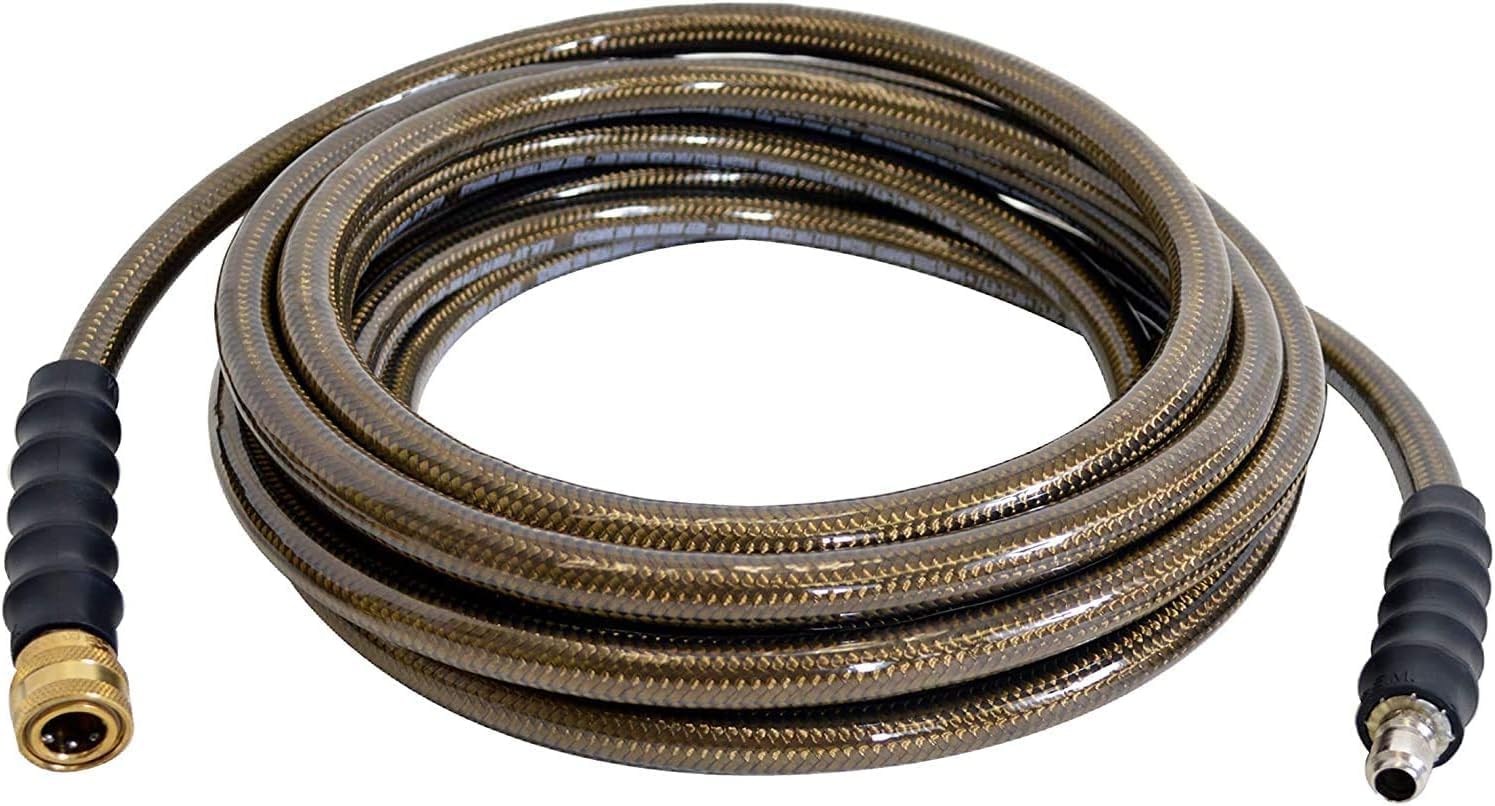
The Simpson Monster is 50 feet of 3/8 inch hose rated to 4500 PSI, cold water only. Two things matter there. First, 50 feet means you park the machine once and walk the hose, instead of dragging a running unit around the driveway and hunting for a spot near an outlet every 20 feet. Second, 3/8 inch is the diameter that keeps flow up over distance. A long, thin hose chokes your GPM, and your GPM is the whole point.
The 4500 PSI rating sits far above anything a residential electric will ever produce, which is exactly what you want. A hose rated well above your machine's ceiling is a hose that is never the weak link, and it will outlast the washers you connect it to.
Cold water only. That is not a suggestion. Hot water will ruin it, so if you run a hot water machine, this is not your hose.
Best Generator Fix: fullas 308054123 Carburetor for Ryobi 2300
This one is not glamorous, and it is the reason a lot of job days end early. If you run a gas pressure washer or a hot water skid on a site with no outlet, you are running a generator, and the generator is the weakest link in the chain.
The fullas 308054123 is a replacement carburetor for the Ryobi 2300 generator models, including the RYi2300, RYi2300BT, and RYCi2200BTA, and it fits the Ryobi 1800 and 2300 watt inverter generators. If a generator has been sitting with ethanol fuel in it, the carb is usually the first thing to go. It hunts, it surges, and it dies the moment you put a load on it.
Keeping a replacement on the shelf is cheaper than losing a Saturday. Swapping a carburetor on an inverter generator is a bench job with basic hand tools, and it is the difference between a two-hour delay and a canceled appointment.
How to read a pressure washer spec sheet
Three things decide everything, and only one of them is printed on the front of the box in giant letters.
Cleaning units. Multiply PSI by GPM and you get a rough measure of actual cleaning work. This is why a 1500 PSI, 2.0 GPM machine can beat a 3000 PSI, 1.0 GPM machine on a concrete slab. The high pressure number sells the box. The product of the two cleans the driveway.
Nozzle orifice. Nozzles are sized in degrees and orifice numbers. Going too small on the orifice can push pressure past what the pump wants to deliver and shorten its life. Use the nozzle chart that comes with the machine, and if a nozzle seems to be doing nothing, the orifice is probably too large for your flow.
Detergent draw. A washer that cannot pull soap is a hose with a trigger. Some machines do it with an onboard tank, some with a downstream injector, some with a foam cannon on the end of the wand. All three work. None of them work if the pickup tube is clogged, so flush it.
Then there is duty cycle. Electric machines need to cool. If you are planning to run a unit for two hours straight, that is a gas machine's job, and a cheap electric will let you know it.
The pressure washer setup reference table
This is the setup I would build, piece by piece. Match the hose and nozzle to the machine, and match the machine to the job.
| Piece | Role in the setup | What to check | Verdict |
|---|---|---|---|
 Visit on Amazon → Visit on Amazon →Sun Joe SPX100-GO |
Main electric unit for cars, patios, siding, and furniture | Foam cannon, four nozzles, standard outlet, 13-amp draw | The one I would buy first |
 Visit on Amazon → Visit on Amazon →Greenworks GPW1501 |
Budget unit for cars and small patios that stores on a shelf | 1500 PSI, 1.2 GPM, turbo nozzle, upright hand-carry | Best starter or second machine |
 Visit on Amazon → Visit on Amazon →Simpson 50 ft Monster hose |
Replaces the short stiff hose that ships in the box | 50 ft length, 3/8 inch diameter, 4500 PSI rating, cold water only | The upgrade most people feel first |
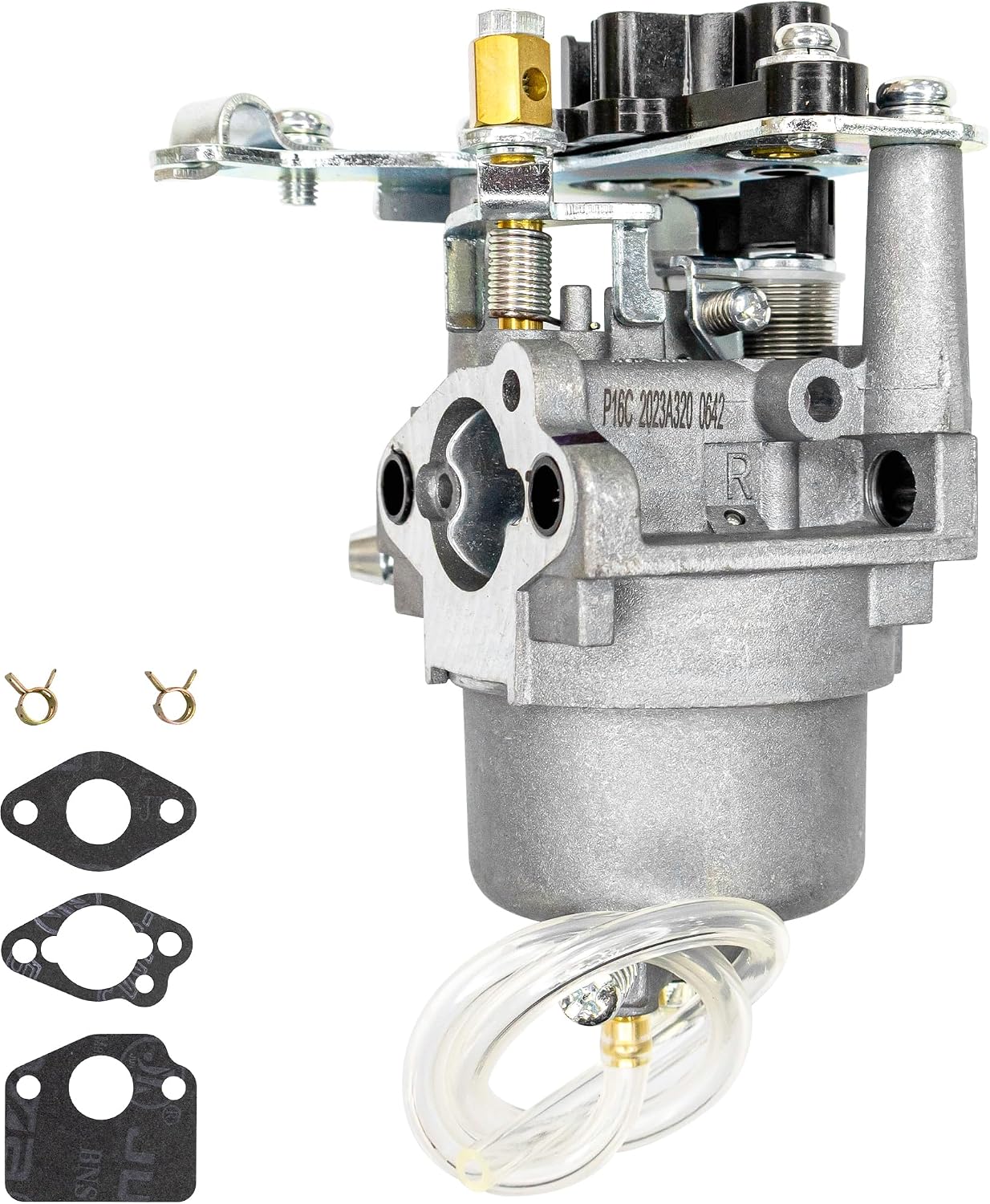 Visit on Amazon → Visit on Amazon →fullas 308054123 carburetor |
Keeps a Ryobi 2300 generator running on a site with no power | Model fit: RYi2300, RYi2300BT, RYCi2200BTA, 1800 and 2300 watt inverters | Cheap insurance for a job day |
The pattern in that table is the pattern of every good setup. Flow first, nozzle second, hose third, and keep the power source alive.
Should you buy the Sun Joe SPX100-GO?
Yes, if your list is cars, patios, siding, and outdoor furniture. Four nozzles and a foam cannon cover the jobs most people actually have, and it runs on a normal outlet, which means no fuel, no fumes, and no pull cord. It is not the machine for a driveway full of black organic staining. Nothing at this size is. Buy it for everything else and rent or borrow for the once-a-decade slab job.
Should you buy the Greenworks GPW1501?
Yes, if storage and simplicity matter more than speed. The upright hand-carry shape goes on a shelf, the turbo nozzle gives it real bite for its size, and 1.2 GPM keeps it firmly in the car-and-patio lane. If you have a long driveway and a fence to do every spring, step up to something with more flow. If you have a car, a porch, and a garage wall, this is plenty.
Should you add the Simpson 50 ft Monster hose?
If your current hose kinks every five feet, yes, and you will notice it on the first job. Fifty feet of 3/8 inch hose rated to 4500 PSI means fewer moves of the machine and more flow at the nozzle. Cold water only, so keep it away from a hot water machine.
Should you buy the fullas carburetor?
Only if you own one of the Ryobi 2300 generator models it fits, or you run equipment on sites without power. If that is you, a spare carburetor on the shelf is the cheapest way to keep a job day from turning into a rescheduled appointment. If you do not own a generator, you do not need it.
That is the whole setup. Flow first, nozzle second, hose third, and keep the generator alive. Everything else is technique, and technique you can learn on a Saturday.