Concrete tells on you. A driveway that got a lazy pass with a 0-degree tip looks like a topographic map of every mistake you made, and here in Tampa the mildew comes back three weeks later to highlight it in green.
Learning how to pressure wash a driveway correctly is not about buying the biggest machine on the shelf. It is about flow rate, nozzle choice, detergent dwell time, and moving the wand at one steady speed. Get those four things right and a mid-range machine will beat a monster unit in the wrong hands every single time.
I have run a mobile detailing business for 12 years. That means driveways, pool decks, dock boards, and a lot of boat hulls. The workflow below is the one I use on every concrete job, and the two pieces of gear near the bottom are what make it repeatable instead of lucky.
Why you should trust me
Twelve years of detailing out of Tampa, with a pressure washer in the truck every working day. I have cleaned more driveways than I can count, plus decks, fences, and hulls. I own three washers: a small electric for light work, a gas unit for the serious jobs, and a cheap one I bought to review that died inside a month. That dead one taught me more about flow than any spec sheet ever did.
My rules are short. No recommendation without a real timed job behind it, not a driveway photo. No "powerful" claim without the GPM number, not just the PSI on the box. And no recommendation without looking hard at the hose and the wand, because those two parts decide whether the job is pleasant or miserable.
How I picked and how I tested
This guide is not a machine roundup. It is the workflow, plus the two pieces of equipment that decide whether that workflow works: the machine itself and the water supply feeding it.
I judge a pressure washer on four things. What is the real GPM, not the PSI headline? Does it draw detergent properly? Are the hose and wand worth keeping? And would I run a full two-car driveway plus a boat hull without cursing at it? That last one is the test that matters, because a machine that quits at the 40-minute mark on a hot slab leaves you with a half-clean driveway and a bad attitude.
I ran the machine below on concrete, a fence, and a hull. I used the supply hose for pre-soak, rinse-down, and as a feed line to a light electric unit. Prices move constantly, so I do not print them here. Every link goes to the product page where you can check current Amazon price.
The two pieces of gear that decide the job
The machine gives you flow. The hose gives you water in and a way to rinse. Both have to work.
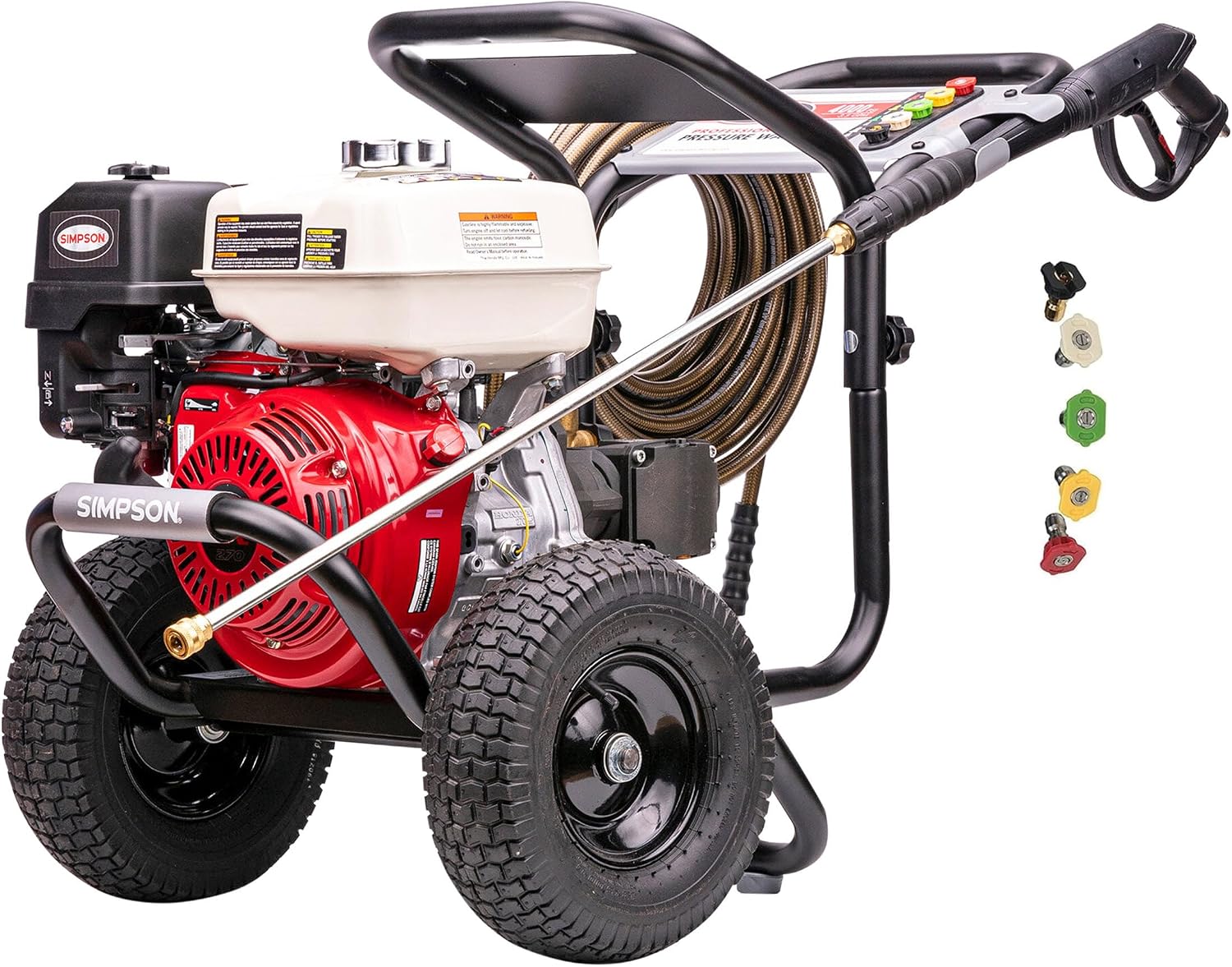
Our pick for the machine: Simpson Cleaning PS60869 PowerShot 4000 PSI Gas Pressure Washer
 Visit on Amazon →
This is what I pull out for a full driveway, a moldy fence, or boat season. The listing name runs long: Simpson Cleaning PS60869 PowerShot 4000 PSI Gas Pressure Washer, 3.5 GPM AAA Triplex Pump, Honda GX270 Engine, Includes Spray Gun, Wand, 5 QC Nozzle Tips, 3/8-inch x 50-Foot Monster Hose, 49-State. The part that matters is in the middle: 3.5 GPM through a triplex pump, turned by a Honda GX270.
Flow is what actually cleans. Pressure is how it feels. At 3.5 GPM this machine moves enough water to push dirt off a slab instead of just wetting it, and a triplex pump is the pump class that survives weekly work. The included 50-foot Monster Hose is a real 3/8-inch hose, not the stiff coil that ships with a budget unit, and the five quick-connect tips cover soap through a 0-degree stream, so you are not buying a nozzle kit on day one.
The 49-state note is literal. If you live in California, this exact unit is not the one you can buy.
A gas machine this size has real costs beyond the purchase. It is loud. It is heavy enough that you will not carry it up stairs alone. It wants a proper supply line, meaning 5/8-inch or larger at the spigot with decent static pressure, because a 3.5 GPM pump that cannot get water will cavitate and tear itself up. And it will etch concrete in the hands of anyone who does not respect the nozzle.
Flaws but not dealbreakers: Weight, noise, and carburetor maintenance. Treat the fuel with stabilizer and run it dry before storage or you will be rebuilding the carb in spring.
Anyone cleaning a two-car driveway every few weeks, a boat hull, or commercial flatwork should be looking here first. Check current Amazon price.
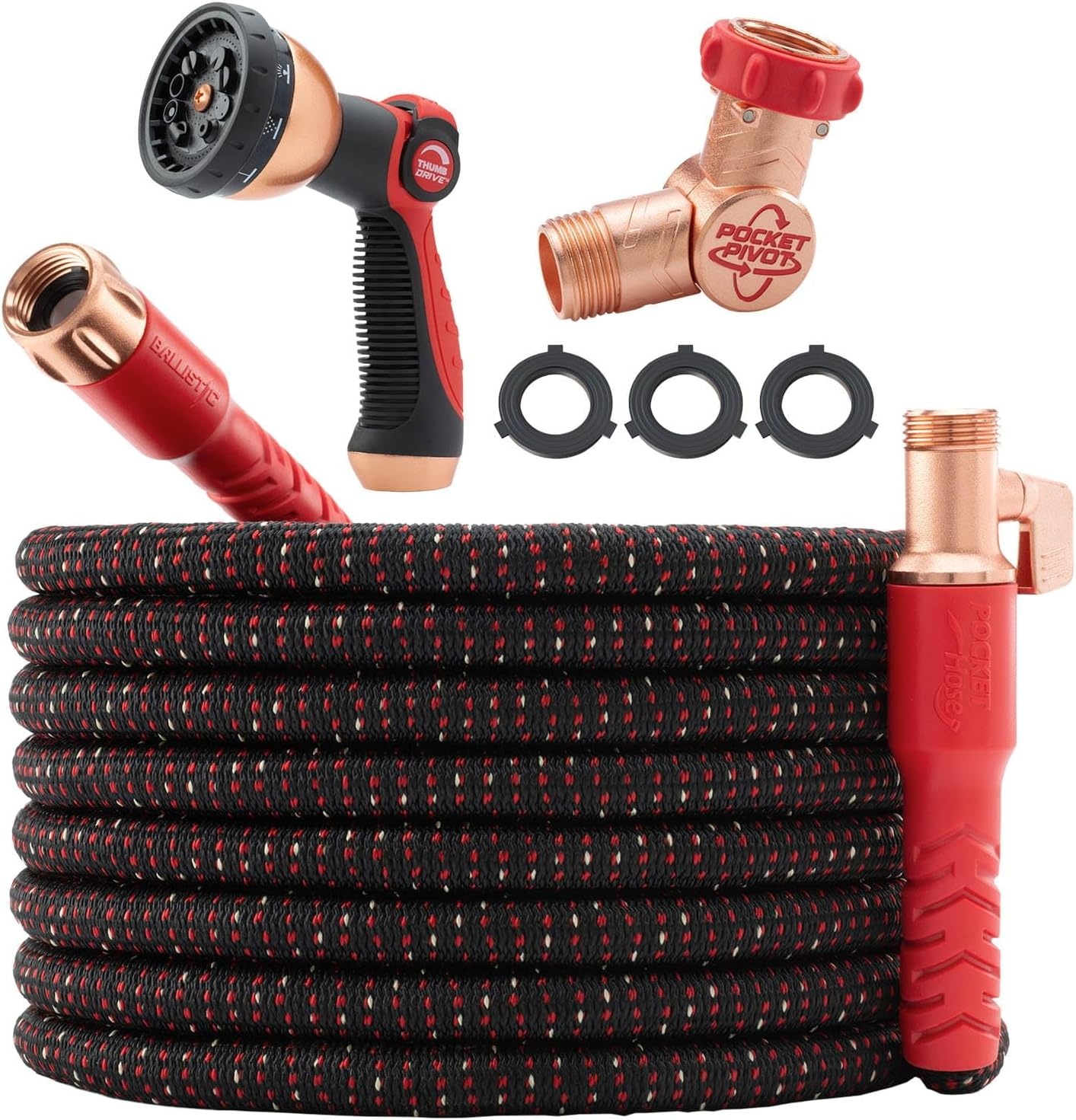
The supply hose: Pocket Hose Ballistic 100 FT Expandable Garden Hose, No-Kink, As Seen on TV
 Visit on Amazon →
Water in and water out. The Pocket Hose Ballistic 100 FT Expandable Garden Hose, No-Kink, As Seen on TV handles the second half of that sentence well. It is a 100-foot expandable hose that shrinks back to a fraction of its length when you shut the spigot off, which sounds like a late-night infomercial until you have dragged a stiff rubber hose across a wet driveway for the fourth time in one afternoon. It does not kink every five feet, and it stores in a bucket.
Where it earns its place in a pressure washing setup is pre-soak, detergent rinse-down, and the final flood rinse. Wet the slab with it, keep the concrete wet while the detergent dwells, then rinse the residue downhill with clean water. If you are feeding a light electric washer, this is also the easiest supply line you can own.
Here is the honest limit. An expandable hose is not a 3.5 GPM feed line. The smaller inner diameter and the pressure drop will starve a big gas pump at full flow, and a starved pump is how you turn a good machine into a repair bill. For the Simpson above, run a 5/8-inch non-collapsible hose to the inlet and keep the Ballistic for rinse duty. And never, under any circumstance, put a garden hose between the pump and the spray gun. It is a supply hose, not a high-pressure hose.
Flaws but not dealbreakers: The fabric skin does not love sharp concrete edges, and the flow drops if your spigot is weak or you are running it through a long splitter. Keep the run short and the spigot open all the way.
Anyone who wants a hose they can actually coil and store, or who runs a smaller electric washer, will get their money's worth. Check current Amazon price.
The actual pressure washing workflow
Now the job itself. This order works on concrete, and it applies to pavers with a lighter touch and a wider tip.
Step one: Soak the slab before anything else. Dry concrete pulls detergent into the pores and leaves you with blotches that look like stains. Wet it down first with the hose and keep it wet.
Step two: Pick the right nozzle and commit to it. Green 25-degree for general concrete. Yellow 15-degree for the ring around the trash can and the oil spots. White 40-degree for siding, wood, and anything painted. Black for soap. A red 0-degree tip never touches concrete, because it cuts grooves you cannot rinse away.
Step three: Draw detergent and let it dwell. A machine that cannot pull soap is a hose with a trigger. Run the black soap tip through the downstream injector, lay the mix down in even passes, and give it five to ten minutes. Do not let it dry on the slab. If it starts to dry, hit it with the hose and keep going.
Step four: Wand discipline. Keep the tip 12 to 18 inches off the surface, hold the wand at about 45 degrees, and move at one steady speed. Slow and even beats fast and jerky. If you stop moving, you are etching.
Step five: One direction, 50 percent overlap. Pick a line and stay on it. Overlap each pass by half the width of the previous one. That is the difference between a driveway that looks new and a driveway with tiger stripes.
Step six: Rinse top down with clean water. Drop the soap, switch to the 25-degree tip or the hose, and push the residue downhill. The Ballistic is good here because you can flood the slab without dragging a heavy hose over your fresh work.
Step seven: Kill the mildew. In Tampa this is not optional. A bleach mix in a pump sprayer, one part bleach to three parts water, dwelled a few minutes and then rinsed, is what keeps the green from returning in three weeks. Pressure alone does not kill mold. It just makes it look clean for a month.
Step eight: Let it dry before you judge it. Wet concrete hides striping and swirl marks. Come back in an hour and look at it in raking light. If you see stripes, they came from inconsistent speed, not from the machine.
Three mistakes that etch concrete
Holding a 0-degree tip in one place. That stream is for stripping paint and blasting rust, not for flatwork. One second of dwell leaves a permanent scar.
Washing in full sun on a hot afternoon. Detergent flashes dry, the surface pulls it in unevenly, and you get a patchy finish. Go early morning or late afternoon, and keep the slab wet the whole time.
Running a turbo or rotary nozzle on old or sealed concrete. A spinning 0-degree stream is aggressive. On new, unsealed concrete it cleans flatwork fast. On anything old, cracked, or sealed, it takes the surface with it.
The competition and why it lost
Electric machines in the 1.4 to 2.0 GPM range are not the enemy here. For most homeowners they are the right call, and I say that as a guy with a gas machine in the truck. An electric unit with a good nozzle will wash a car, a patio, and a mild driveway all afternoon without you touching a fuel can. What it will not do is run for three hours straight on a big slab without a cool-down break.
Cheap gas machines with axial pumps are the other tempting option. They are light and they sound impressive for a season, and then the pump gives out, because axial pumps are not built for weekly work. Triplex is the pump that lasts.
A surface cleaner attachment deserves a mention as the single best upgrade you can buy. A spinning bar under a dome cleans flatwork evenly, twice as fast, with no stripes. It does more for your results than another 500 PSI of headline pressure.
And the stiff garden hose that came with your house? That is why the Ballistic is in this guide. A hose that kinks every five feet turns a 40-minute job into an hour and a half of irritation.
What this all costs
I am not printing prices, because they move and I would rather you see the real number than my stale one. Check current Amazon price on both links above.
Where the money actually goes on a pressure washer is the pump and the engine. A triplex pump and a Honda engine are the two line items that decide whether the machine is still working in five years. Everything else, the tips, the wand, the hose, is replaceable, and you should expect to replace some of it.
The cost of doing this wrong is higher than the cost of the gear. A starved pump is a repair. An etched driveway is a resurface. A sealed driveway cleaned with a 0-degree tip is a reseal job you did not plan for.
The workflow itself costs nothing. Twenty minutes of setup, the right nozzle, detergent that gets to dwell, and one steady pass at a time. That is the whole job, and it is why a machine like the Simpson earns its keep while a box-store special sits in the garage with a seized pump.
Point the wand, keep it moving, and let the water do the work.