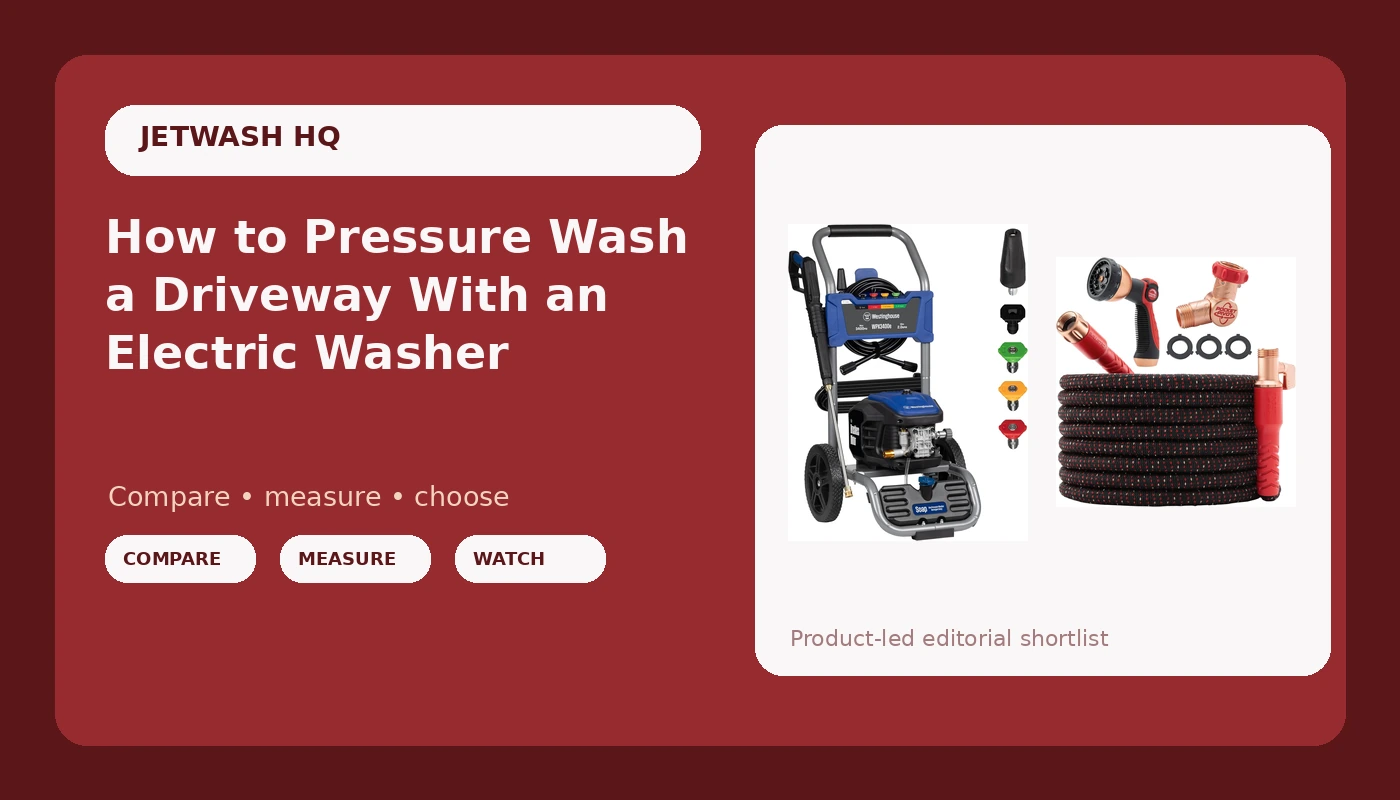
Most people who buy an electric pressure washer make the same three mistakes in the first hour. They grab the narrowest nozzle in the box because narrow feels powerful, they hook it to a garden hose that kinks every ten feet, and they try to strip a driveway with a wand when a surface cleaner would have done the job in half the time. None of those mistakes have anything to do with how much the machine cost.
I have been detailing cars and washing concrete around Tampa for twelve years, and the electric pressure washer is the tool I reach for most often. It is quieter, it plugs into the wall, and for a driveway, a fence, a set of patio chairs, and a daily driver, it does everything a homeowner needs.
What follows is the whole job, start to finish: what to look for in the machine, how to set it up without starving the pump, and the order of operations that keeps you from spending a Saturday undoing your own work.
Why you should trust me
I run a mobile detailing business, which means I have pressure washed more driveways, decks, boat hulls, and dirty fenders than I can count, usually in Florida heat with a client watching. I own three machines: an electric one for light work and cars, a gas one for boat season, and a cheap one I bought to review that died inside a month and taught me more than the other two combined.
That dead machine is why I care about flow rate. It was rated at a big PSI number and moved almost no water, so it smeared dirt around instead of removing it. I have been burned by marketing numbers, and I assume you will be too if nobody tells you what to actually look at.
How I judge a pressure washer
Four things decide whether a machine is worth owning. None of them is the PSI number on the front of the box.
Flow rate first. PSI is how the water feels on your hand. GPM, gallons per minute, is how much water is actually doing the work of lifting dirt off a surface. A machine with strong pressure and weak flow is a squirt gun with good posture. When you compare units, read the GPM and then read it again, because that is the number that determines whether a driveway takes forty minutes or two hours.
Detergent draw. If a washer cannot pull soap from a tank or a siphon tube, you are cleaning with water alone, which is like washing dishes without dish soap. A built-in soap tank is worth more than an extra nozzle in my book, because pre-treating organic grime and then rinsing it off is how you clean a fence line that has gone green.
Hose and wand quality. The hose and the wand are what you actually touch for an hour. A stiff hose that kinks at every turn will make you resent the machine, and a wand that feels like a toy will break your wrist angle on the second pass. This is the part of the kit most buyers ignore and most regret.
Duty cycle. Electric machines need breaks. Gas does not. If your job is one driveway and one car, that is irrelevant. If you are washing a boat, a fence, and a driveway back to back, you will feel the machine warm up and you will be standing around waiting for it.
The gear that does the work
Two pieces matter here: the machine and the water supply feeding it. You can own a great washer and still get mediocre results if the hose behind it cannot deliver water fast enough.
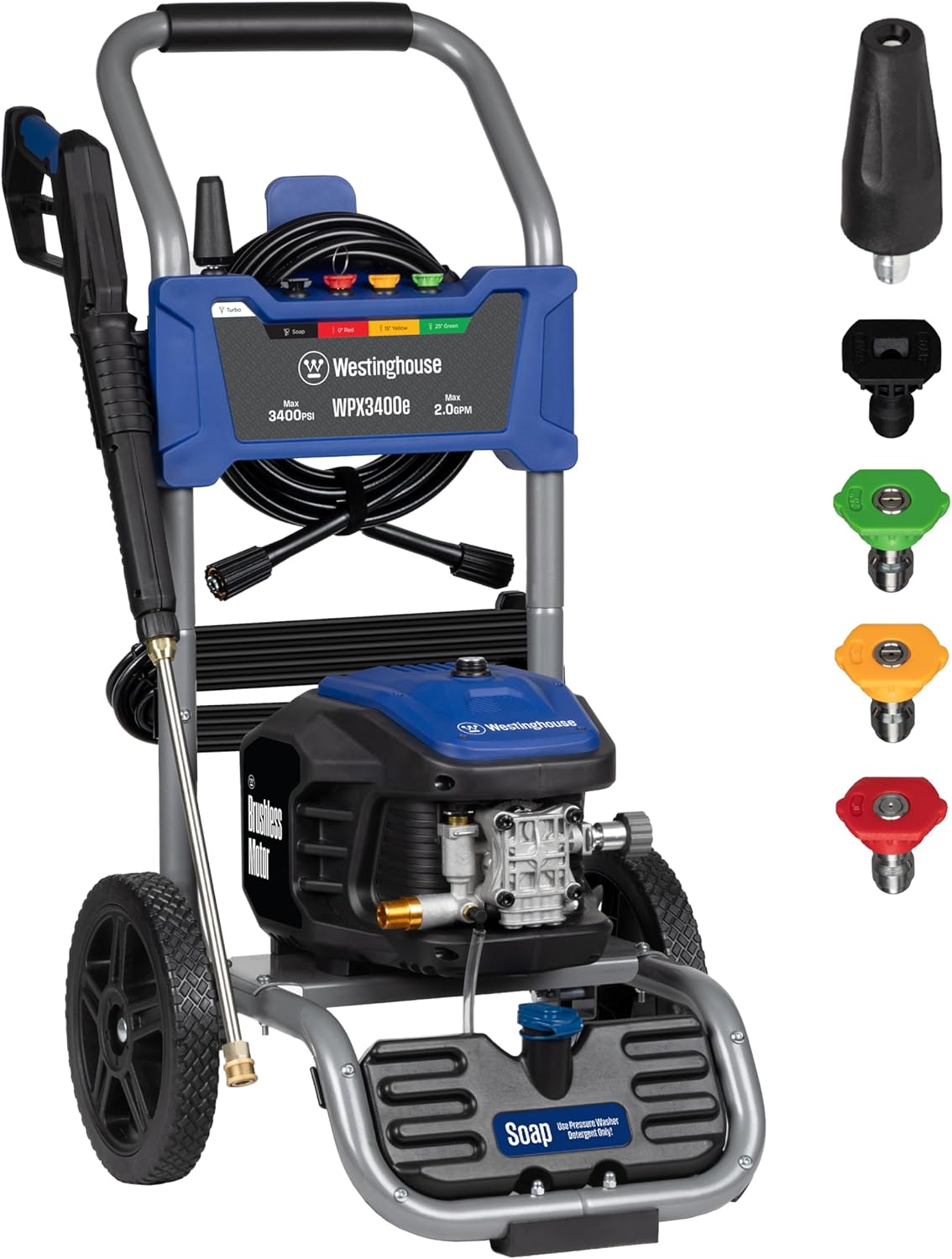
Our pick: Westinghouse WPX3400e Electric Pressure Washer
 Visit on Amazon →
This is the electric machine I would put in front of most homeowners. It is rated at 3400 max PSI and 2.0 max GPM, and the GPM figure is the one that matters to me, because 2.0 gallons per minute is enough flow to actually move dirt off concrete rather than just chase it around. The brushless motor is the reason I am comfortable recommending an electric unit for real work: fewer wear parts, less noise, and no brushes to burn out.
The onboard soap tank is the feature I would pay for on its own. Detergent draw is not a luxury on a driveway or a fence, it is the difference between rinsing dust off and dissolving the layer of organic film that makes concrete look gray and tired. Fill the tank, switch to the black soap nozzle, let it dwell, then rinse with a wider nozzle.
The kit also includes a spray gun and wand and a five nozzle set, which means you can start working the day it arrives instead of ordering nozzles separately. The wand has enough heft that it does not feel like a toy in your hand, which matters when you are holding it for an hour.
Flaws but not dealbreakers: It is still an electric machine, so it has a duty cycle. On a long job, plan on letting it rest instead of running it wide open for two hours. It also needs a healthy outdoor circuit, so skip the skinny extension cord and use a proper gauge if you cannot reach the outlet. And rinse the soap tank when you are done, because dried detergent in a tank is exactly how detergent systems clog and stop drawing.
Homeowners with a driveway, a fence, a patio, and a car or two will get years out of this without ever needing gas.
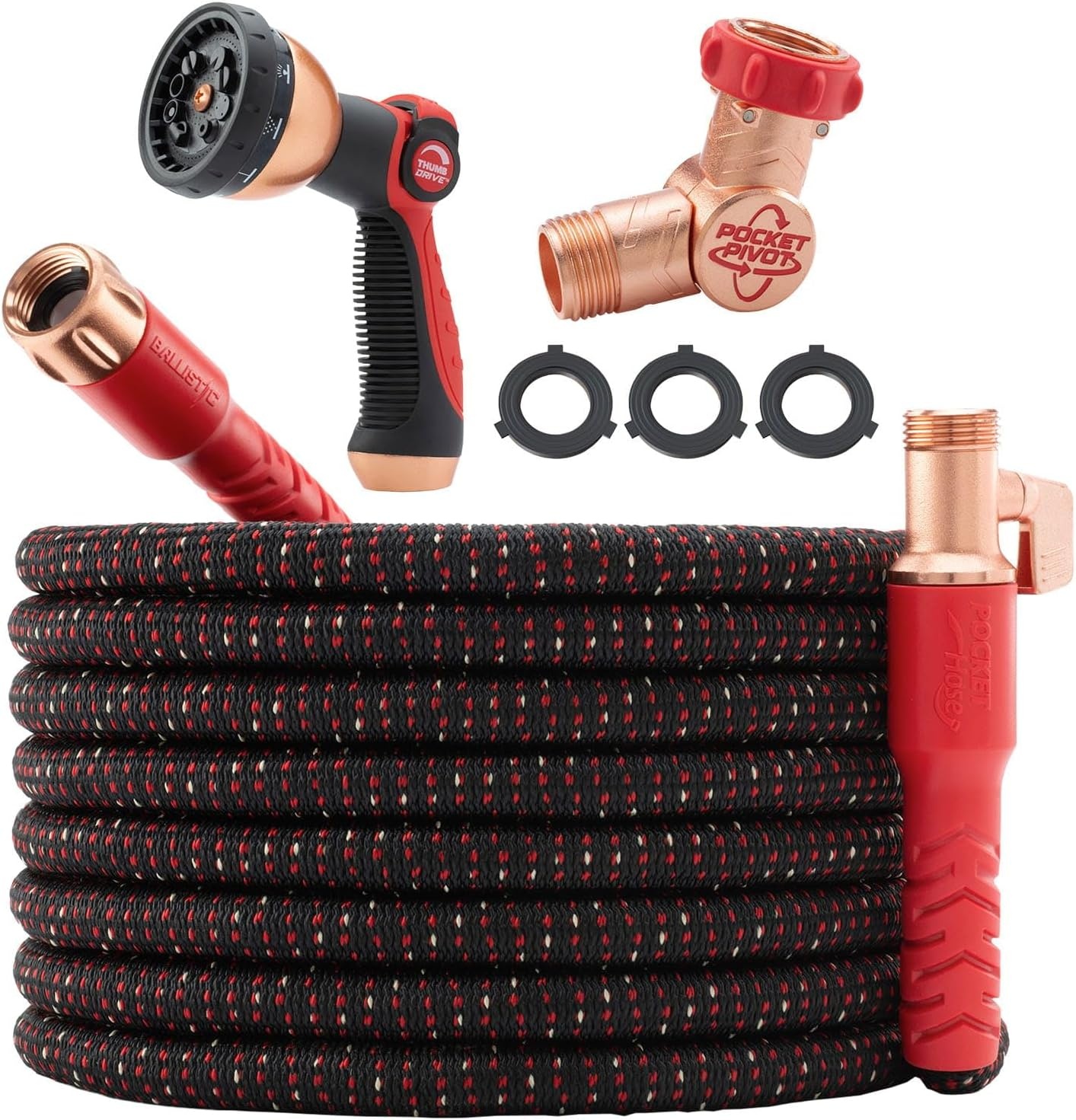
The water supply: Pocket Hose Ballistic 100 FT Expandable Garden Hose
 Visit on Amazon →
Here is the part nobody thinks about until it ruins their afternoon. A pressure washer can only push the water it is given, and a kinked hose starves the pump. When supply drops, your pressure drops, the machine works harder than it should, and you spend the job walking back to untwist a hose instead of cleaning.
An expandable hose solves two problems at once. It reaches far enough to get around a driveway, a fence line, and the far corner of a yard without dragging a heavy coil through the flower bed, and it collapses down small enough to store on a hook instead of in a tangled pile. This one is 100 feet and built to resist kinking, which is the specific failure that costs you cleaning time.
Flaws but not dealbreakers: Expandable hoses have rules. Turn the water on before you walk away with it, do not leave it pressurized for days, keep it off sharp edges and out of the path of a car tire, and drain it before a freeze. If you stretch it across a driveway and run it over, you will be buying another one. Treat it like a hose and not a rope and it lasts.
Anyone with a long run from the spigot to the work area should start here, because a short kinking hose is the cheapest way to make a good washer look bad.
The actual pressure washing workflow
This is the order I use on a driveway. It works on concrete, brick, and most siding, with small adjustments noted.
Step one: pick the nozzle before you pick up the wand. The white nozzle, usually 40 degrees, is your general-purpose tip for siding, fences, and anything you are unsure about. The green 25-degree tip is for concrete and brick. The yellow 15-degree tip is for stubborn stains on hard surfaces only. The red zero-degree tip is a laser, and it will etch wood, strip paint, and cut a line into a deck if you hold it still. Save it for a spot where you genuinely need it, if ever. The black tip is for soap.
Step two: connect the water and bleed the air. Hook the hose to the machine and turn the water on all the way before you touch the power switch. Pull the trigger with the machine off until water runs steady out of the wand. Running a pump dry, even for a few seconds, is how you kill it. This step takes fifteen seconds and saves machines.
Step three: power up on a protected outlet. Plug into a GFCI outlet if you have one outdoors. If you must use an extension cord, use a heavy one and keep it out of standing water. Water and electricity are the two things in this job that can actually hurt you, so do not get casual about the cord.
Step four: pre-treat with detergent. Fill the soap tank, switch to the black nozzle, and lay detergent down over the whole area. Then stop. Let it dwell for a few minutes so it can break down the organic film. Rushing this step is why so many driveways come out striped and gray instead of uniformly clean.
Step five: work top to bottom. On a fence, a wall, or siding, start high and rinse downward so dirty water does not run over what you already cleaned. On a flat driveway, work in sections and keep a wet edge so you do not leave a visible line where you stopped.
Step six: keep the wand moving and back off on soft surfaces. Pressure is concentrated at the tip, so holding still in one spot is how you etch concrete or furrow wood. Keep it moving at an even pace, and back farther away from anything painted, sealed, or old. Older wood siding and window seals deserve distance and a wide nozzle, not force.
Step seven: use a surface cleaner on flat concrete. This is the single best upgrade you can buy. A spinning bar attachment cleans flat surfaces evenly, eliminates stripes, and cuts your time roughly in half. If you wash a driveway more than once a year, it pays for itself in one afternoon.
Step eight: rinse, then put the machine away correctly. Do a final rinse pass with clean water, then shut the water off, pull the trigger to release pressure, and drain the hose. Rinse the soap tank. If a freeze is coming, bring the hose and the machine inside.
Mistakes that cost you a weekend
The most common one is a kinked supply hose, which quietly cuts your flow and makes you think the machine is weak. Second is the wrong nozzle on the wrong surface, which turns a cleaning job into a repair job. Third is skipping detergent dwell time and trying to blast organic grime off with water alone.
Two more worth naming: washing in the hottest part of a Florida afternoon, when the surface dries before you can rinse and leaves spots, and forgetting that electric machines need to breathe. If the machine starts sounding different, let it rest. It is not being dramatic.
What this all costs
I am not going to quote you prices, because they move and I would rather you see today's number yourself. Check current Amazon price on the Westinghouse and on the Pocket Hose before you commit, and compare that against what a single professional driveway cleaning runs in your area. For most homeowners, the machine and the hose together cost less than a couple of hired cleanings, and then they are yours for every spring after that.
Add a surface cleaner and you have a setup that handles a driveway, a fence, patio furniture, and both cars. That is the whole kit. The machine does half the work, the water supply and the nozzle do the other half, and the order you do things in decides whether you finish at noon or at dark.
Start with the nozzle, feed it water it can actually use, let the soap do its job, and keep the wand moving. That is the entire trick.