Most driveways don't need 4,000 PSI. They need flow, a wide fan pattern, and a pass rhythm that keeps the wand moving. If you're shopping for an electric pressure washer for driveways, the big number on the front of the box is the least useful thing on it. Gallons per minute is what carries the dirt off the concrete. Pressure is just how hard the water feels on your hand.
I've cleaned driveways for a living for twelve years, first as a detailer, now running a mobile detailing business out of Tampa that handles everything from daily drivers to boats. In that time I've watched homeowners etch their own concrete with a turbo tip, blast the paint off a garage door, and buy a washer that couldn't draw detergent to save its life. None of that is a machine problem. It's a technique and nozzle problem, and both are fixable in an afternoon.
Here's the full workflow, plus the two machines I'd actually put on a driveway job.
Why you should trust me
Twelve years of detailing, and a mobile rig that has pressure washed more driveways, decks, and boat hulls than I can count. I own three pressure washers: an electric one for light work, a gas one for the serious jobs, and a cheap one I bought to review that died inside a month. That last one taught me more than the other two combined.
I don't care what the box says about power. I care about real GPM, whether the unit can pull detergent on its own, whether the hose kinks every five feet, and whether the wand feels like a tool or a toy. If a machine fails any of those, it doesn't get recommended, no matter how good the spec sheet looks.
What actually cleans a driveway
Three things decide the result, and none of them is the PSI number.
GPM. Gallons per minute is the volume of water doing the work. A 2.0 GPM machine at 3,000 PSI will out-clean a 1.2 GPM machine at 3,500 PSI every single time, because the water is what lifts and carries the grime. Anything under 1.5 GPM is a hose with a trigger, and you'll spend more time waiting on the water than cleaning.
The nozzle. The nozzle is the machine. A 25-degree tip is your general-purpose concrete nozzle. A 15-degree tip is for stubborn stains and edges. A turbo, or rotating, nozzle is for concrete only, and even then, keep it moving or it will leave a permanent spiral scar. Never point a turbo tip at wood, paint, or a car.
Detergent draw. Concrete that's been sitting under oak trees for a decade has a layer of tannin and mildew that water alone won't touch. A machine that can't draw soap is fighting with one hand tied behind its back. Downstream injection is fine, but it has to actually pull.
The single best upgrade you can buy is a surface cleaner, a spinning bar attachment that cleans flat concrete evenly. It kills the zebra stripes you get from freehand wand work and it cuts the job time in half. A cheap surface cleaner turns a mediocre washer into a professional tool.
What you need before you start
Gather this before you drag the machine out:
- A surface cleaner sized to your machine's flow, with a 12 to 15 inch deck being the sweet spot for an electric unit.
- A nozzle set: 25-degree, 15-degree, and a soap tip.
- A detergent made for concrete, or a dedicated deck cleaner, depending on the surface.
- A hose that reaches with slack, plus a second one if the driveway is long.
- Closed-toe shoes that grip when wet, eye protection, and hearing protection if you're running gas.
- A stiff broom and a leaf blower, because you clean the surface before you clean the surface.
Prep matters more than the machine. Sweep the driveway, pull the weeds out of the expansion joints, and pre-wet the concrete so the detergent doesn't dry on it. Pre-wetting also keeps the cleaner from flashing in the Florida sun, which is where most streaking comes from.
The two washers worth putting on a driveway
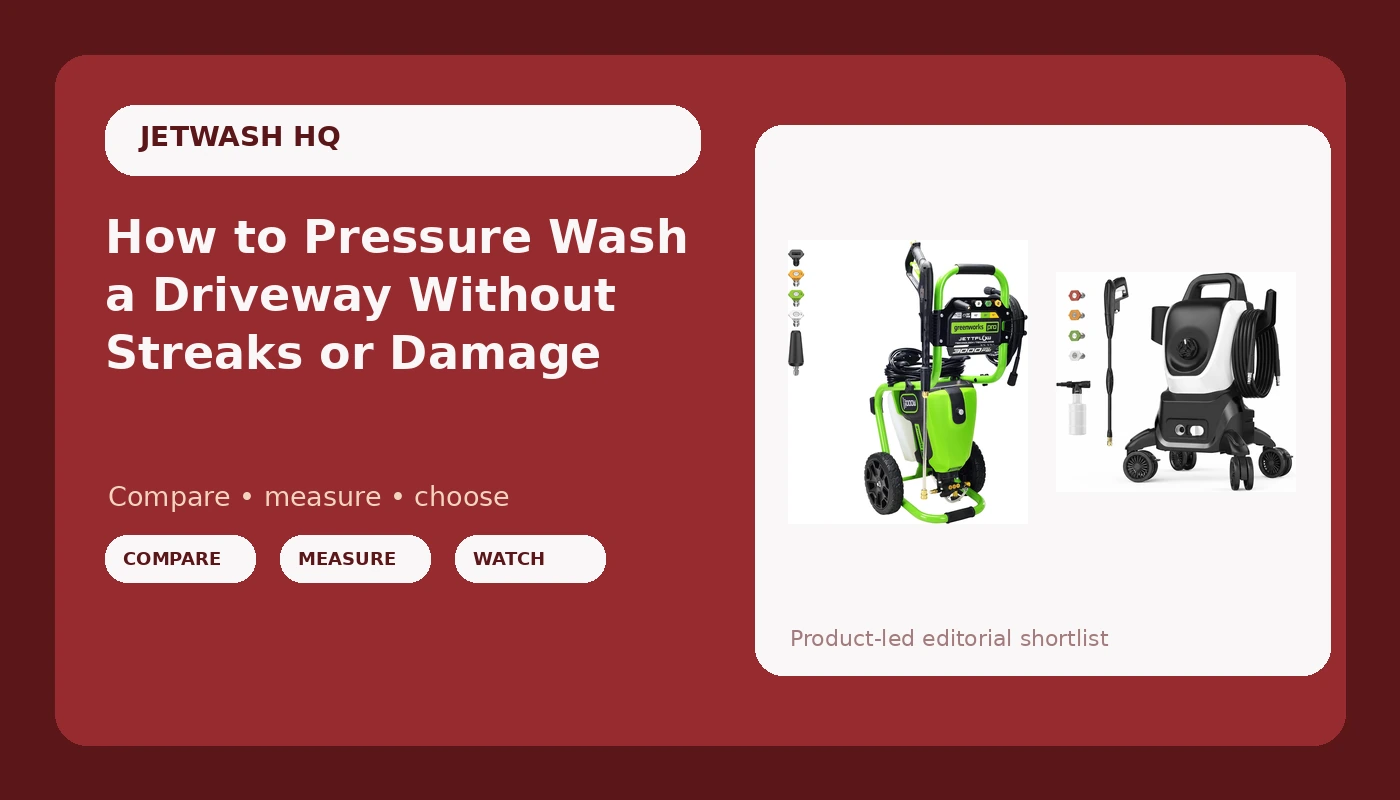
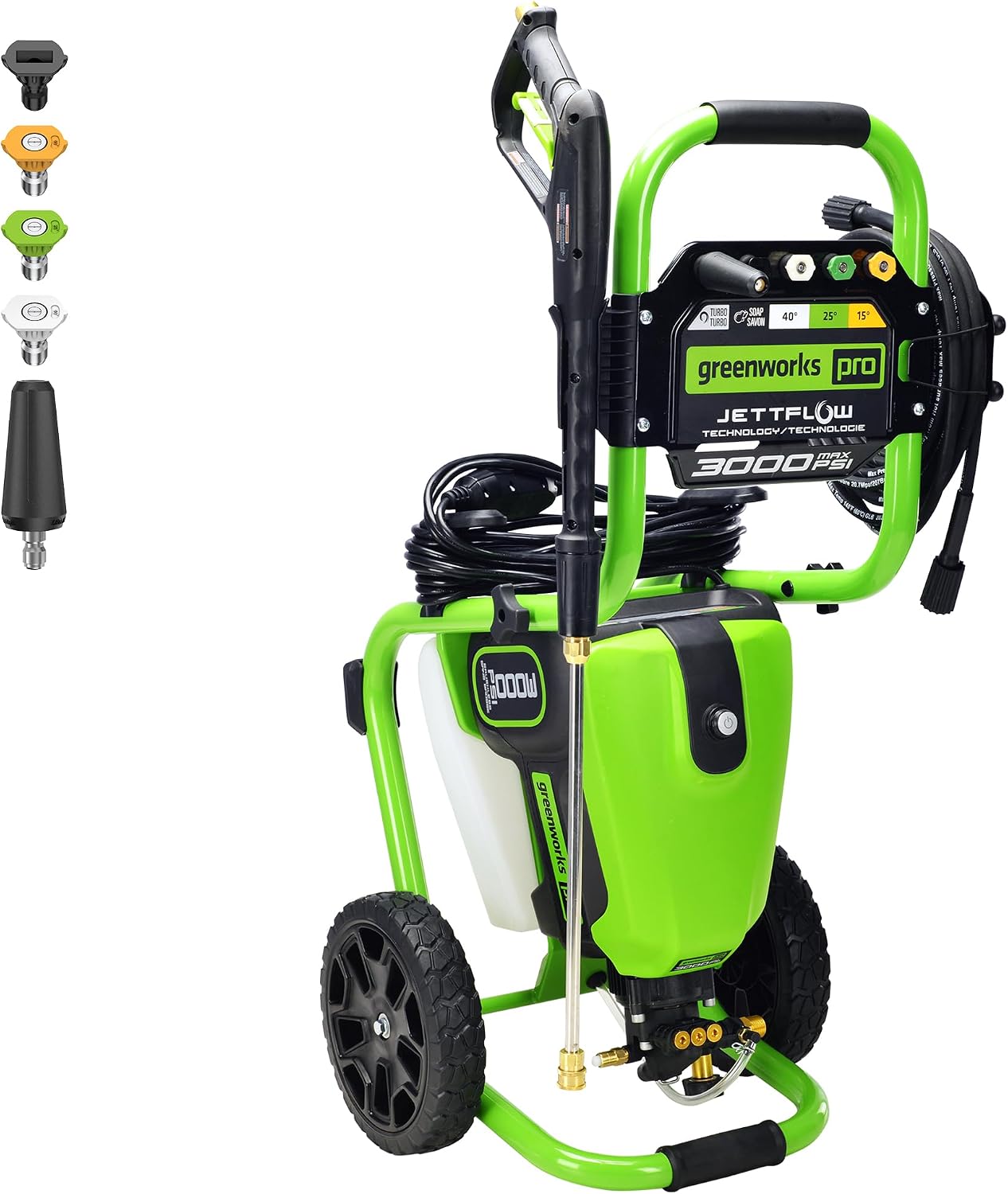
Our pick: Greenworks 3000 PSI (2.0 GPM Max) Brushless Electric Pressure Washer
 Visit on Amazon →
This is the one I'd hand to a homeowner with a two-car driveway, a patio, and a couple of cars to wash. The 2.0 GPM max flow is the number that matters here, and it's paired with 3,000 PSI, which is plenty for concrete without being so much that you have to tiptoe around your own siding. The brushless motor is the part that separates it from the cheap units, because brushless runs cooler and lasts longer on long jobs, and a driveway job is a long job.
The practical test I run on any electric machine is whether it can hold pressure through a full driveway pass without fading. Flow rate and motor type are what decide that, and both are on this machine's side.
Flaws but not dealbreakers: Electric machines have a duty cycle. If you're planning to wash three driveways back to back for clients, you'll want gas. For one house, one weekend, this is the right tool.
Anyone with a normal suburban driveway who wants to stop paying someone else to clean it will be happy here.
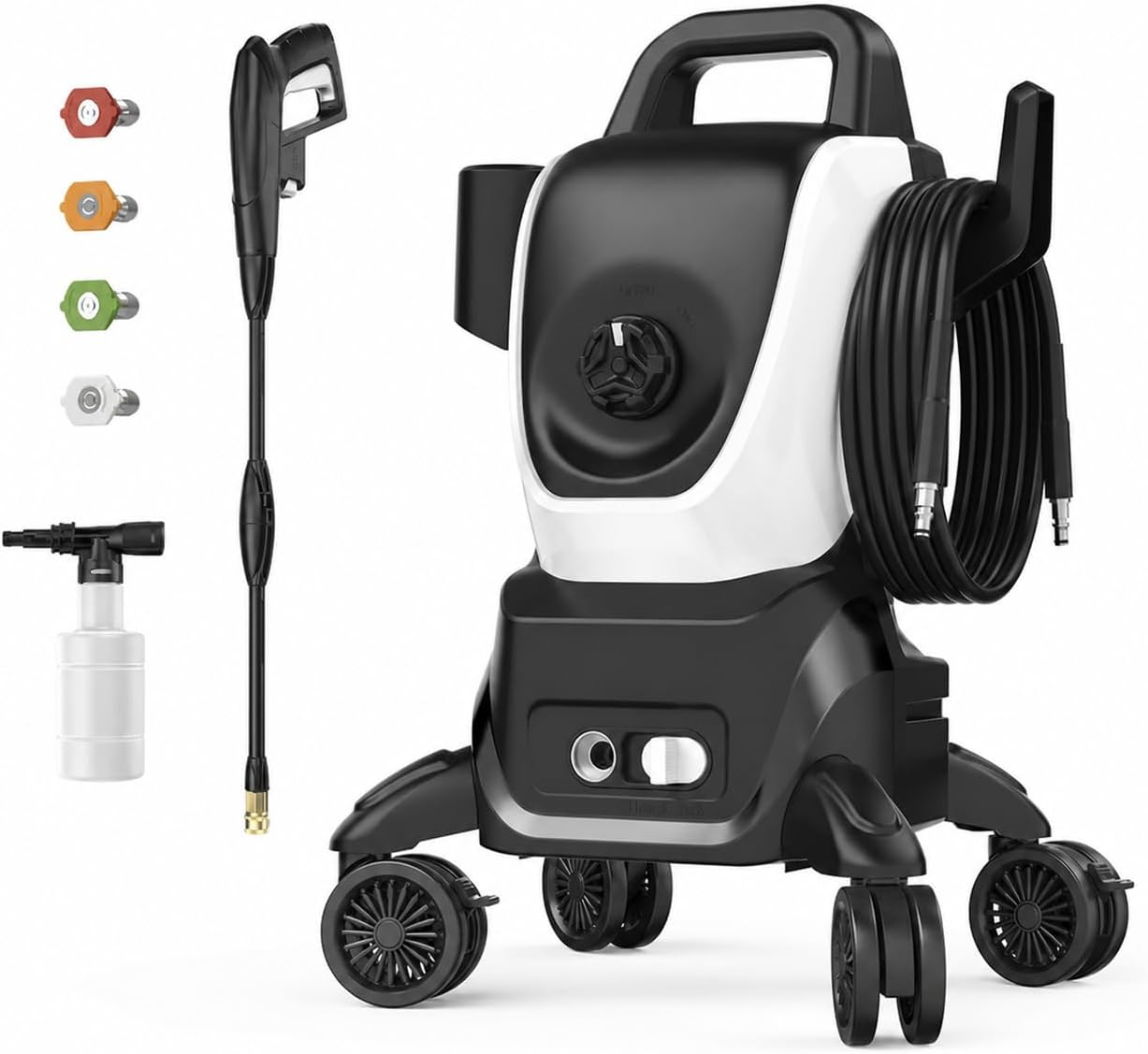
Big-job pick: Pressure Washer, 3800 Max PSI, 2.4 GPM, 4-Wheel Mobility, Foam Cannon
 Visit on Amazon →
Two things sell this one: 2.4 GPM and four wheels. The extra flow over the Greenworks is the difference between a driveway that looks clean and a driveway that looks new, especially on stamped or heavily soiled concrete where you're fighting years of buildup. The 3800 max PSI rating gives you headroom to run a surface cleaner without the machine falling on its face.
The four-wheel mobility is not a gimmick. A pressure washer you have to drag across a driveway on two wheels is a machine you stop using, and the hose kink that comes with dragging is the number one reason homeowners hate their washer by month three. The included foam cannon is a genuine bonus if you wash cars too, because foam dwell time is what loosens road film before you ever touch the paint.
Flaws but not dealbreakers: More flow means more water, so plan your hose run and your drainage before you start. A machine this capable will also find every gap in your concrete, so keep the wand moving and stay off the expansion joints with anything tighter than a 25-degree tip.
Anyone with a long driveway, a big patio, or a fleet of vehicles to keep clean should start here.
The actual driveway workflow
This works on concrete, and the same pattern works on pavers with lighter pressure and a wider tip.
Step one: Clear and pre-treat. Sweep the surface, pull the weeds, and pre-wet the concrete. If there's mildew or tannin staining, hit it with detergent first and let it dwell for five to ten minutes. Don't let it dry.
Step two: Set up the machine. Connect the water supply and run water through the wand before you start the motor. Running a pump dry even for a few seconds is how you kill it. Check the inlet filter, and check the detergent line if your machine draws soap.
Step three: Pick the nozzle. 25-degree for the main passes. 15-degree only for stains you can see from ten feet away. Turbo only on concrete, and only with the wand moving.
Step four: Start at the top and work down. On a driveway, that means starting at the garage apron and pushing water toward the street, not toward the house. On siding or a fence, work top to bottom so dirty water doesn't run over what you already cleaned.
Step five: Keep the tip moving. This is the whole game. Hold the wand at a consistent distance, roughly 12 to 18 inches on concrete, overlap each pass by half, and never let the spray sit in one spot. A stationary tip is what etches concrete and strips paint.
Step six: Use the surface cleaner for the field. Freehand the edges and the expansion joints, then run the surface cleaner over the open concrete in overlapping lanes. Two passes in different directions gives you an even finish with no zebra stripes.
Step seven: Rinse and re-check. Rinse the whole surface with a wide fan, let it dry, and look at it from the street. Freshly cleaned concrete lightens as it dries, so a spot that looks faint while wet is usually gone.
Step eight: Clean your gear. Flush the detergent line with clean water, run fresh water through the pump, and coil the hose without kinks. Ten minutes of maintenance is what makes the machine last past year three.
Mistakes that cost you a driveway
Etching concrete with a turbo tip. You'll know it when you see white swirl marks that don't rinse away. There's no fixing that without a grinder, so keep the turbo tip moving or leave it in the box.
Blasting wood. On a deck or fence, drop to a 25 or 40-degree tip, keep the wand further back, and go with the grain. Too much pressure raises the grain and fuzzes the wood, which means sanding before you can stain.
Spraying up under siding. Water forced upward behind vinyl siding goes into the wall and stays there. Keep the angle downward.
Skipping the detergent. Water alone on organic staining is a waste of a Saturday. Chemistry does the work, and pressure rinses it away.
Cleaning in direct sun. Detergent dries before it works and leaves streaks. Early morning or an overcast day is the right window.
What this all costs
An electric washer with real flow costs less upfront than a gas machine, and it covers a driveway, a patio, a fence, and two cars without much fuss. A gas machine with higher flow and a longer duty cycle costs more and needs more maintenance, but it's the right call if you're cleaning for clients or running a boat through it every week.
The attachments are where the value hides. A surface cleaner and a proper nozzle set cost a fraction of a new machine and change the result more than upgrading the machine would. That's the math nobody puts on the box.
Whatever you buy, buy flow. Check the GPM before the PSI, confirm the detergent system actually draws, and put a surface cleaner on the end of it. Then keep the wand moving and let the water do the work.