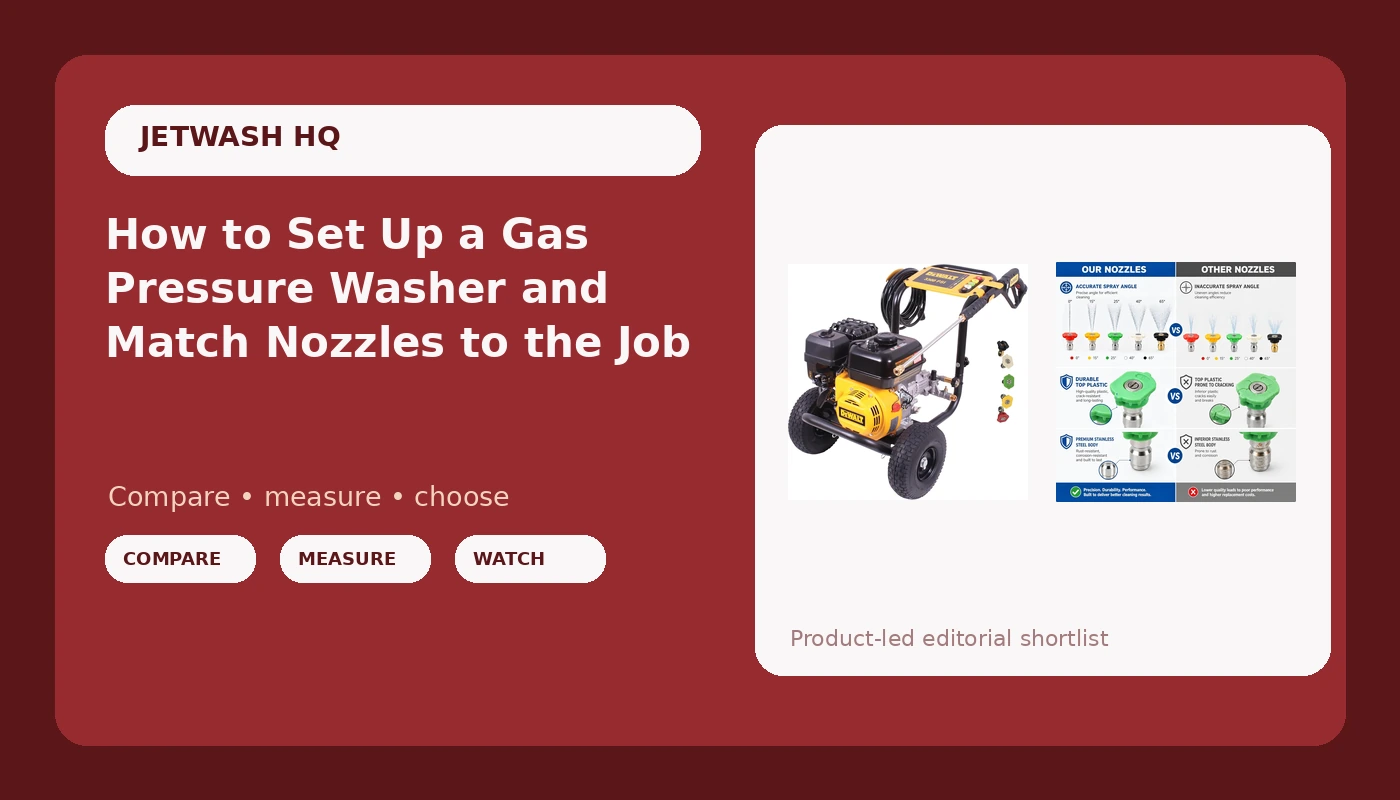
Most people buy a pressure washer by the PSI number on the box, then spend all Saturday on a two-car driveway wondering why the dirt is winning. I have been running a mobile detailing business out of Tampa for 12 years, and the biggest change to my results did not come from a bigger machine. It came from getting the pressure washer nozzle tips right and understanding that flow, not pressure, is what actually lifts grime off a surface.
PSI is how hard the water feels when it hits your hand. GPM is how much water is doing the work. A 3,300 PSI machine moving 2.4 gallons a minute will out-clean a "4,000 PSI" box-store unit all day, because the second number is the one carrying the dirt away.
This is the setup and nozzle guide I would hand a friend who just unboxed a gas machine and wants to wash a driveway, a fence, and a car without ruining any of them.
Why you should trust me
I detail cars, boats, and driveways for a living. My week is a mix of daily drivers in a client's office lot, boat hulls down at the ramp, and flatwork at houses where the concrete has not been touched since the house was built. I own three pressure washers: the electric one for light work, the gas one for the serious jobs, and a cheap one I bought to review that died inside a month.
That last machine taught me more than the good ones did. It had a big PSI sticker and a weak pump, and no nozzle on earth could rescue it. I keep the gas machine for anything that involves a real surface area, and I keep a stack of spare tips in the truck because the tip is the part of the system most people never think about and the part that changes the result most.
How I picked and how I tested
This is not a list of every pressure washer on the market. It is the two pieces I actually use together: one gas machine with honest flow numbers, and one cheap nozzle set that turns that machine into a tool instead of a hose with a trigger.
When I judge a machine, I look at four things before anything else. Real GPM, not just the PSI figure on the front of the box. Whether it draws detergent on its own, because a washer that cannot inject soap is fighting with one hand tied behind its back. The quality of the hose and the wand, since a stiff hose that kinks every five feet is a daily annoyance you will resent by the third job. And duty cycle, meaning how long the unit can run before it needs a break.
For nozzles, the test is simpler. Does the tip seat properly in the quick connect without wobbling, does the spray pattern hold its shape instead of turning into a fan of mist, and is the orifice sized so it does not choke the flow the machine is trying to deliver. A tip that is too small for the pump is a bottleneck you paid for.
Everything below is gear I run on real jobs, not a driveway photo and a good mood.
The gear that does the work
You need two things to start: a machine with real flow, and a set of tips you can identify by feel while your hands are wet.
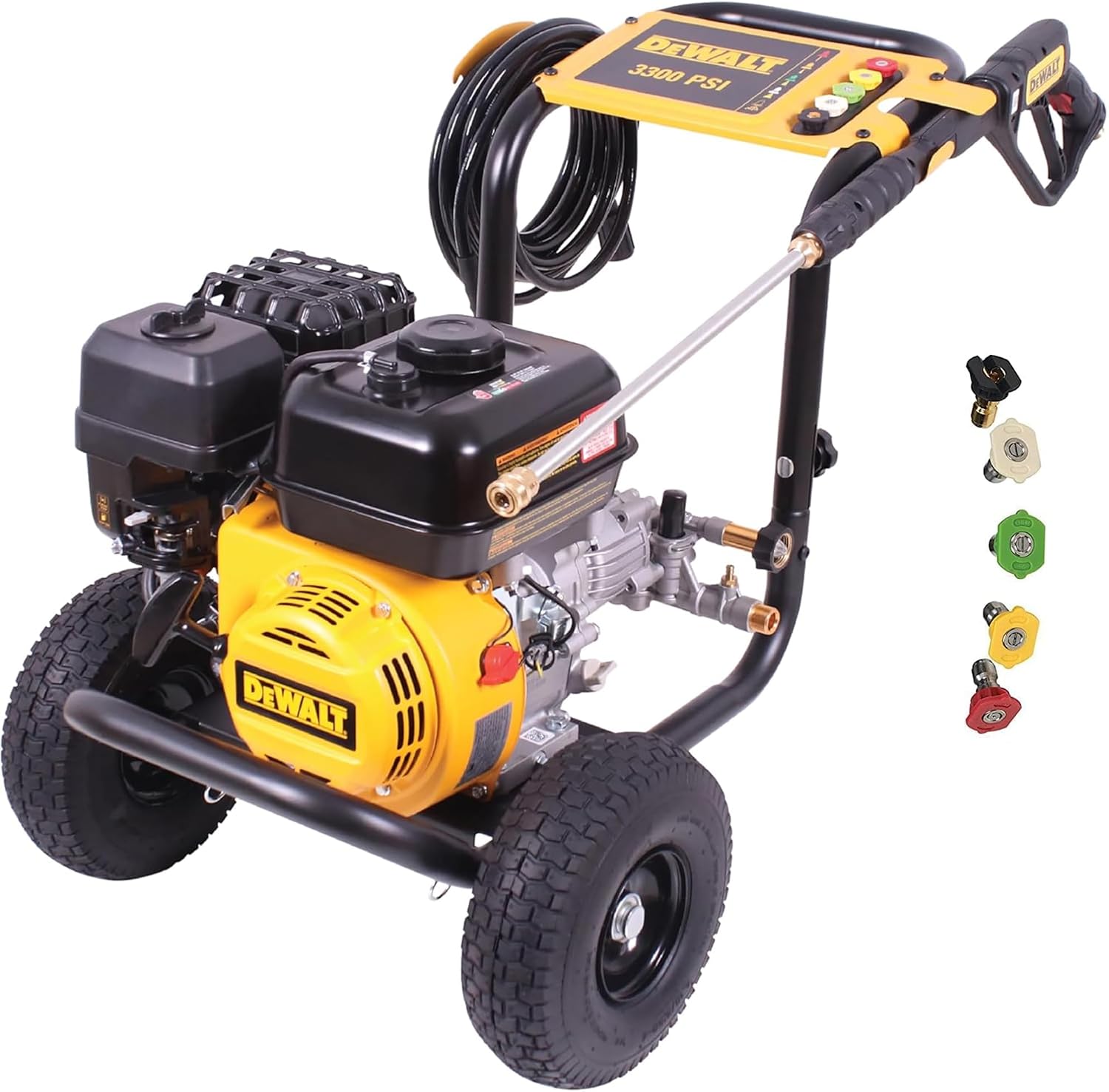
The machine: DeWalt 3300 PSI Gas Pressure Washer, 2.4 GPM, Residential Model DXPW3300-S
 Visit on Amazon →
This is the gas machine I reach for when the job is a full driveway, a fence line, or a hull. The 2.4 GPM flow rate is the number that matters here, and it is honest flow for a residential unit, which is why it strips a season of algae off concrete in overlapping passes instead of just pushing the top layer of dirt around.
The trade-offs are the ones every gas unit brings. It is loud enough that your neighbors will know you are working, it is heavy enough that you will think about where you park the truck before you unload it, and it needs fuel and oil attention the way any small engine does. If you want to pull a trigger and have it start, this is not that machine. If you want a full driveway done in an afternoon without waiting on a duty cycle, this is the category you buy from.
Flaws but not dealbreakers: It is a residential model, so treat it like one. Keep up with the oil, do not leave ethanol fuel sitting in it over winter, and it will keep earning its place in the truck.
Anyone washing flatwork, siding, or a boat on a regular basis will get real use out of the flow. Someone who wants to rinse a patio twice a year is overbuying.
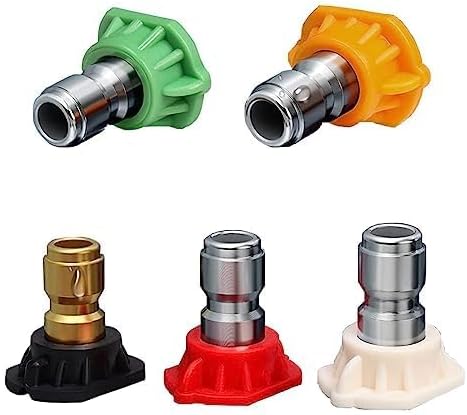
The nozzle set: 5.0 GPM Pressure Washer Nozzle Tips 5-Pack, Color Coded, Quick Connect
 Visit on Amazon →
This is the cheapest upgrade in the entire hobby and the one that changes your results the most. The pack is rated at 5.0 GPM, which is more flow than the DeWalt's 2.4 GPM, so the tips are not the restriction anywhere in the system. That is exactly what you want. A tip that is undersized for the pump chokes the flow and turns a capable machine into a weak one.
The color coding matters more than it sounds. When your hands are wet, your gloves are on, and the wand is live, you are not reading tiny stamped numbers on a brass fitting. You are grabbing the color you need. The quick connect seats with a push and a twist, and the five tips cover the whole range from stripping a stain on bare concrete to washing a car panel without hurting the clear coat.
Flaws but not dealbreakers: Loose tips disappear. They get dropped in grass, left on a tailgate, kicked off a curb. Buy the pack, then keep the tips on a lanyard or in a small pouch in the same pocket of your bag every single time. Also check the rubber O-rings now and then, because a worn O-ring will leak at the connection and cost you pressure for no reason.
Anyone who owns a pressure washer with a standard quick connect fitting should own a set of these. It is the difference between one spray pattern and a full toolkit.
The actual setup and washing workflow
Here is the sequence. It works on the DeWalt above and on almost any gas machine with a standard quick connect.
Step one: Check the machine before you add water. Oil level, fuel level, and a quick look at the inlet screen on the water connection. A clogged screen starves the pump, and starving a pump is how you kill it. If the machine has been sitting, this takes 60 seconds and saves you a repair bill.
Step two: Connect water first, then start the engine. Attach the garden hose to the inlet, turn the water on all the way, and squeeze the trigger with the engine off until water runs steady out of the wand. That purge pushes the air out of the system. Starting a gas pump dry, even for a few seconds, is the fastest way to wreck it.
Step three: Start the engine, then choose your tip. With the machine running and the wand pointed in a safe direction, lock the trigger and push the tip into the quick connect until it seats. Never swap a tip with the trigger squeezed. That is how people shoot a nozzle across a driveway, or into their own shin.
Step four: Match the tip to the surface. This is the part that decides whether you clean something or destroy it.
The standard color code runs from narrow and aggressive to wide and gentle. The 0 degree tip is a pencil-thin stream that will etch concrete and cut wood, so it is for spot work on bare slabs only. The 15 degree tip is your concrete and brick workhorse. The 25 degree tip handles siding, fences, and painted surfaces. The 40 degree tip is for cars, boats, and anything with a finish you care about. The black tip is the soap tip, and it is the one you use with detergent.
When in doubt, go one step wider than you think you need. You can always come back with something more aggressive. You cannot put the grain back into a deck board you just carved.
Step five: Test on a hidden patch. Find a corner nobody looks at, hit it for a few seconds, and check the result. Every surface is different. Old paint, soft wood, and aged concrete all react differently to the same tip. Thirty seconds of testing saves you an hour of regret.
Step six: Work in overlapping passes and keep the wand moving. Never hold the wand still. A stationary tip digs a stripe into whatever is under it, and those stripes are permanent. Move at a steady pace, overlap each pass by about half, and keep a consistent distance from the surface. Start farther away and walk in until the dirt lifts, then hold that distance.
Step seven: Apply detergent bottom up, rinse top down. If your machine draws soap, apply from the bottom of the wall or panel upward so the detergent does not streak as it runs down over dry dirt. Let it dwell for the time the bottle says, then rinse from the top down. Never let soap dry on a surface in the sun. In a Tampa summer that window is short, so work in sections.
Step eight: Never spray upward under siding, and never spray into vents. Water forced up behind vinyl siding goes into the wall cavity and stays there. Water into a vent goes into the house. Angle down and out, always.
Step nine: Shut down in order. Trigger off, engine off, water off, then squeeze the trigger once more to bleed the pressure out of the line. Pull the tip, dry it, and put it back with the others. Store the machine with the fuel treated and the pump protected.
Two safety rules that are not optional. Wear eye protection, because a pressure washer will throw grit and debris back at your face. And never point the wand at a person or a pet, at any distance, with any tip. A 0 degree stream at close range is a serious injury.
The competition and why it lost
The electric machines are not the enemy. For 90 percent of homeowners, an electric unit is genuinely the right call, and I say that as someone whose truck runs on gas. Electric is quieter, lighter, needs no fuel, and handles a car, a patio, and some siding without complaint. If that is your whole job list, buy electric and put the savings into a surface cleaner attachment.
What I skip is anything under 1.5 GPM, regardless of the PSI number printed on it. That spec sheet is built to sell, not to clean, and a low-flow machine means you spend more time waiting for the water to do its job than you spend actually cleaning.
I also skip the bargain bin nozzle packs that do not list a flow rating at all. An unrated tip might be undersized for your pump, which means you paid money to reduce the performance of a machine you already bought. The rated set costs about the same and does not fight you.
The last thing I skip is buying a second machine to solve a nozzle problem. Most people who feel like their washer is weak do not need more PSI. They need a tip that is not choking the flow and a technique that keeps the wand moving.
What this all costs
The honest math here is that the nozzle set is the cheapest part of the entire setup and the part that does the most work. The gas machine is the real investment, and it earns its place if you are washing flatwork, a fence, or a boat more than once or twice a year.
Add it up this way. One gas machine that flows 2.4 GPM. One five-tip set rated above what the machine can push, so nothing in the line is a bottleneck. A garden hose, a fuel can, and a Saturday morning. That is the whole kit.
Compare that to what you would otherwise do, which is rent a machine every time you need one, or pay someone to come out and do it for you. If you are going to own a house with concrete, a deck, and a car, owning the tool is the version of this that makes sense.
Check current Amazon price on both pieces before you commit, because pricing on pressure washers moves with the season. Buy the machine once, buy the tips once, and then spend your money on nothing but fuel and detergent for the next several years.
That is the whole job. Pick the flow, match the tip, keep the wand moving. Your driveway was built to be cleaned. Let it happen.