A gas pressure washer setup is mostly plumbing, patience, and one order of operations you do not get to improvise. Water on before the engine. Nozzle chosen before the trigger. Detergent drawn at low pressure, not high. Get those three right and the machine runs for years. Get them wrong and you will be shopping for a pump in a month.
I run a mobile detailing business out of Tampa. Twelve years of daily drivers, boat hulls, and a client's moldy fence that swears it comes back every rainy season. I own three pressure washers: an electric one for light work, a gas one for the jobs that pay the bills, and a cheap one I bought to see how bad it was. It died in a month, and the autopsy was a pump that had been run dry one too many times.
Here is the setup and running order I use on every gas machine, plus the one I would buy if I were outfitting a trailer tomorrow, and the replacement pump I keep bookmarked for the day the old one lets go.
Why you should trust me
I have been detailing cars, boats, and the occasional dock for twelve years, and I have pressure washed more driveways, decks, and hulls than I can count. I have replaced pumps on my own machines, unclogged detergent injectors at 6 a.m. before a job, and thrown away a hose that kinked every five feet until I wanted to scream.
The old detailer who trained me beat one rule into my head: PSI is how it feels, GPM is what cleans. I still check the PSI number first out of habit, then I look at the flow rate, the pump type, and the hose, because those are the things that decide whether you finish a driveway in an hour or spend the afternoon chasing stripes.
What I check before I recommend a gas machine
Four things decide whether a gas washer is a tool or a toy.
Flow rate. Gallons per minute is the actual cleaning power. A 4,000 PSI machine pushing 2.0 GPM moves less dirt than a 3,000 PSI machine pushing 3.5 GPM, because flow is what carries the debris off the surface. If a listing leads with PSI and buries the GPM, that tells you something.
Pump type. A triplex pump has three pistons in an oil bath, it can be rebuilt, and it is the reason commercial machines last. An axial cam pump is cheaper to build, it is not worth rebuilding, and it is usually the first thing to fail on a budget gas unit.
Engine quality. A commercial-grade engine with a real air filter and a cast iron sleeve starts on the second pull after sitting all winter. A homeowner engine starts on the fifteenth pull in April and needs a carburetor cleaning in June.
Hose, wand, and detergent draw. A 3/8-inch hose at 50 feet flows more water and kinks less than a 1/4-inch hose at 25 feet. A stiff wand that feels like a toy will ruin your wrist by lunch. And a machine that cannot draw its own detergent is a hose with a trigger.
The gas machine I would put on a trailer
If the work is boats, long driveways, and a fence that needs stripping, this is the class of machine you want.
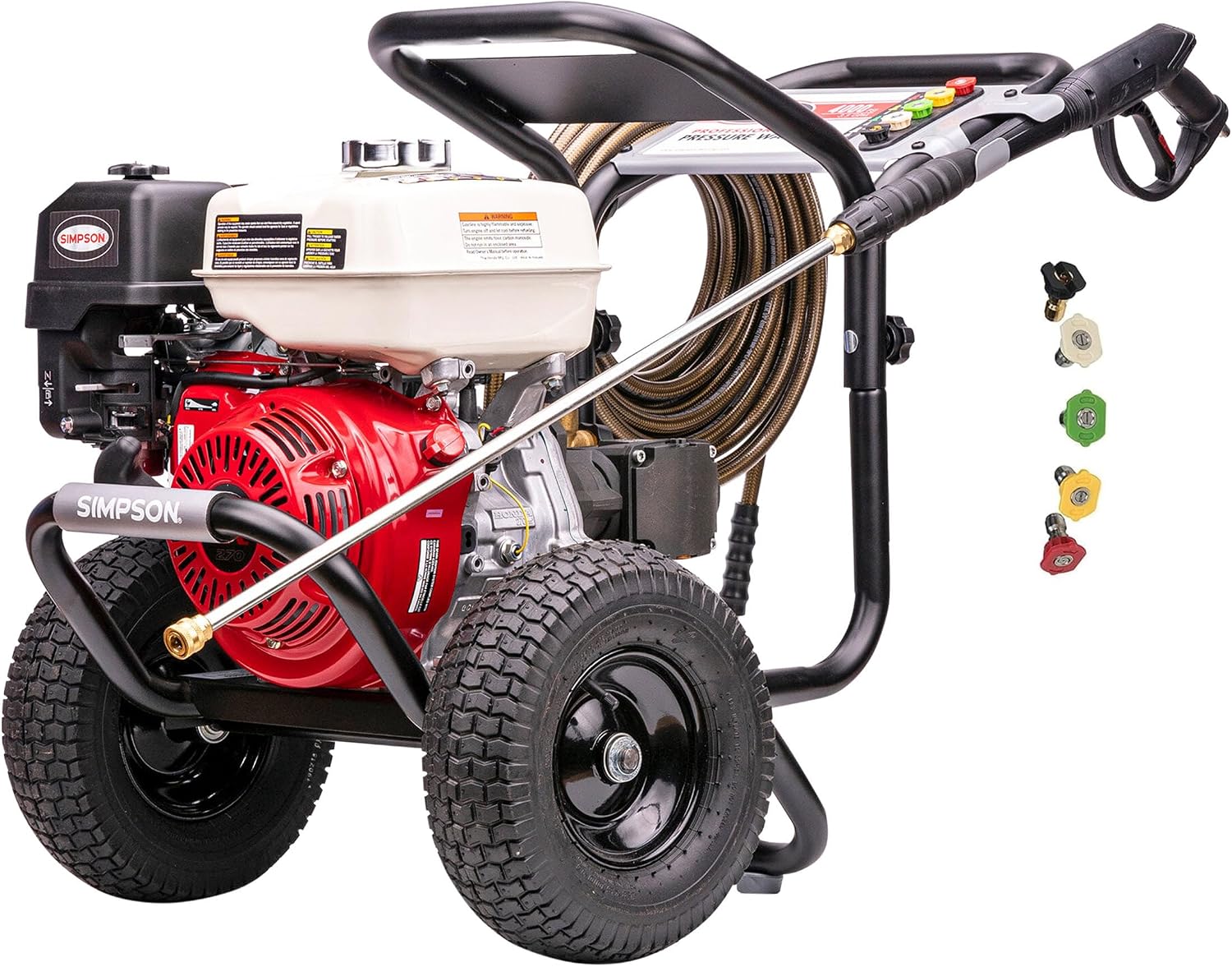
The heavy-duty pick: Simpson Cleaning PS60869 PowerShot 4000 PSI Gas Pressure Washer, 3.5 GPM AAA Triplex Pump, Honda GX270 Engine, Includes Spray Gun, Wand, 5 QC Nozzle Tips, 3/8-inch x 50-Foot Monster Hose, 49-State
 Visit on Amazon →
The number that matters here is the 3.5 GPM, not the 4,000 PSI. Three and a half gallons a minute is real working flow. That is the difference between rinsing a driveway and actually stripping it, and it is why a machine in this class can push a surface cleaner without stalling out in the middle of a pass.
The AAA triplex pump is the part I care about most, because it is the part that dies first on cheaper units. A triplex pump runs in an oil bath, holds up to long jobs, and can be rebuilt instead of replaced. Pair that with a Honda GX270, which is a commercial engine rather than a homeowner one, and you have a power plant that will start in February after sitting since October.
The included kit is worth more than people give it credit for. Five quick-connect nozzle tips mean you can go from a 15-degree tip on concrete to a 40-degree tip on siding in two seconds. The 3/8-inch by 50-foot hose is the size and length I would buy anyway, and a long, thick hose is the difference between walking the machine around the truck and dragging it behind you like a stubborn dog.
Flaws but not dealbreakers: It is heavy, it is loud, and it needs fuel and oil checks before every job. The 49-state designation also means it is not sold for use in California, so check that before you order. And frankly, it is more machine than a once-a-year patio rinse needs. Check current Amazon price.
Anyone washing boats, long concrete runs, or commercial property every week should be looking at this class first.
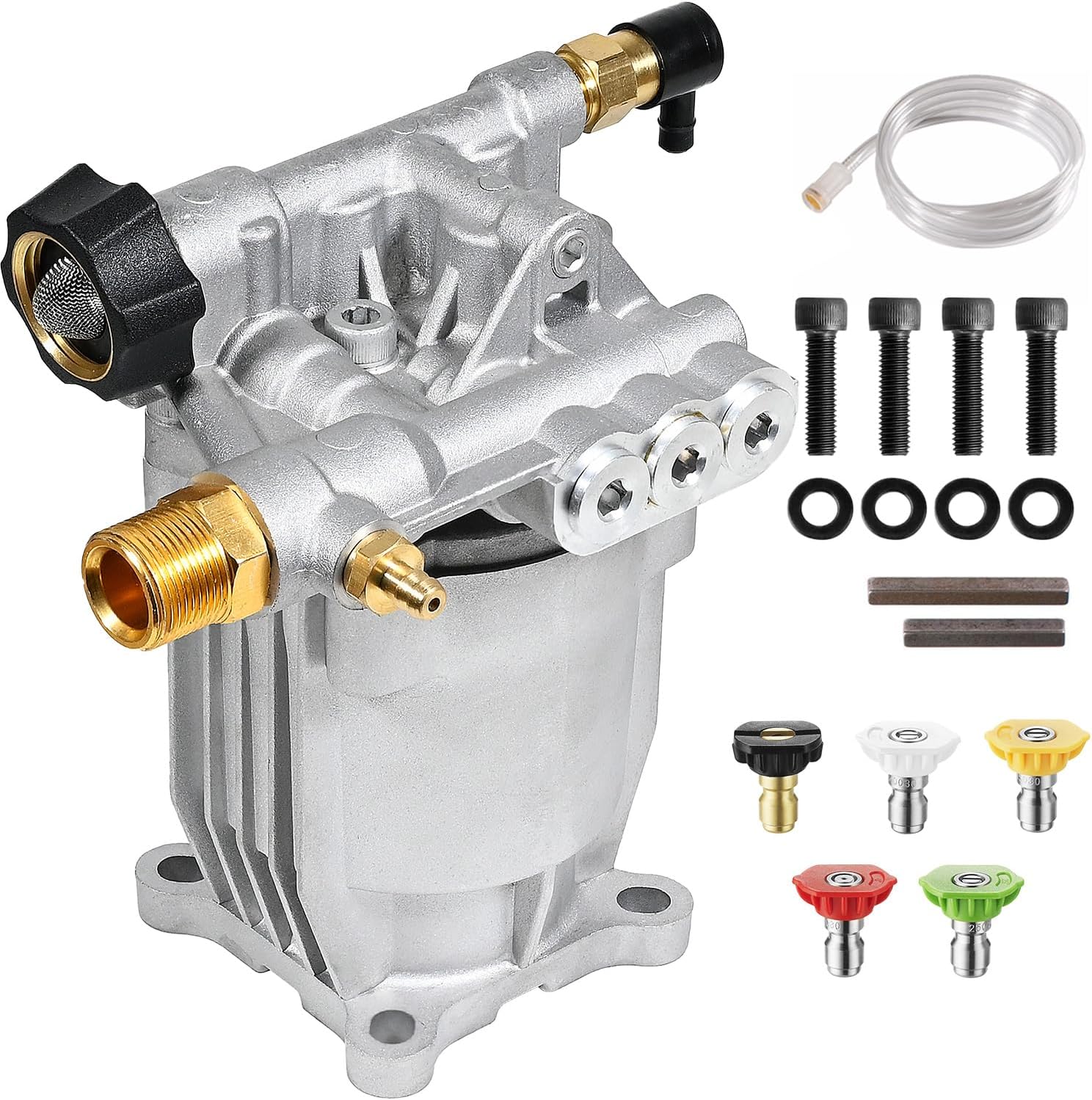
When the pump finally goes: YAMATIC Pressure Washer Pump 3/4" Shaft Horizontal Max 3200 PSI 2.5 GPM
 Visit on Amazon →
Replacement pumps are the cheapest way to keep a gas washer alive. The engine outlives two or three pumps on a machine that gets used hard, so knowing what a pump is rated for matters more than most people think.
This one is a horizontal shaft pump rated to a maximum of 3200 PSI and 2.5 GPM, with a 3/4-inch shaft. That shaft size is the common one on mid-size horizontal engines, which is exactly the class of machine this pump belongs on. It is not the pump for the 3.5 GPM machine above, and you should not try to make it one. A pump rated below your engine's output will be overworked from the first pull.
Before you order any replacement pump, measure four things: shaft diameter, shaft length, keyway, and the bolt pattern on the flange. Then compare the pump's PSI and GPM rating to the machine's rating plate. If the numbers do not line up, keep shopping. Check current Amazon price.
Anyone with a mid-size horizontal gas washer whose pump has started losing pressure, surging, or leaking from the housing should start here.
The setup workflow, in order
This is the sequence I run. It works on any gas machine, from a $200 box-store unit to a trailer rig.
Step one: Read the manual and check the oil. Pumps sometimes ship without oil in the crankcase, and engines ship dry. Fill the engine to the dipstick line, and if the pump has its own oil reservoir, fill that too. Running a pump with no oil is a five-minute death sentence.
Step two: Water on before anything else. Connect a garden hose to the inlet, turn the spigot on full, and squeeze the trigger on the gun until you get a steady stream with no sputtering. That purge pushes the air out of the pump and the hose. Air pockets cause cavitation, cavitation destroys seals, and destroyed seals are why you are reading the pump section above.
Step three: Connect the high pressure side. Attach the high pressure hose to the pump outlet and to the gun, then click your wand on. Check that every quick connect is fully seated. A hose that pops off under pressure is a genuinely dangerous event, not an annoyance.
Step four: Pick the nozzle before you pull the trigger. The tip controls the pressure at the surface, not the machine. A 0-degree tip will cut a groove in wood and etch concrete, so treat it as a stripping tool for metal and nothing else. A 15-degree tip is for concrete and brick. A 25-degree tip is the general-purpose choice for driveways and sidewalks. A 40-degree tip is for siding, fences, and cars. The soap tip is the lowest pressure of the set, and that is the point.
Step five: Set up the detergent draw. Drop the filter end into your bucket of soap and use the low pressure soap tip. Soap sprayed at full pressure shears apart and wastes chemical, which is why the soap nozzle exists. Give it dwell time, a couple of minutes on a moldy fence, then rinse with the next tip up. If the machine has an onboard tank, fill it and let the injector do the work.
Step six: Start the engine in the right order. Fuel valve on, choke out, throttle set, then pull. Once it catches, push the choke in and let it idle for thirty seconds before you squeeze the trigger. Never start the engine with the water off.
Step seven: Work like you mean it. Keep the nozzle moving. Overlap your passes by a third so you do not leave tiger stripes. Work top down on anything vertical and follow the grain on decks. Hold the tip about twelve inches off concrete and three feet off siding. Never park the spray on one spot to watch it work, because that is how you etch a permanent mark into a surface.
Step eight: Shut down in the right order. Release the trigger, turn the engine off, then turn the water off. Bleed the pressure out of the gun and the hose before you disconnect anything. If you skip the bleed, you get a face full of water and a hose whipping around the driveway.
Step nine: Flush and winterize. Run clean water through the detergent line so it does not clog, then run pump saver or antifreeze through the pump if there is any chance of a freeze. A cracked pump housing from one cold night costs more than the pump itself. Store the machine indoors if you can.
When the pump is the problem
Before you blame the pump, check the cheap stuff. A clogged inlet screen starves the pump and looks exactly like a failing pump. A nozzle tip that has wallowed out from years of concrete will drop your pressure noticeably. An air leak on the inlet side will make the machine surge. And a stuck unloader will make it cycle on and off.
If all of that checks out and the pump is leaking from the housing, making water in the oil, or losing pressure after ten minutes of work, the pump is done. On a horizontal machine, replacement is a bolt-on job: unbolt the old pump, keep the key from the shaft, match the new pump to the engine's shaft and rating, and torque it down. That is an afternoon, not a repair shop bill.
What I skip and why
Gas machines under 2.5 GPM are not worth the fuel. You will spend more time waiting on the water than cleaning.
Axial cam pumps on a box that advertises 4,000 PSI are the classic PSI marketing trick. The pressure number sells the machine, the weak flow rate and the disposable pump are what you live with.
25-foot quarter-inch hoses and plastic wands go straight in the trash. A hose that kinks every five feet is a daily annoyance you will resent, and a toy wand makes every job feel harder than it is.
Machines with no detergent draw are a hose with a trigger. If it cannot pull soap, you are fighting with one hand tied behind your back.
And if you wash a car and a patio twice a year, buy electric. Electric is fine for 90% of people. Gas is for boats, long driveways, and weekly work.
What this all costs
You are paying for three things: flow rate, pump type, and engine quality. Everything else on the spec sheet is decoration.
A triplex pump that can be rebuilt spreads the cost of the machine over a decade instead of over three seasons. A commercial engine does the same. A replacement pump is the cheapest insurance in this whole article, because it turns a dead machine into a working one for a fraction of a new unit.
Check current Amazon price on the machine and check current Amazon price on the pump, then do the math against what a new washer would run you.
The bottom line
Water on before the engine. Nozzle chosen before the trigger. Soap at low pressure. Bleed before you disconnect. Do those four things and your pump will outlast your patience for washing the fence.
A gas pressure washer setup is not complicated. It is just unforgiving about the order. Get the order right, keep a spare pump in the garage, and the machine will still be earning its keep when the next boat shows up with a hull full of algae.