Related: Pressure Washer Nozzle Color Chart: What Each Tip Actually Does
I have spent twelve years washing cars, driveways, decks, and boat hulls for money, and the same conversation happens every spring. Someone buys a machine, gets it home, and calls me because the driveway still looks gray. Nine times out of ten the pump is fine. The pressure washer hose and nozzle setup is the problem, or the water line feeding it is. Flow rate is what cleans, pressure is just how it feels, and a kinked 5/8 inch garden hose will strangle a 1.76 GPM machine down to something that barely wets concrete.
So this guide is about the parts around the machine: the hose that carries the water, the nozzle that shapes it, and the small fuel-side parts that decide whether a gas rig starts on the first pull in March. I am not going to sell you a pressure washer you do not need. I am going to show you how to stop fighting your water line.
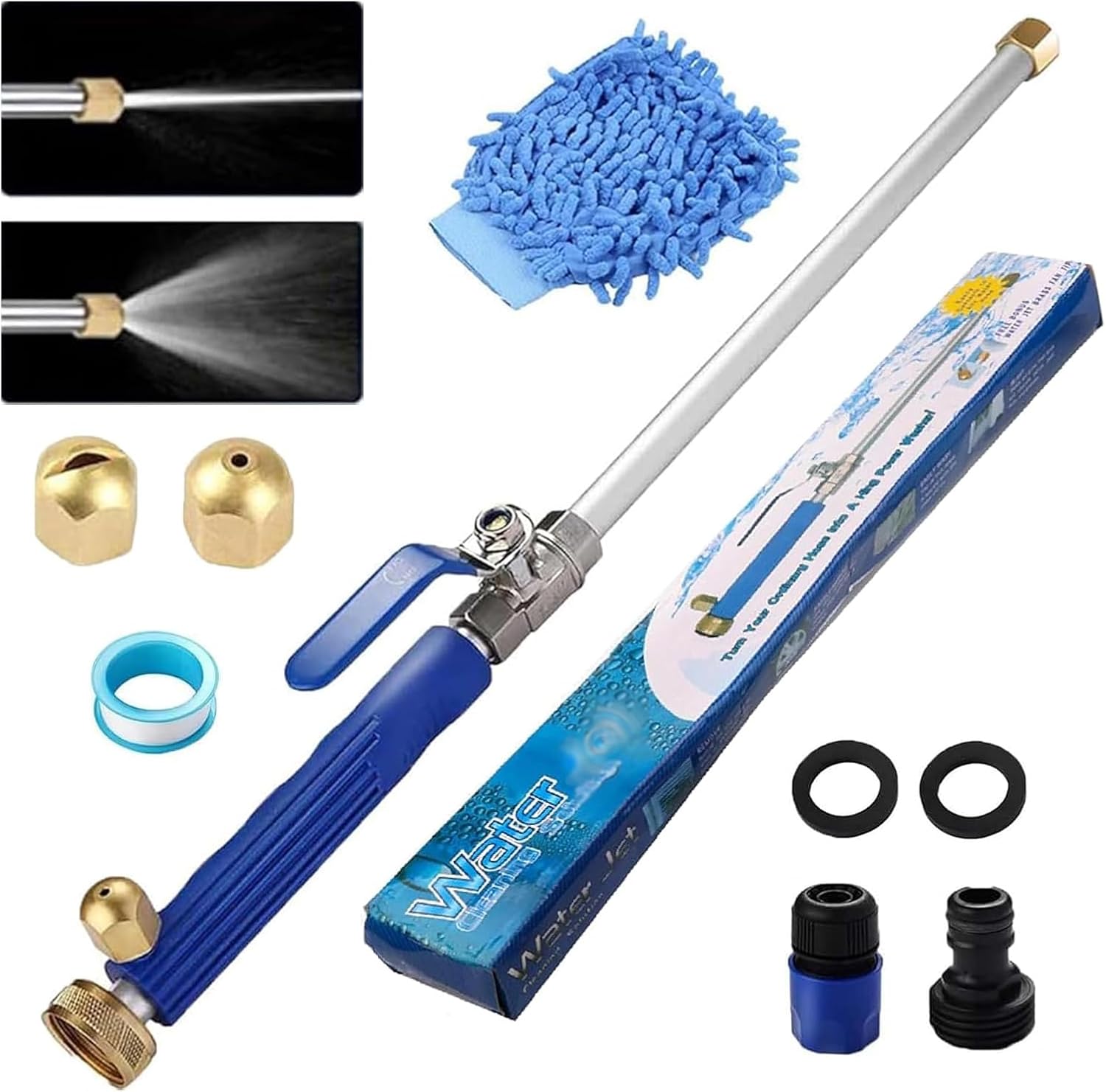
Jet Flux Hose Pressure Washer: best overall for hose-fed cleaning
Not everybody needs a machine. Renters, apartment dwellers, and anyone with a single car and a small patio can get most of the way there with a hose-fed jet washer, and this is the one I would hand a first-timer. It is a 2-in-1 unit with two different jet nozzles and hose quick connectors, built for car washing and patio cleanup. You supply the pressure from the house spigot, and the nozzle shapes it into something far more useful than a garden sprayer.
The quick connectors matter more than they sound. Threading a hose onto a nozzle every time you pull it out is the kind of small friction that makes people stop using a tool. Click on, click off, done. The two jets give you a narrow stream for wheel wells, rocker panels, and the seam where a deck board meets the rim joist, plus a wider pattern for rinsing a patio or knocking pollen off siding.
What it will not do is strip paint or cut a clean line through a driveway. That is not a flaw. It is the honest limit of spigot pressure. For a car, a set of patio chairs, and the mud off a mountain bike, it is plenty. Check current Amazon price.
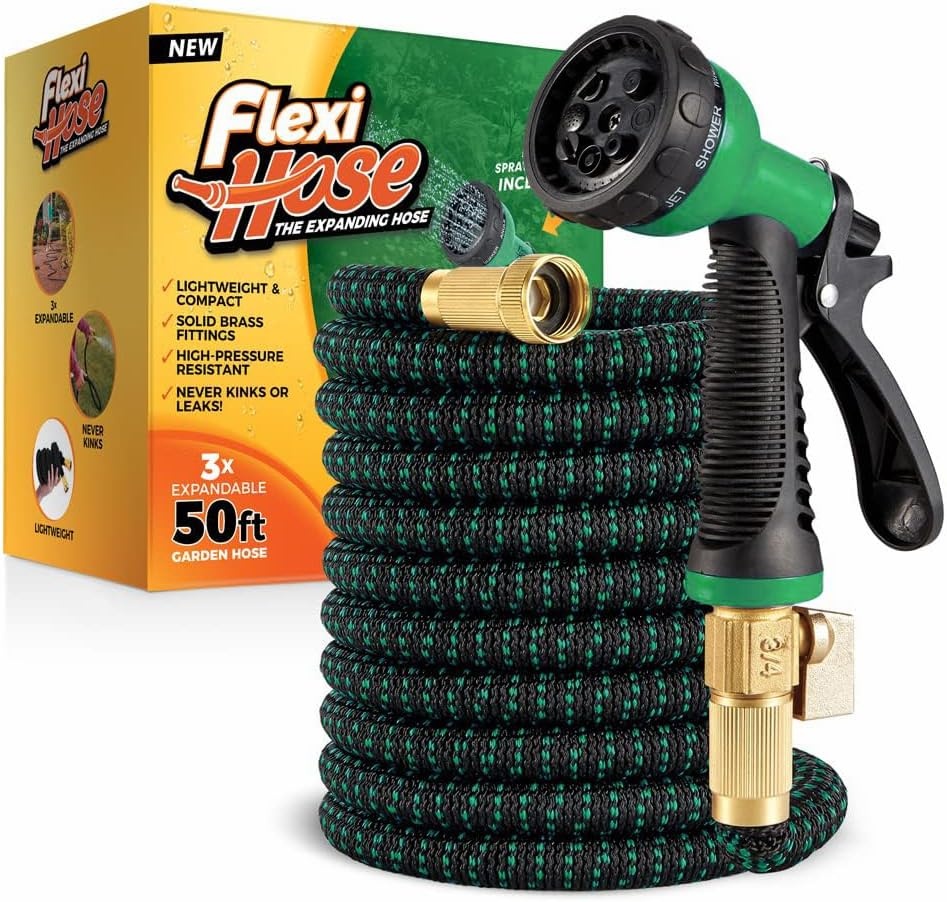
Flexi Hose with 8 Function Nozzle, 50FT: best value hose upgrade
The hose is where most home setups lose the fight. A stiff vinyl hose kinks at the same two spots every time you pull it around a wheel, and every kink costs you flow. The Flexi Hose is the fix I recommend most often: 50 feet, lightweight and expandable, with 3/4 inch solid brass fittings and a double latex core. The brass is the part that lasts. Cheap plastic couplings crack at the threads after a season of being dragged across concrete, and then you are standing in a puddle wondering why your pressure dropped.
The 8 function nozzle is the second half of the value. One hose, and you get a soft shower for rinsing soap off a car, a jet for blasting mud out of a wheel arch, a cone for watering, and a fan for patio furniture. Empty, it shrinks down small enough to hang on a hook, which sounds like a gimmick until you have spent a winter tripping over a coiled hose in the garage. Black and green, if you care about that sort of thing. I do not. Check current Amazon price.
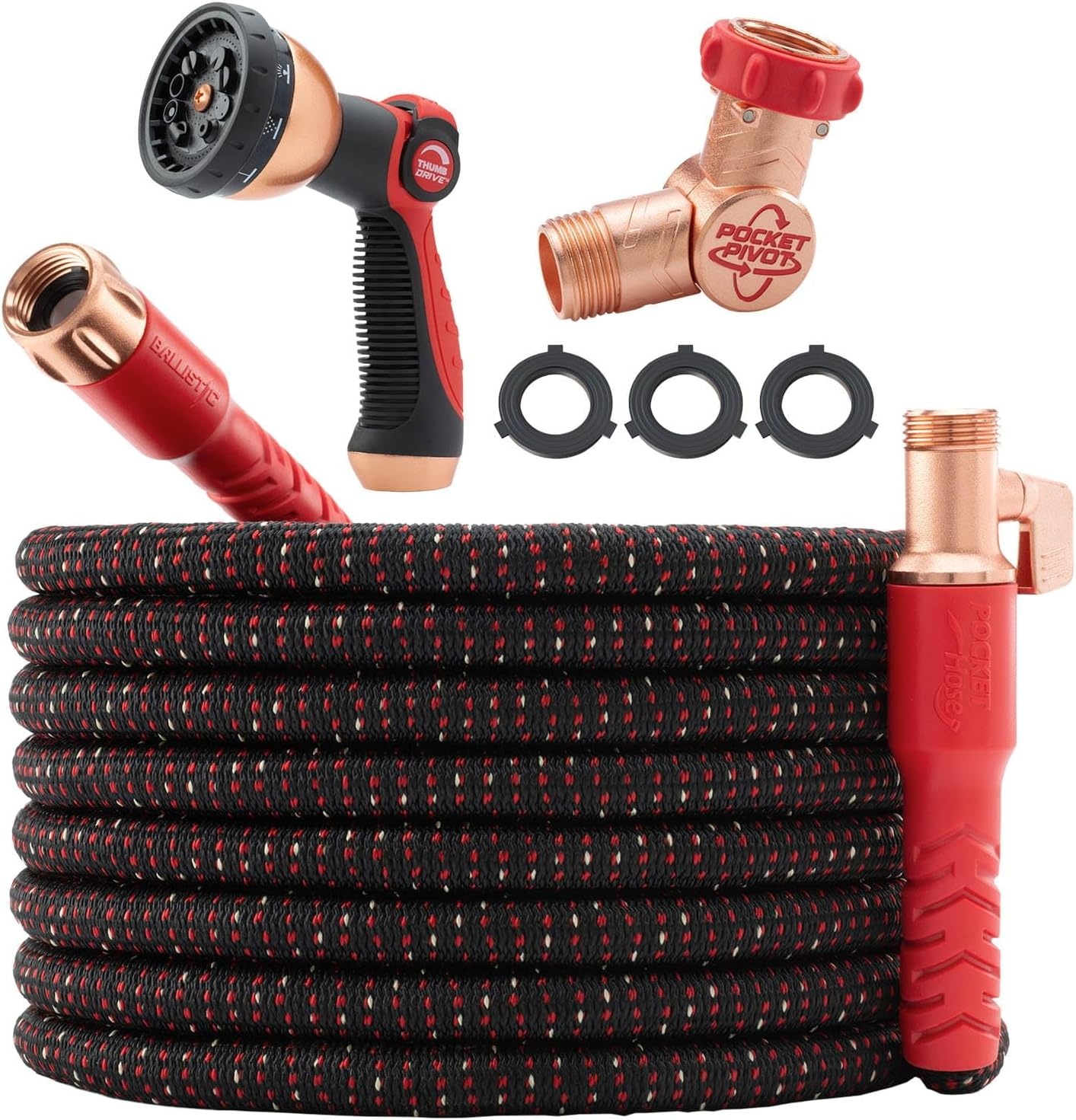
Pocket Hose Ballistic 100 FT: best for long runs
If your spigot is on the wrong side of the house, 50 feet will not get you there, and daisy-chaining two hoses means two more fittings that can leak. The Pocket Hose Ballistic 100 FT is the answer for long runs: expandable, no-kink, and long enough to reach the far end of a driveway without a second connection. It is the one I would pick for a property where the water source and the work are nowhere near each other.
The trade-off is that a 100 foot expandable hose is a bigger commitment. It takes longer to fill and longer to drain, and it is heavier in hand when full than a 50 footer. That is physics, not a defect. If you genuinely need the reach, the length is worth the hassle. If you do not, buy the shorter hose and save yourself the wrestling match.
One habit worth building: drain it before you coil it. Expandable hoses last a lot longer when they are not stored wet. Check current Amazon price.
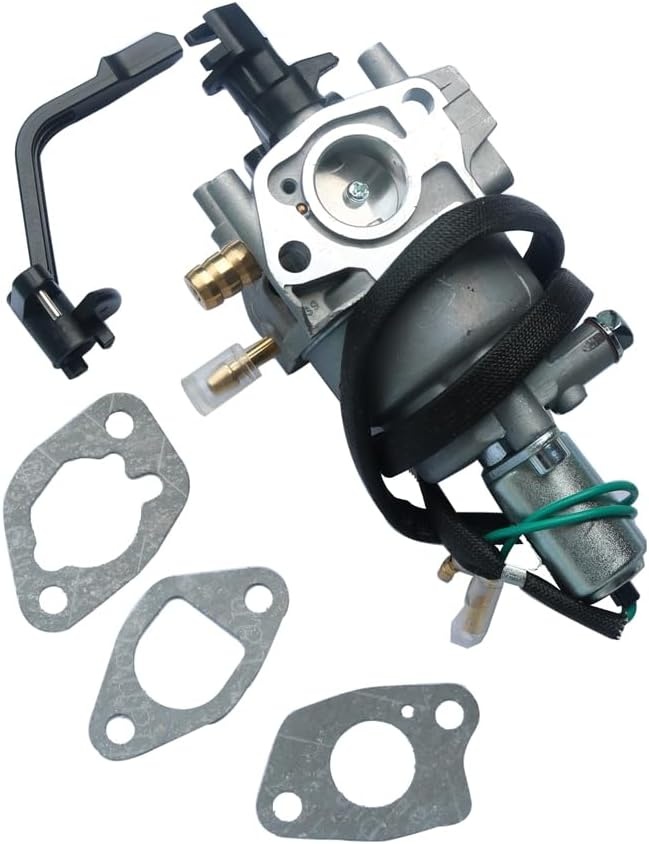
Carburetor for WEN DF475 series: the support part nobody plans for
Here is the part most guides skip. If you run gas equipment, the fuel side fails before the mechanical side does, and it fails in spring, on the first warm Saturday, when you have a job booked. Ethanol fuel sits in the bowl all winter, gums up the jets, and the engine either will not start or only runs on choke. That is the carburetor, and it is one of the cheapest parts on the whole rig to replace.
This carburetor is built for the WEN DF475T, DF475X, and DF475 4750 watt dual fuel generators, the ones that run on LPG, gas, or propane. If you keep a dual fuel generator around to run a vacuum, an extractor, or lights on a mobile job, a spare carburetor on the shelf is the difference between a fifteen minute fix and a lost afternoon. It is a small, boring part that earns its place. Check current Amazon price.
Keep the fuel side clean and the machine side keeps working. That has been true of every gas engine I have owned, including the loud ones.
How to judge a hose and nozzle before you buy
Three questions, in this order.
First, what is the real flow rate of what you are feeding? A machine's GPM number assumes a supply that can keep up. A half-inch hose at the end of a long run will not. If your washer is rated at 1.5 GPM or higher, use a 5/8 inch hose at minimum, keep the run as short as the job allows, and check the inlet screen for grit before you blame the pump.
Second, how does it connect? Brass fittings with a real thread, or quick connectors that click, both work. What does not work is a plastic coupler that cross-threads on the second use. Look at the fitting material before you look at the color of the hose.
Third, what does the nozzle do? A single adjustable nozzle is a compromise. Two dedicated jets, one narrow and one wide, out-perform it every time, because the shape of the spray is doing the work. For a machine, a set of color-coded tips plus a surface cleaner attachment is the upgrade that changes results. For a hose-fed washer, two fixed jets are the equivalent.
I also check the nozzle body in hand. If it feels like a toy, it will behave like a toy. Weight in the wrong place makes your wrist tired by the third wheel, and a trigger that sticks is a soaked shoe waiting to happen.
Analysis: what the numbers actually mean
Pressure is the number on the box. Flow is the number that cleans. A machine rated at 2,030 PSI and 1.76 GPM moves more water in a minute than one rated at 3,000 PSI and 1.2 GPM, and moving water is what lifts dirt off concrete. When you see a big PSI number attached to a small GPM, you are looking at marketing, not cleaning power.
Hoses follow the same logic. Diameter and length both cost you pressure at the nozzle. A 100 foot hose delivers less pressure at the far end than a 50 foot hose of the same diameter, which is why long runs sometimes need a larger diameter to compensate. Expandable hoses add a second variable: the inner core expands under pressure and contracts when the water is off. That is what makes them light and easy to store, and it is also why the fittings and the core material decide whether the hose lasts two seasons or ten. A double latex core with solid brass ends is the spec to look for.
Nozzles are pure geometry. The same water, shaped into a pencil jet or a wide fan, behaves like two different tools. Narrow streams concentrate force and can etch wood or strip paint if you hold them still. Wide fans spread the same water thin and are safe on siding. Most deck damage I see was not caused by too much pressure. It was caused by the wrong pattern in the wrong spot, held too long.
Then there is detergent. If a washer or a nozzle cannot draw soap, you are doing half the job with water alone. For car work, a soap stage breaks down road film so the rinse actually removes it. For a patio, a detergent step lifts the organic film that pressure alone just pushes around.
The pressure washer hose and nozzle reference table
This is the table I keep in my notes when someone asks what to pair with what. Match the tool to the job, not to the biggest number on the box.
| Product | Best for | Key spec | Notes |
|---|---|---|---|
 Visit on Amazon → Jet Flux Hose Pressure Washer |
Cars, patio, siding rinse | Two jet nozzles, hose quick connectors | Needs a spigot and decent house pressure |
 Visit on Amazon → Flexi Hose with 8 Function Nozzle, 50FT |
Small yards, car washing | 50 ft, 3/4 inch brass fittings, double latex core | Shrinks for storage, 8 spray patterns |
 Visit on Amazon → Pocket Hose Ballistic 100 FT |
Long driveways, far spigots | 100 ft expandable | Drain before storing |
 Visit on Amazon → Carburetor for WEN DF475 series |
Generator fuel side | Fits DF475T, DF475X, DF475, 4750 watt dual fuel | LPG, gas, and propane units |
The pattern in that table is simple. Hose first, nozzle second, machine third. Almost every disappointing pressure washing result I get called about is a supply problem wearing a machine problem's clothes.
Should you buy the Jet Flux Hose Pressure Washer?
Yes, if you want car and patio cleaning without owning a machine. Two jet nozzles and quick connectors do the work, it stores in a bucket, and it is the least intimidating way to start. No, if you expect driveway results. Spigot pressure has limits, and no nozzle changes that. Decide based on the jobs you actually do, then Visit on Amazon →.
Should you buy the Flexi Hose 50FT?
Yes, for most homes. Fifty feet covers a car, a patio, and a small yard, the brass fittings survive being dragged, and the 8 function nozzle replaces two or three cheap plastic sprayers. It is the upgrade that makes every other tool in your garage more pleasant to use. If your run is longer than 50 feet, step up to the 100 foot hose instead. Visit on Amazon →.
Should you buy the Pocket Hose Ballistic 100 FT?
Yes, if reach is the problem. It is the difference between one hose and a leaking chain of two. If reach is not the problem, it is more hose than you want to manage, and the 50 footer is the smarter buy. Visit on Amazon →.
Should you buy the WEN DF475 carburetor?
Yes, as a spare. It is a cheap part that turns a dead generator on a job day into a fifteen minute repair, and if you run a dual fuel unit on propane, the gas side is the side that sits and gums up. Buy it before you need it, not after. Visit on Amazon →.
Get the water to the work at full flow, shape it with the right nozzle, and keep the fuel side clean. That is the whole game. The machine is the easy part.