Related: Cordless vs corded pressure washers: which one actually finishes the job
I have been washing other people's property for a living for twelve years, and I still check two numbers before anything else: GPM first, PSI second. The pressure washer GPM and PSI conversation is where most buying decisions go wrong, because the box shouts the second number and says nothing at all about the first. Flow rate is what carries dirt off concrete. Pressure is what makes the wand jump in your hand.
That is the whole argument, and it explains why the four machines below are not ranked by their PSI claims. One of them publishes a flow rate. The other three lead with pressure and leave the flow question open, which is exactly the thing you should be asking about before you hand over a card. Two are corded, two are cordless, and between them they cover a driveway, a boat, a fleet of daily drivers, and a patio.
I am not going to pretend a spec sheet is a test. What I can do is tell you what each number means, which ones are marketing, and which machine belongs in which driveway. That is how you avoid buying 5,000 PSI of disappointment.
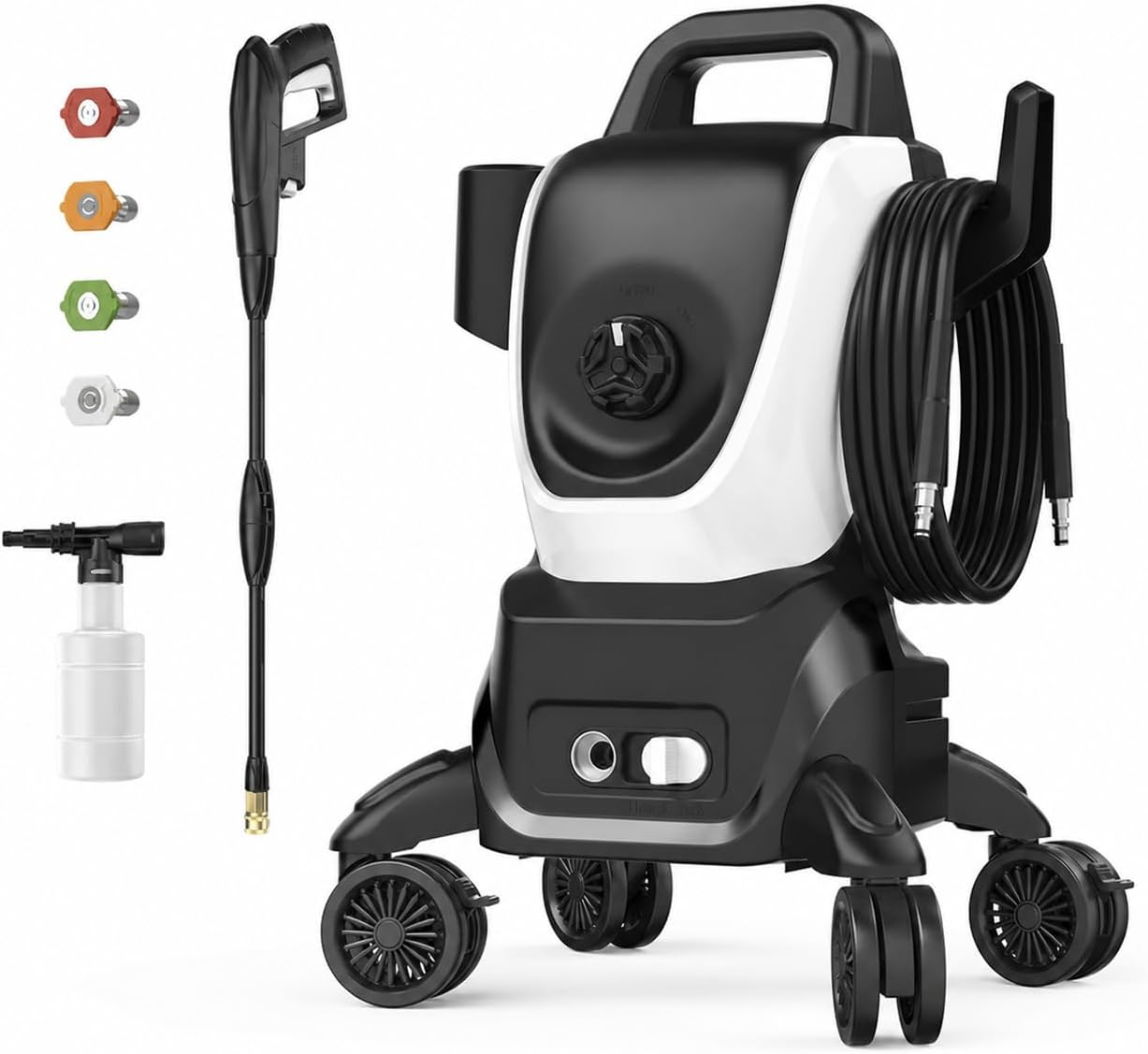
Best Overall: Pressure Washer, 3800 Max PSI, 2.4 GPM, 4-Wheel Mobility, Foam Cannon
This is the one I would put in my own garage out of this group, and the reason is a single figure: 2.4 GPM. Every other unit in this article leads with PSI and leaves the flow rate out of the name entirely. That is not a coincidence. Flow rate decides whether a driveway takes twenty minutes or an hour, and it is the number that gets left off when it is not flattering.
3800 max PSI is plenty for concrete, and notice the word "max." Peak pressure is the burst a pump can hit; working pressure is lower, and no box in the store explains the difference. What matters here is that 2.4 GPM and a max number like that describe a machine with real volume behind it, which is what rinses a slab clean instead of pushing a wet stripe around the driveway.
The foam cannon is the part most people underrate. A washer that can draw detergent properly changes the entire job. You foam a car, let it dwell, rinse it, and skip half the hand contact. On siding and fences, soap is the difference between washing and blasting, and a machine that cannot pull soap is fighting with one hand tied behind its back.
The four wheels matter more than they sound. On flat concrete you push the unit with one hand and the wand with the other, which is how a big job stays comfortable. On steps, gravel, and grass the wheels are useless, so plan on carrying it to those spots.
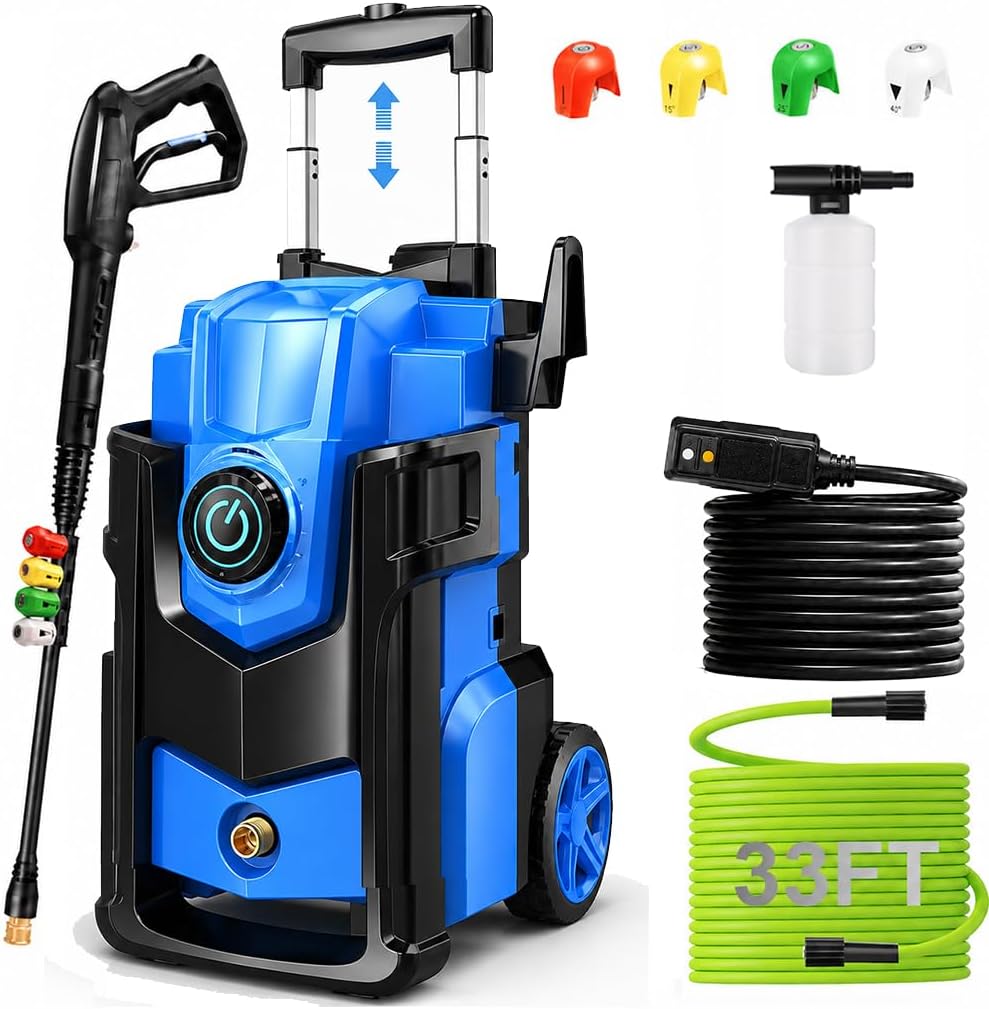
Heavy Duty Electric 5000PSI Pressure Washer, Power Washer Electric Powered
Corded electric, and corded is the underrated choice. No battery to charge and no runtime clock ticking in the back of your head. Plug in, hook up the hose, and work until the job is done. For anyone washing a driveway, a fence line, and a set of patio cushions in one Saturday, that matters more than the spec sheet suggests.
The 5000 PSI claim is the loudest number in this article. Treat it as a ceiling rather than a working figure, and ask the question the listing does not answer out loud: what is the GPM? High pressure with weak flow cleans in stripes, and you spend the afternoon chasing your own rinse water across the slab.
What I would want to know before buying: does the detergent draw actually pull soap, is the hose one that kinks every five feet, and does the wand feel like a tool or a toy? Those three things decide whether you like this machine in month two, long after the PSI number stopped mattering. Check the nozzle connection too, because a quick-connect fitting is what lets you add a surface cleaner later. A spinning surface cleaner is the single best upgrade in this whole hobby, and it needs a machine it can bolt onto.
Buy it if you have a nearby outdoor outlet and a job list longer than one car.
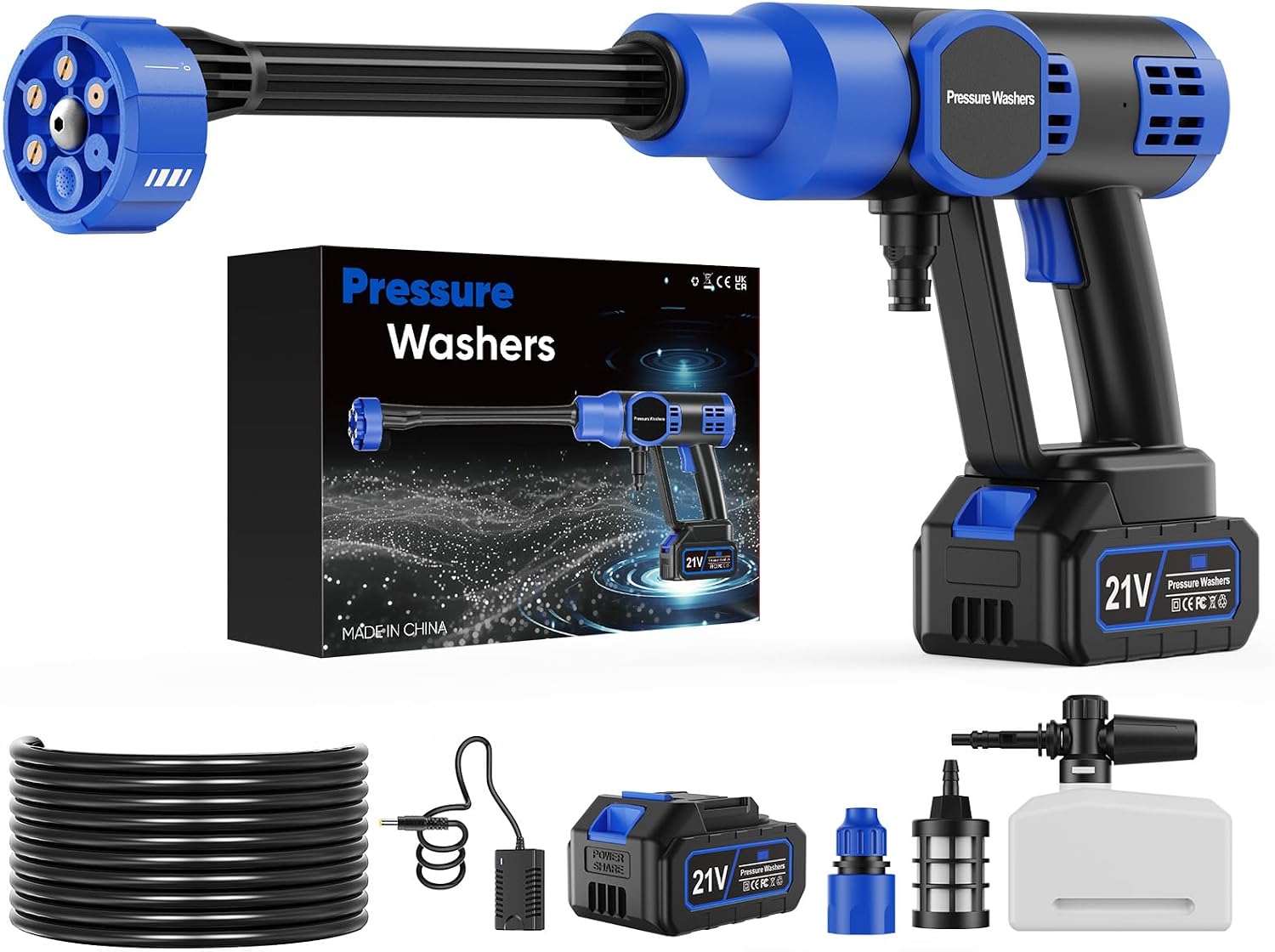
5000 PSI Cordless Pressure Washer with 4.0Ah Battery
This is the machine for people whose problem is location, not power. A 4.0Ah battery and no cord means it goes where the outlet is not: the marina, the back fence, the curb, the job site, the far corner of a lot with no exterior plug. If you wash boats, you already know why that matters. Nothing kills a wash day like dragging a hundred feet of extension cord through wet grass.
The tradeoff is runtime. Battery capacity is a clock, and every minute spent on a wide open nozzle pattern is a minute off the end of it. Work in bursts, use the narrowest pattern the surface allows, and think about a second battery if you plan to finish a hull in one sitting.
The other thing to check on any battery machine with a big PSI claim is flow. Pressure is easy to advertise on a cordless unit and hard to feel; volume is what actually rinses soap off gelcoat and lifts road film off a bumper. Portability has a second payoff, too. It is quiet, it needs no gas, and it stores on a shelf, which means it is the machine that actually gets used because it is already loaded in the truck.
Cordless Pressure Washer, 1200 PSI Portable Power Washer with 6-in-1 Nozzle
The cheap one, and the honest one. 1200 PSI is a believable figure for a small portable machine, and it tells you exactly what it is for: cars, wheels, patio furniture, bikes, trash cans, window screens, condenser coils, and the little concrete pad by the back door.
The 6-in-1 nozzle is the smartest feature on this unit. One wand, six patterns, nothing to lose in the grass. Half the frustration with budget washers is a missing tip or a clogged nozzle, and a single adjustable head removes that entire category of annoyance.
What it will not do is strip a driveway, lift old paint, or blast mold out of a deck. That is not a flaw, it is a boundary, and knowing it up front keeps you from being disappointed. This is a car-and-patio machine, and for that it does the work at the lowest cost in this group. As a second machine for the truck, or a first machine for someone in an apartment with a parking spot, it earns its place.
How I judge a pressure washer
Four things, every time, in this order.
- Flow rate. If the listing will not tell me the GPM, that tells me something. It is the number that moves dirt, and the number a weak machine hides.
- Detergent draw. A washer that cannot pull soap is a hose with a trigger. If there is no foam cannon, no soap tank, and no siphon tube, you are doing the chemistry by hand.
- Hose and wand quality. A stiff hose that kinks every five feet is a daily annoyance you will resent by week three. A wand that feels like a toy will not survive a season.
- Nozzle set and duty cycle. Quick-connect tips, a color-coded set, and a machine that can run long enough to finish a driveway without a cooldown break. Cheap electrics lose here. Corded units do not have a battery clock, but they still have a motor that needs to breathe.
What the numbers actually mean
PSI is how the machine feels. GPM is what the machine does. Pressure without volume is a water pick, and volume without pressure is a garden hose. You need both, and the spec sheet only ever brags about one of them.
Max PSI is not working PSI. The peak number is a burst, the working number is the sustained figure, and the gap between them is where marketing lives. When you see 5000 PSI on a cordless unit running on a battery, the honest question is not whether it can hit that for a second. The question is what the flow rate is while it does.
The nozzle is the machine. A cheap washer with the right tip beats an expensive one with the wrong tip, every time. That is why the 6-in-1 nozzle on the smallest unit here is worth more than its price suggests, and why a foam cannon on the biggest one changes the kind of work it can do.
Soap is not optional. Detergent is what breaks down the organic film on siding, the road grime on a car, and the algae on a fence. Blasting dry concrete with clear water just moves the mess around.
And the hose decides whether you enjoy any of it. A kinking hose is the number one reason people leave a perfectly good washer in the garage.
Pressure washer reference table
| Machine | Power source | Best job | Notes |
|---|---|---|---|
 Visit on Amazon → Pressure Washer, 3800 Max PSI, 2.4 GPM, 4-Wheel Mobility, Foam Cannon |
Corded electric | Driveways, siding, decks, cars | Only unit here that publishes a flow rate; foam cannon included |
 Visit on Amazon → Heavy Duty Electric 5000PSI Pressure Washer |
Corded electric | Long concrete and fence jobs near an outlet | No GPM listed; ask before buying |
 Visit on Amazon → 5000 PSI Cordless Pressure Washer with 4.0Ah Battery |
Cordless, 4.0Ah battery | Boats, fences, and anywhere with no outlet | Runtime is the tradeoff; check flow rate |
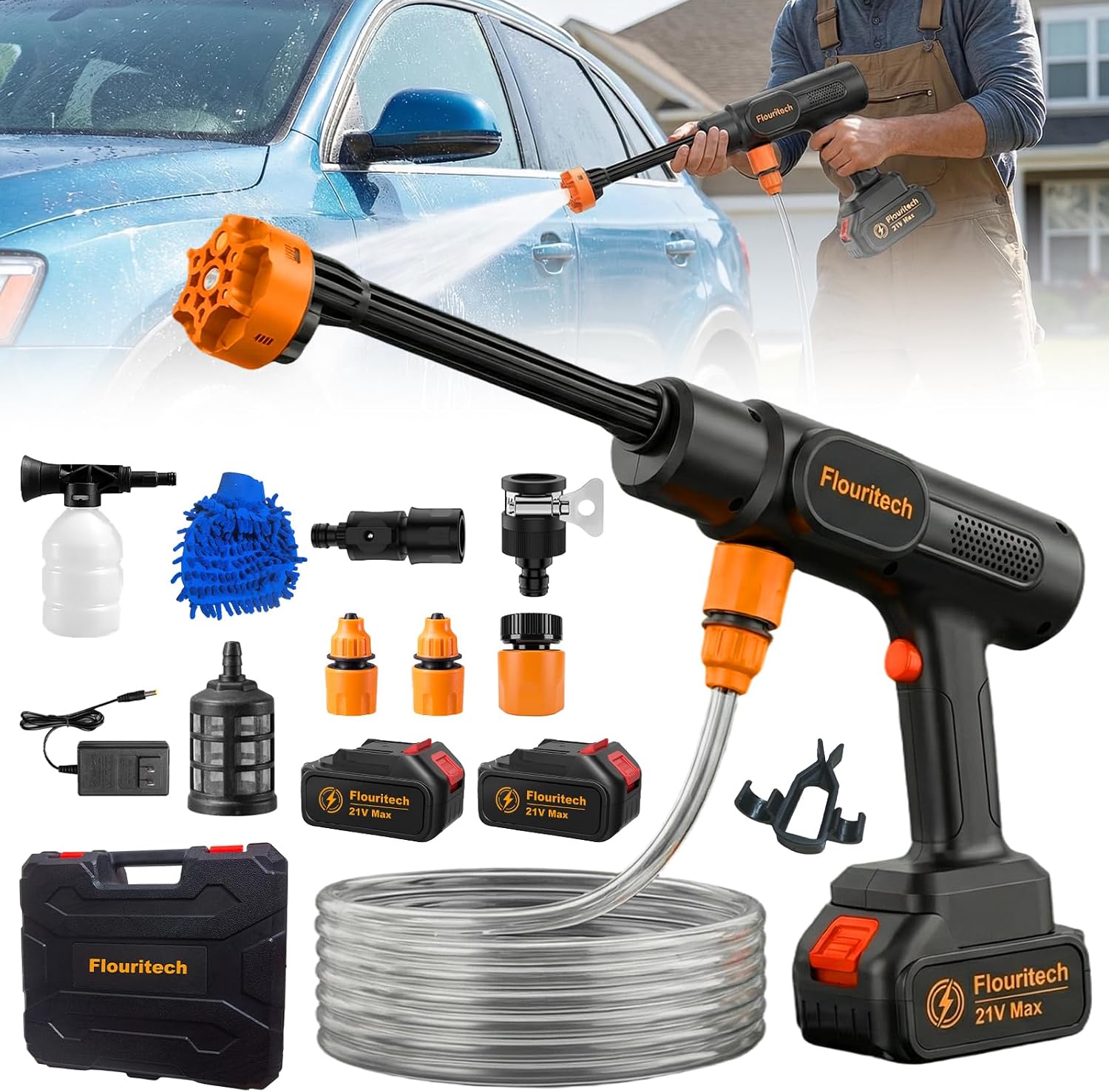 Visit on Amazon → Cordless Pressure Washer, 1200 PSI Portable Power Washer with 6-in-1 Nozzle |
Cordless, portable | Cars, patio furniture, bikes, screens | 6-in-1 nozzle; light duty by design |
Two of these machines answer the flow question in the product name. Two do not. That single difference should carry more weight in your decision than any pressure figure on the page.
Should you buy the 3800 Max PSI pressure washer?
Yes, for most homes. It is the only machine in this group that publishes its flow rate, and 2.4 GPM is a real number rather than a wish. The foam cannon covers the soap side of the job, the four wheels save your back on flat concrete, and 3800 max PSI is enough for a driveway, a fence, and a car without wandering into paint-stripping territory.
If you own a house with concrete, siding, and a vehicle, this is where the money goes. It is the one I would buy first.
Should you buy the Heavy Duty Electric 5000PSI?
If you have an outdoor outlet and a long job list, the corded setup is genuinely appealing, because there is no battery clock to beat. Just go in with your eyes open about the numbers. The pressure claim is the highest here and the flow rate is not published, so ask the GPM question before you commit.
For a driveway that gets washed twice a year, this is more machine than the job requires. For a homeowner with a fence line, a patio, and a truck, it has the muscle.
Should you buy the 5000 PSI cordless?
Buy it if the outlet is the problem. A 4.0Ah battery and a cordless body let you wash a boat at the marina, a fence at the back of the lot, or a car at the curb where no plug exists. That freedom is worth real money to anyone doing mobile work.
Plan your runtime, work in bursts, and keep an eye on flow rate rather than the pressure headline. Cordless is a convenience purchase, and convenience is a legitimate reason to buy.
Should you buy the 1200 PSI portable?
Yes, if you are honest about the job. This is a car, patio furniture, bike, and window-screen machine, and it does that work with a 6-in-1 nozzle that will not leave you hunting for a lost tip. It will not strip a driveway and it is not built to.
As a second machine for the truck, or a first machine for a small place with a parking spot and a patio, it is the smartest cheap purchase in this article.