Most pressure washers get blamed for something they did not do. The pump is fine. The motor is fine. What actually ruined your afternoon was a stiff 25 foot hose that kinked every time you rounded the corner of the house, and a wand that flexed like a drinking straw the second you squeezed the trigger.
I run a mobile detailing business out of Tampa, and I have swapped more pressure washer hose and wand combos than I can count. Not because the machines were bad, but because the factory accessories are the cheapest parts in the box. The hose and the wand are the two pieces your hands touch all day, and they are almost always the first thing worth replacing.
The good news is that this is the cheapest real upgrade in pressure washing. You are not buying a machine. You are buying the parts the machine should have shipped with.
Why you should trust me
I have been detailing cars for 12 years and running my own mobile operation for most of that. My weeks are driveways, decks, boat hulls and the occasional moldy fence that a client swears came back overnight. I own three pressure washers: an electric unit for light work, a gas machine for the serious jobs, and a cheap one I bought to evaluate that died inside a month.
That last one taught me the lesson I repeat constantly. PSI on the box is marketing. GPM is the work. A 1.4 GPM machine with a kinked hose and a plastic wand cleans worse than a 1.2 GPM machine with a straight hose and a proper trigger. The accessories decide which one you actually get.
How I picked and how I tested
This is not a guide about which pressure washer to buy. It is about the two parts you attach to the one you already own, and I judge them the same way I judge a machine.
For a hose, I look at four things. First, the burst rating versus your machine's rated pressure, because a hose rated below your pump is a failure waiting for a hot afternoon. Second, the diameter, because a 3/8 inch hose moves more water than a 1/4 inch hose at the same pressure, and flow is what lifts dirt off concrete. Third, the fittings, because brass threads survive being connected and disconnected weekly and plastic ones do not. Fourth, how it behaves cold and stiff versus warm and soft, since a hose that only cooperates in July is useless in January.
For a wand, I check the body material, the connection at the gun, and whether the nozzle gives me a real fan pattern for rinsing and a tight stream for blasting. I also look at the seals, because a wand that drips down your forearm all afternoon is a wand you will stop using.
The practical test for both is simple: can I work a full driveway, a set of wheels and a rinse-down without stopping to untangle, re-tighten or re-seat anything. If the answer is yes, the part stays on the truck.
The two upgrades that matter most
Start with whichever one is annoying you right now. If your hose kinks and fights you, replace the hose. If your wand feels like a toy and the spray pattern is a mess, replace the wand. If both are bad, do both, because they are not expensive and they are the difference between a tool and a chore.
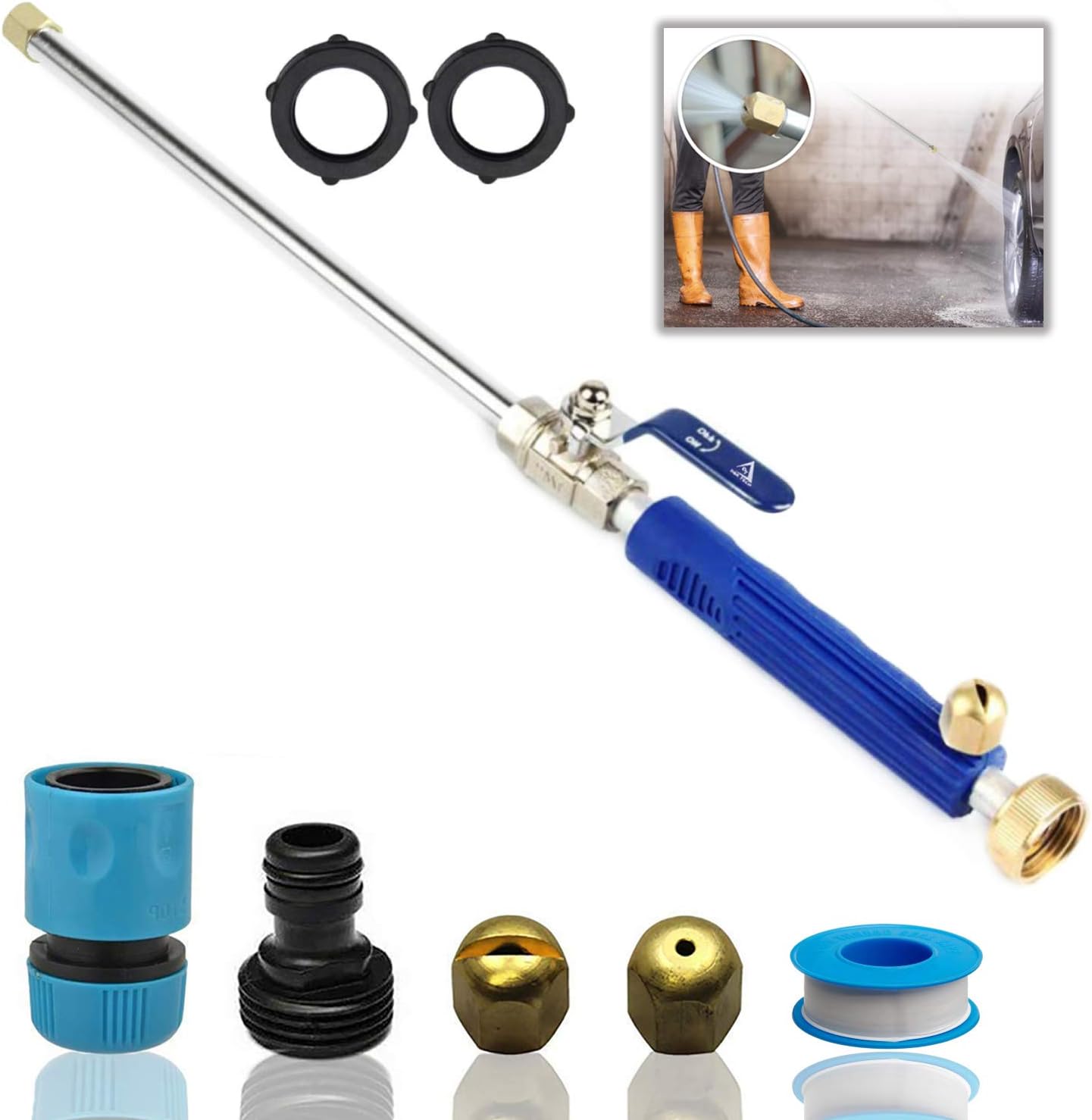
Budget pick: Hydro Jet High Pressure Power Washer Wand for Car Washing or Garden Cleaning, Heavy Duty Metal Watering Sprayer with Universal Hose End, Hydrojet Water Power Nozzle, Fan and Jet Stream
 Visit on Amazon →
This is the cheapest way to make a garden hose useful. The body is metal rather than the hollow plastic you get on most wands at this level, and the universal hose end means it connects to a standard garden hose without an adapter hunt. You get two behaviors out of the nozzle: a fan pattern for rinsing soap off a panel, a wheel or a patio chair, and a tighter jet for knocking mud out of wheel wells and crud out of gutter seams.
Be clear about what it is. It concentrates the flow you already have, it does not create pressure. If you expect it to strip paint or blast a driveway clean, you will be disappointed, and that is on the expectation, not the wand. Where it earns its place on my truck is the rinse stage and the small jobs where dragging out the gas machine is absurd, like washing down a client's patio furniture or hosing down the bay floor at the end of a detail.
Flaws but not dealbreakers: The trigger is a simple on and off, so there is no fine control of the spray. Learn to work the distance instead of the trigger and it stops mattering.
Anyone who wants more control at the end of a garden hose, or a dedicated rinse tool that does not require firing up a machine, will get real use out of this.
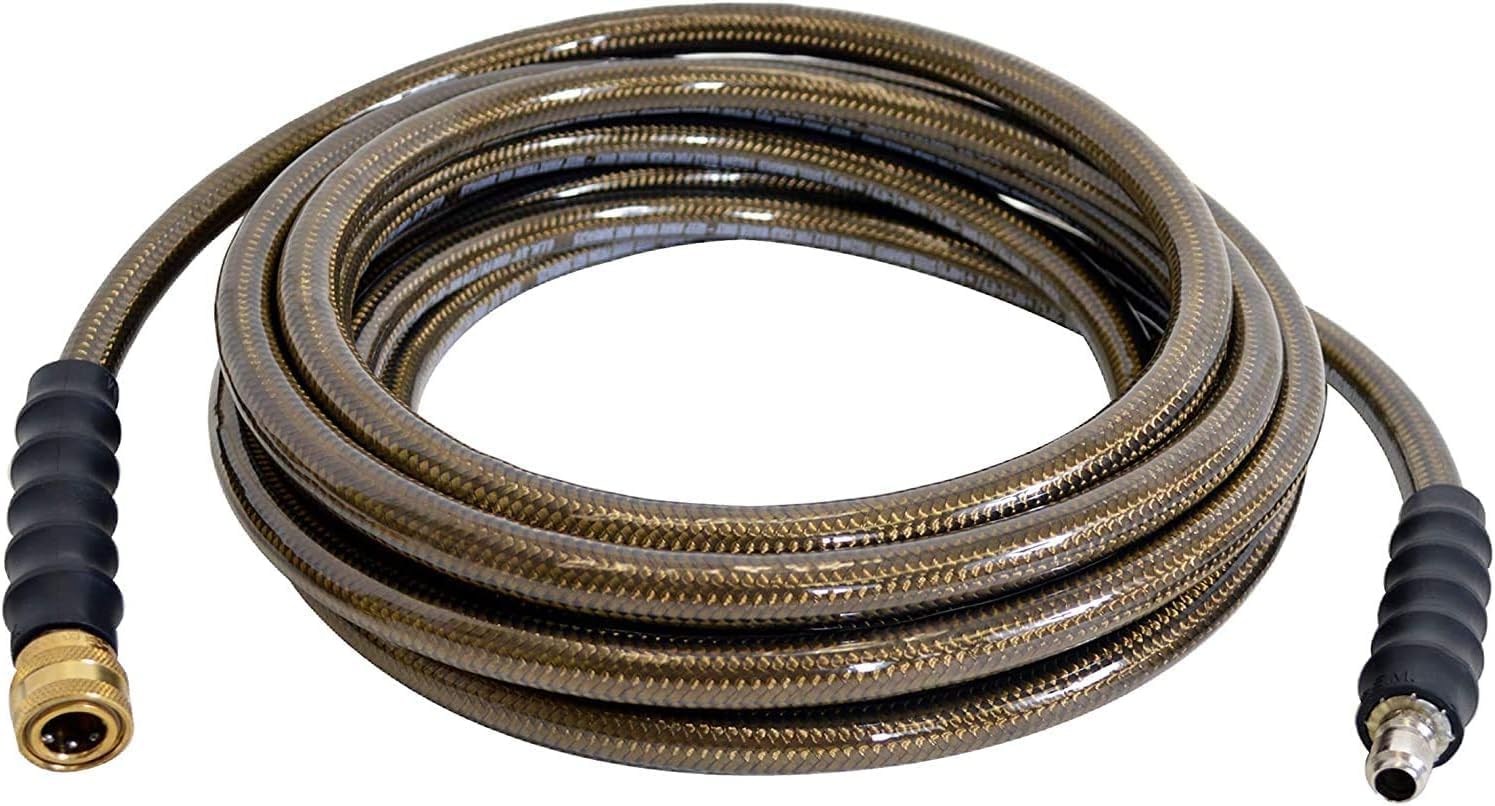
Our pick: Simpson 50ft, 3/8" 4500 PSI Monster Cold Water Pressure Washer Hose, 41028
 Visit on Amazon →
If you only change one thing, change the hose. The stock hose on most consumer machines is 25 feet of stiff rubber that kinks under its own weight and forces you to drag the machine around the driveway every ten minutes. This one is 50 feet, 3/8 inch, and rated to 4500 PSI, which means it has headroom over anything a residential pump will ever ask of it. That headroom is the point: a hose working well below its limit stays soft, stays round, and does not bulge at the crimp.
The 3/8 inch diameter matters more than the length. Bigger inside diameter means less friction loss, so the pressure at the nozzle is closer to the pressure at the pump. On a machine that is already modest on GPM, that difference shows up as a stronger, more consistent pattern instead of a spray that fades when you walk to the far end of the driveway.
Fifty feet also changes how you work. I can leave the machine parked at the garage and reach the entire front walk, the driveway and two vehicles without moving it. That sounds like a small thing until you have done it both ways.
This is a cold water hose, so it belongs on a cold water machine. Do not put it on a hot water unit and expect it to shrug it off.
Flaws but not dealbreakers: Fifty feet of hose has to go somewhere when the job is done. Coil it properly on a reel or a hook, because a heap of hose on a hot concrete slab is how you get a permanent kink.
Anyone with a gas or electric machine who is tired of moving the washer every fifteen feet should start here.
How to swap a pressure washer hose in five steps
This takes about five minutes and requires one adjustable wrench.
Step one: Shut everything down. Kill the water supply, and if it is a gas machine, shut off the engine. Never disconnect a hose while the system is pressurized.
Step two: Bleed the pressure. Squeeze the trigger on the gun and hold it until water stops spitting. You are emptying the line so nothing sprays your face when the fitting comes loose.
Step three: Disconnect both ends. The hose comes off the pump outlet and off the gun inlet. Most consumer machines use the same M22 threaded connection at both points, which is why replacement hoses fit so many brands. Turn counterclockwise, and if a fitting is stubborn, hold the mating part with a second wrench so you are not twisting the pump housing.
Step four: Inspect the o-rings. There is a small rubber o-ring seated inside the female fitting on each end. If it is flattened, cracked or missing, the connection will drip no matter how tight you make it. Replace it before you install the new hose, not after you notice the leak.
Step five: Thread the new hose on by hand. Get it started by hand so you know the threads are aligned, then snug it with a wrench about a quarter turn past hand tight. Overtightening crushes the o-ring and creates the leak you were trying to avoid. Turn the water back on, purge the air by squeezing the trigger, and check both connections while the system is running.
If your machine has a quick connect setup instead of threads, buy the matching adapters once and leave them on the pump and the gun. It makes every future hose swap a two second job.
How to get the most out of a hydro jet wand
The wand is not a pressure washer, and treating it like one is why people leave bad reviews on a tool that works fine. Use it as a rinse and detail tool.
Attach it to a standard garden hose using the universal end and tighten by hand. Turn the water on at the tap first and let it run for a second so you are not pushing debris into the nozzle. Pick your pattern before you start spraying: fan for anything with paint or a finish, jet for concrete, wheel wells and grout lines.
Keep the tip moving. Holding any water stream in one spot on clear coat, on wood, or on a painted fence will leave a mark, and the mark shows up faster than you expect. Work top down on vertical surfaces so dirty water runs over ground you have not cleaned yet.
When you are done, turn the water off, squeeze the trigger to drain the wand, and hang it rather than dropping it in a bucket. The metal body will outlast the plastic ones, but the seals still do not enjoy sitting in grit.
Where people get this wrong
The most common mistake is buying a hose rated below the machine. A 4500 PSI rating on a hose is not overkill on a 2,000 PSI washer, it is margin. Hoses fail at the crimp when they are run at or near their limit, and a burst hose at full pressure is a bad afternoon.
The second mistake is ignoring diameter. A 1/4 inch hose on a machine with decent flow is a bottleneck you paid for. If your washer has real GPM, give it a hose that can carry it.
The third is mixing hot and cold. Cold water hoses on hot water machines fail early. Check what your machine actually is before you order.
The fourth is overtightening every fitting until the o-rings are flat. Hand tight plus a quarter turn is the whole specification.
The fifth is storage. Hose left in the sun gets brittle, hose coiled in a figure eight with a twist in it develops a memory kink, and both of those turn a good hose into the one you just replaced.
What this all costs
Both of these are accessory money, not machine money, and that is the entire argument. A new pressure washer costs hundreds and does not fix the reason you were unhappy, because the reason was the hose and the wand that came in the box.
Frame it as cost per job. If you wash your car twice a month and hit the driveway and the patio a few times a season, you are looking at a few dozen uses a year out of parts that should last several seasons. Divide the wand and the hose across that, and the daily number is small enough to stop thinking about.
The hose is the bigger of the two purchases and the one that changes how a full job feels. The wand is the smaller one and the one you will reach for on the quick jobs where setting up a machine is not worth it. Buy the hose first if you own a machine. Buy the wand first if most of your outdoor cleaning is rinsing, furniture and small messes.
Then do the boring part. Store the hose coiled and out of the sun, keep spare o-rings in a drawer, and check the fittings at the start of every season.
That is the whole upgrade. Two parts, five minutes with a wrench, and a pressure washer that finally feels like the tool you thought you bought.