Most pressure washers are sold on a number that does not clean anything: PSI. What actually moves dirt is flow, and the two parts that decide whether that flow arrives at the surface in good shape are the hose and the nozzle. That is why a pressure washer hose and nozzle upgrade is the highest-return money you can spend on a machine you already own. A stiff hose that kinks every five feet and a nozzle with a hogged-out orifice can turn a decent 2,000 PSI unit into a chore. A supple hose and the right tip can make a modest electric washer embarrass a machine that cost three times as much.
I have been detailing cars, boats, and driveways around Tampa for twelve years. I run three pressure washers: a small electric for light work, a gas unit for boats and long driveways, and a cheap one I bought to see what the bottom of the market looks like. That third one died inside a month. The hose and the nozzle are where the money is, and this is how I think about both.
Why you should trust me
I make my living with a wand in my hand. Twelve years of mobile detailing means I have replaced more hoses than most people will ever own, and I have watched cheap ones fail in the same three places every time: the crimp at the gun end, the bend where the hose leaves the machine, and the coil that never lays flat again after the first cold morning.
Two things I will not do here. I will not quote a PSI number off a box as if it means something on its own, because PSI without GPM is a lie. And I will not pretend I ran a lab test on the two products below. What I can tell you is what each piece is rated for, what job it is actually built for, and where it fits into a real workflow. That is more useful than a driveway photo.
The rule I work by: show me the GPM and the nozzle. The pressure number on the box is for people who do not clean for a living.
Why the hose and nozzle matter more than the machine
A pressure washer is a pump, a hose, a wand, and a tip. The pump is the expensive part and it is usually fine. The hose and the tip are the cheap parts and they are usually the problem.
Flow is the work, pressure is the feeling. A machine moving 1.4 gallons per minute puts more water on the surface in ten seconds than a machine moving 1.1 GPM does. Water volume is what lifts and carries dirt away. Pressure is what makes the wand kick back in your hands. You want both, but if you have to choose, flow wins on every surface except concrete.
The hose is a bottleneck. A hose that is too narrow for your machine chokes the flow before it ever reaches the wand. A hose that kinks does the same thing, just intermittently, which is worse because you do not notice until you are halfway across a driveway and the pattern goes flat.
The nozzle is the machine. The tip controls the spray angle and the orifice size. A worn tip with an enlarged orifice drops the pressure at the surface, which is the exact opposite of what you paid for. A 0-degree tip on a wood deck carves stripes you cannot sand out. The right tip on a tired machine makes it look new.
What to check before you buy anything
Five minutes of measuring saves a return label.
- Your machine's outlet fitting. Most gas machines use a threaded M22 connection at the pump and the gun. Many electric machines use a push-on quick connect. Know which one you have before you order a hose.
- Your hose diameter. 3/8 inch is the standard for gas machines and higher-flow electrics. 1/4 inch is common on compact electric units. Do not put a 3/8 inch hose on a machine that was designed around 1/4 inch and expect a miracle.
- Hot or cold water. Most residential machines are cold water only. A cold water hose on a hot water machine is a failure waiting to happen.
- How much reach you actually need. Measure the longest run you make, then add ten feet. Fifty feet covers a two-car driveway and the walkway without moving the machine.
- Whether you need a machine nozzle or a garden hose tool. These are two different tools for two different jobs, and the second one is more useful than people admit.
A nozzle you will actually use on the jobs that do not need the machine
Not every job deserves a 2,000 PSI bath. Rinsing soap off a freshly waxed car, hosing pollen off a screen enclosure, and flushing a wheel well are garden hose jobs, and a garden hose with a bad sprayer makes them miserable.
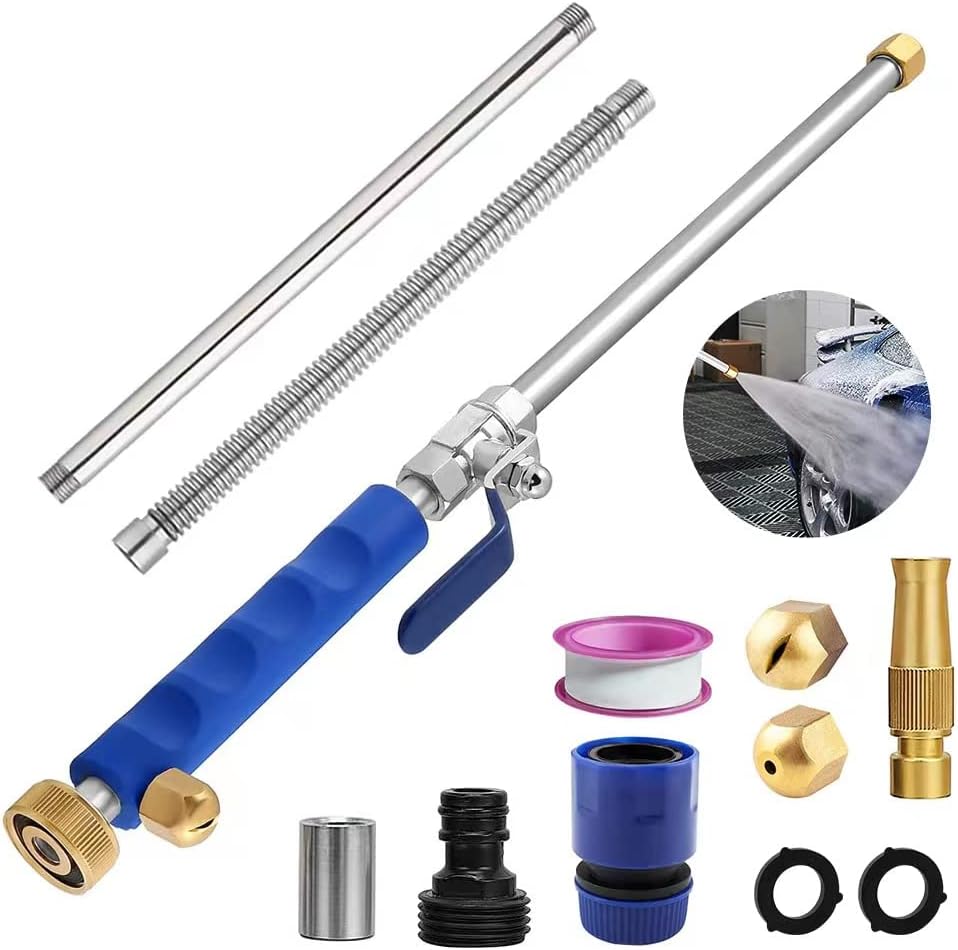
Best value: Jet Nozzle 2-in-1 High Pressure Power Washer, Watering Sprayer Cleaning Tool, Hydro Jet Nozzle Power Washer, Tool Pressure Washer Extension Wand with 3 Hose Nozzles for Garden Hose and Car Washing
 Visit on Amazon →
This is a garden hose tool, not a pressure washer tip, and that is exactly why it earns a spot in the bucket. It threads onto a standard garden hose and gives you two modes: a concentrated jet for targeted work and a wider spray for rinsing. It also comes with three hose nozzles, so you can set up more than one hose or replace a sprayer that has given up. The extension wand is the part that matters most to me. It lets you reach the top of a wheel arch, the underside of a trailer fender, or the gutter line without bending into a pretzel or dragging the machine out of the truck. Check current Amazon price before you commit, because this is the kind of item that quietly goes on sale.
In my rotation, this lives on the rinse hose. After a two-bucket wash, it knocks the suds off faster and with less water than a sprayer with a trigger that dribbles. It is also what I grab for a quick pass on a boat trailer after a saltwater launch, and for rinsing the soap out of a wash mitt before it dries stiff.
Flaws but not dealbreakers: This is a rinsing and light cleaning tool. It will not strip paint, it will not clean a concrete driveway, and it should never be connected to the outlet of a pressure washer. Street pressure through a narrow jet is stronger than you expect, so keep it off window screens, vinyl decals, and anything with a soft clear coat until you know how it behaves on your water pressure.
Anyone who washes a car at home, rinses a patio, or cleans outdoor furniture by hand will get real use out of it. If your only water source is a pressure washer, this is not the tool you want.
The hose that ends the daily annoyance
A hose is the one part of the setup you touch every single job. If it fights you, you will resent the machine, and you will use it less. That is the real cost of a bad hose.
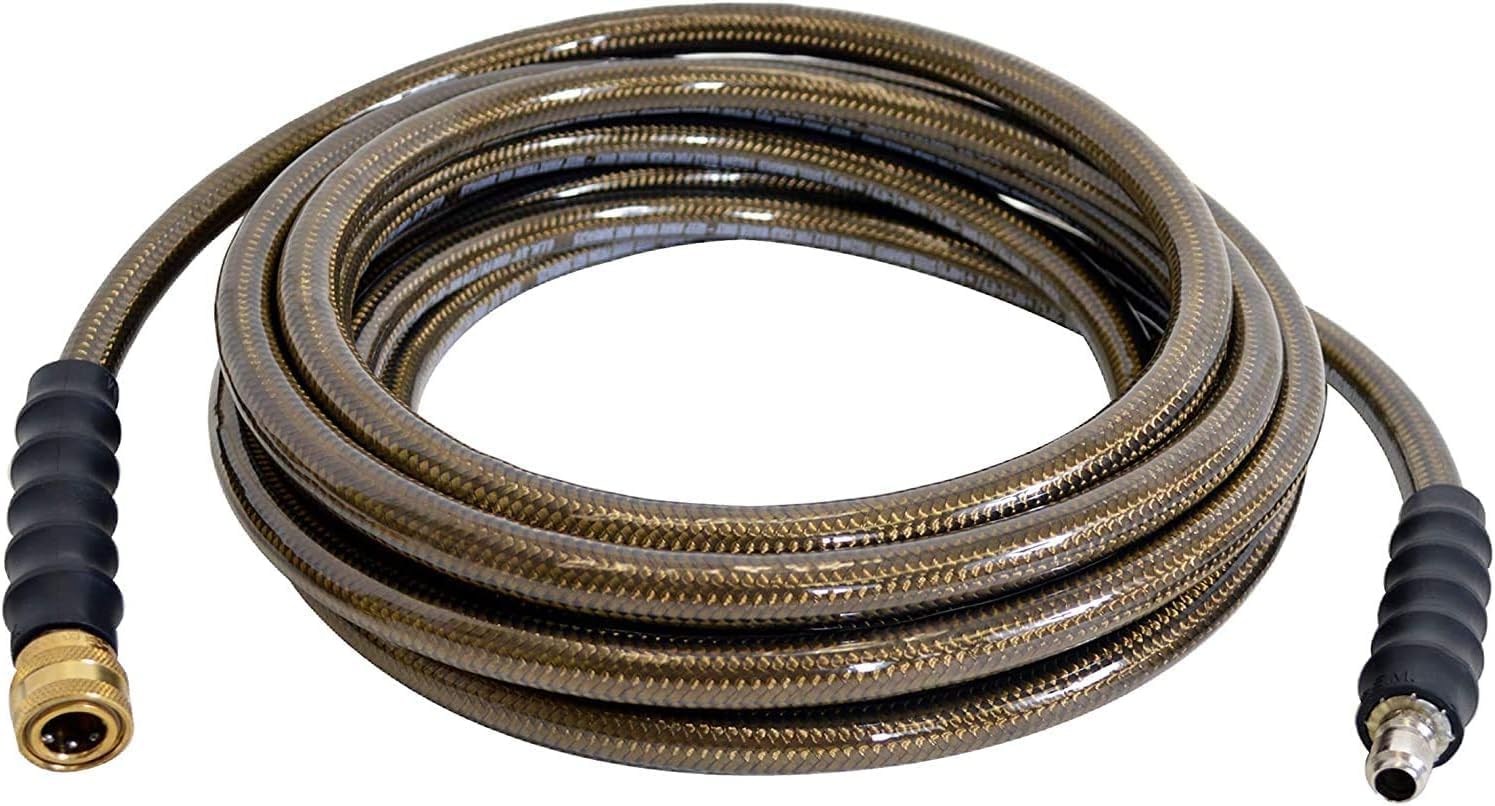
The upgrade pick: Simpson 50ft, 3/8" 4500 PSI Monster Cold Water Pressure Washer Hose, 41028
 Visit on Amazon →
Fifty feet of 3/8 inch hose rated to 4,500 PSI, cold water only. The rating is the point. A hose should never be the weak link in the system, and a 4,500 PSI rating sits far above anything a residential machine will ever ask of it, which means the failure point moves back to the pump where it belongs. The 3/8 inch inside diameter is the right size for a gas machine and for any electric unit that was built around a 3/8 inch connection. Check current Amazon price on the listing.
The 50 foot length is what changes your day. I can walk a full two-car driveway, the walkway, and the front of the garage without repositioning the machine once. That is the difference between a job that takes twenty minutes and a job that takes forty. Longer hoses do cost you a small amount of pressure and flow, and 50 feet is roughly where I stop caring, because the time saved on setup is worth more than the fraction of a PSI lost in the run.
Flaws but not dealbreakers: Cold water only, so do not pair it with a hot water machine. And before you order, confirm your connections. Most gas machines use threaded M22 fittings at the pump and gun, while many electric machines use quick connect. If your machine uses 1/4 inch hose, a 3/8 inch replacement may be more hose than the pump wants, so check the manual first. It is also heavier than the thin hose that came in the box, and that weight is a fair trade for a hose that lays flat and stays flat.
Anyone running a gas machine, or an electric machine that has chewed through two factory hoses, should be looking here first.
How to fit the new hose and nozzle, step by step
The swap itself takes ten minutes. Doing it in the right order is what keeps water out of your face and grit out of your pump.
Step one: Shut everything down. Machine off, water supply off, and then pull the trigger on the gun to release the trapped pressure in the line. If you skip that last part, you will be fighting a pressurized hose with a wrench, and the hose will win.
Step two: Disconnect the old hose at both ends. Gun end first, then the pump outlet. Expect a little water. Have a rag down.
Step three: Inspect the fittings and the o-rings. This is the step everyone skips and it is the reason new hoses leak. Look at the o-ring inside the female fitting. If it is cracked, flattened, or missing, replace it. A dab of silicone plumber's grease on the o-ring keeps it sealing and makes the next disconnect easy. Do not use petroleum jelly, which degrades rubber.
Step four: Flush the new hose before you attach a nozzle. Connect the hose to the machine, turn the water on, and run water through it into a bucket or onto the lawn with nothing on the end. New hoses and hoses that have been sitting in a garage shed grit, and grit through a pump or a tip is how you turn a good nozzle into a bad one.
Step five: Connect the gun and fit the widest tip you own. Start with a 40-degree or a 25-degree tip, never a 0-degree. Test the pattern on a scrap of concrete or an old piece of plywood before you point it at anything you care about.
Step six: Test for leaks at both ends with the trigger held. A drip at a threaded connection usually means it needs another quarter turn. A drip at a quick connect usually means a bad o-ring. Do not overtighten threaded fittings trying to stop a leak that is actually a worn seal.
Step seven: Store it right. Coil the hose in big loops, not tight ones, and hang it rather than leaving it in a heap on the concrete. Drain it before the first cold snap if you live anywhere that freezes. A hose that is drained, coiled loosely, and stored out of direct sun will outlast three that are not.
Mistakes that kill a good hose and nozzle
Reaching for the 0-degree tip on flatwork. The red tip is for stripping paint, not for cleaning a driveway, and on wood it leaves permanent grooves. Use a 25-degree tip at a consistent distance, or a surface cleaner, and let the machine work.
Running a hose at full pressure with nothing on the end for long stretches. It is hard on the pump and pointless.
Mixing garden hose tools with pressure washer outlets. The jet nozzle above is for a garden hose. A pressure washer will destroy it and possibly send pieces where you do not want them.
Ignoring the orifice. A nozzle that has been dropped on concrete, or run for a season on hard water, will not spray the pattern it did when it was new. Tips are cheap. Replace them when the pattern gets ragged.
Leaving the machine pressurized between uses. Release the trigger and disconnect. Trapped pressure ages seals.
What this all costs over a season
The nozzle tool is the smallest line item in the whole setup and it does the most work per dollar, because it covers the jobs where a pressure washer is the wrong answer. The hose is the bigger spend, and it is the one you will notice every single time you use the machine. Both together cost a fraction of a new pressure washer, and neither one will be obsolete when the machine eventually dies. Check current Amazon price on each listing rather than trusting a number you read months ago.
Do the math on your own time instead. If a longer hose saves you fifteen minutes of repositioning on a driveway job, and you wash your car twice a month, the hose pays for itself in a season. If the garden hose tool saves you from dragging the machine out for a rinse job, that is another ten minutes back every time.
The machine you already own is probably fine. Give it a hose that does not fight you and a tip that sprays a clean pattern, and it will clean better than it did the day you unboxed it. That is the whole job.