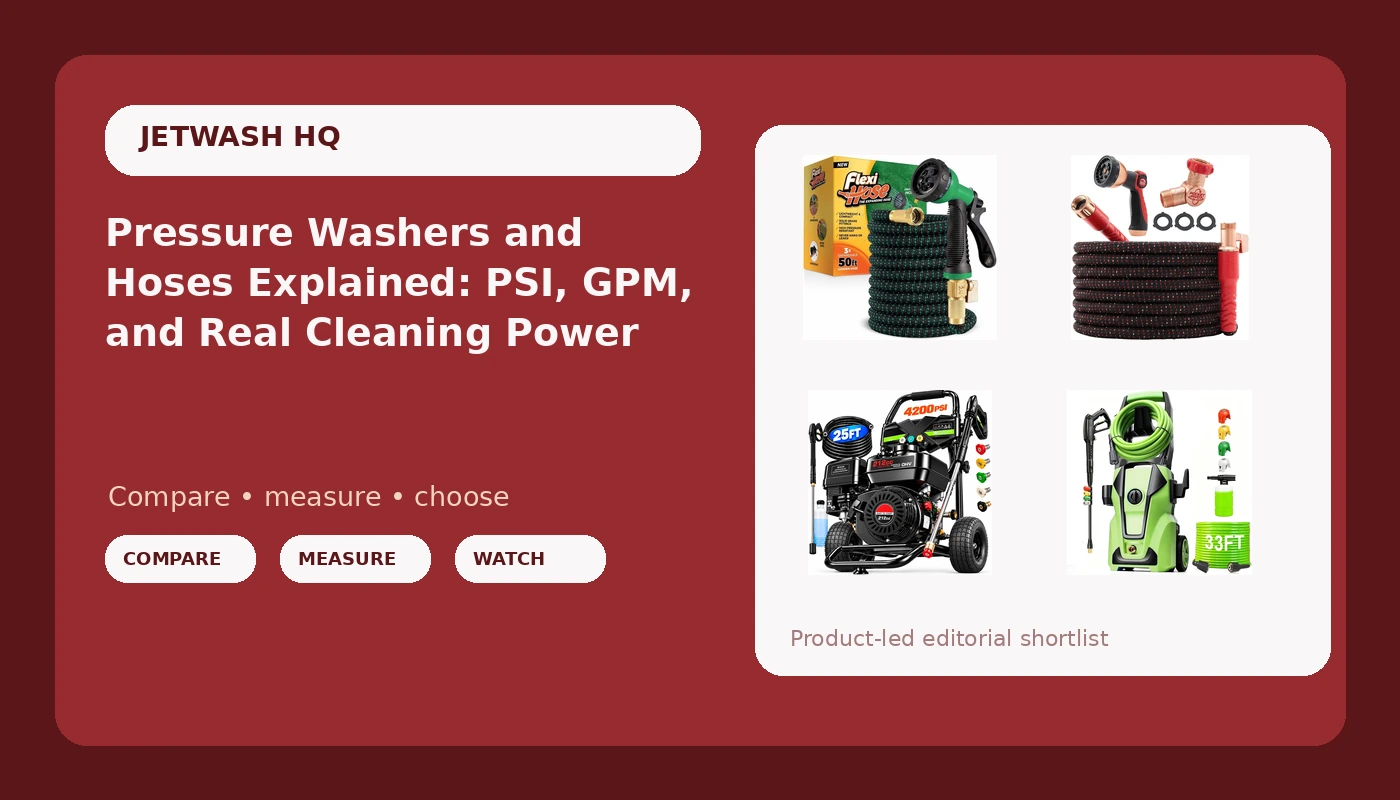
Pressure washers get sold on a single number, and it is usually the wrong one. Walk the aisle of any hardware store and the boxes shout 3,000 PSI, 4,000 PSI, 5,000 PSI, as if pressure alone scrubs a driveway. In practice, a pressure washer and hose setup is a system. The pump moves water at some flow rate, the nozzle shapes that water into a fan or a pencil point, and the hose decides whether you can reach the far corner of the driveway without dragging a kinked snake behind you. Get the flow and the nozzle right and a modest machine humiliates a big one. Get them wrong and you spend a Saturday soaking a concrete slab instead of cleaning it.
This explainer covers how the pieces fit together, then looks at four options that solve very different problems: a gas unit built for heavy work, an electric unit for lighter duty, and two expandable hoses that address reach and storage. Nothing here replaces reading the listing for the specs that matter to you, and nothing here is a measured lab result. It is a map of what each part does so you can decide which combination belongs in your garage.
Related: How to Pick Pressure Washer Nozzles and Surface Cleaners →
Quick answer
Start with flow, not pressure. A gas pressure washer that publishes both a pressure rating and a real flow rate, like the 4.0 GPM, 4200 PSI model below, is the more capable machine for driveways, decks, siding, and boats. An electric pressure washer with a long hose, like the 5000 PSI unit here, can cover cars, patio furniture, and light concrete, provided you respect its duty cycle and confirm its flow figure on the listing. The two expandable hoses solve a different problem entirely: reach and storage, whether you are feeding a spigot or rinsing soap off a car. Verify the flow rate before you buy anything, because a pressure number alone tells you how the water feels, not how much work it does.
4 useful options
| Model | Best fit | What stands out |
|---|---|---|
| 4200 PSI 4.0 GPM Gas Pressure Washer, 212cc Heavy Duty Power Washer, Commercial Gas Powered Pressure Washer for Driveways, Cars, Decks, Patios, Siding and Outdoor Cleaning | Driveways, decks, siding, and boats | The listing pairs a pressure rating with a 4.0 GPM flow figure and a 212cc gas engine |
| Electric Pressure Washer 5000PSI Power Washer with 33FT Hose | Cars, patio furniture, and light concrete | Corded electric power with a 33 ft hose included |
| Flexi Hose with 8 Function Nozzle, 50FT - Lightweight Expandable Garden Hose, No-Kink Flexibility, 3/4 Inch Solid Brass Fittings and Double Latex Core - Black and Green | Everyday rinsing and short reach | Expandable 50 ft design, 8 nozzle functions, and brass fittings |
| Pocket Hose Ballistic 100 FT Expandable Garden Hose, No-Kink, As Seen on TV | Long runs to a distant spigot | 100 ft expandable length with a no-kink design |
The heavy-duty gas option: 4200 PSI 4.0 GPM Gas Pressure Washer
The important detail here is not the pressure figure. It is that the listing also states a flow rate, and 4.0 GPM is a genuine volume of water. Flow is what carries dirt off a surface once the nozzle has loosened it, which is why a machine moving four gallons a minute strips a driveway faster than a machine that only claims a big pressure number. The trade-offs are real, though. Gas means fuel, oil, exhaust, noise, and seasonal maintenance, and a 4 GPM pump needs a supply that can keep up. A standard spigot usually can, but a long, narrow hose between the spigot and the inlet will starve it. If you plan on a full driveway every few weeks or a boat hull twice a season, this class of machine is the one that keeps up. Pair it with a surface cleaner and the work stops being a chore.
The plug-in electric option: Electric Pressure Washer 5000PSI Power Washer with 33FT Hose
Electric units earn their place for reasons that have nothing to do with ratings. They start with a switch, they run without fumes, they are quiet enough for an early morning, and they store on a shelf. The 33 ft hose matters more than people expect, because reach is what stops you from moving the machine every ninety seconds. The caution is the headline number. A 5000 PSI claim on a corded machine is a large claim, and the figure that actually determines cleaning speed is the flow rate, which the listing name does not state. Look for it on the product page and compare it honestly with the gas unit above. Also plan around duty cycle: corded electrics generally want breaks, so a full driveway becomes a series of passes with cool-down time in between. For cars, patio furniture, grills, and light concrete, that rhythm is perfectly fine.
The flexible 50 ft hose: Flexi Hose with 8 Function Nozzle, 50FT
Expandable hoses exist because traditional rubber hoses are miserable to store and worse to drag around a corner. A 50 ft hose that collapses to a fraction of that length is a genuine quality of life upgrade for rinsing a car, watering beds, or hosing down a patio after the pressure washer has done its work. The 8 function nozzle covers the usual spread from a soft shower to a jet, and brass fittings resist the corrosion that chews up cheap plastic couplings. One boundary matters: this is a garden hose, not a pressure hose. It belongs on the supply side or on the rinse side, never between the pump and the wand, because the high-pressure line sees stresses no expandable fabric sleeve is built for. Treat it as the water delivery and rinse tool it is and it will last seasons.
The 100 ft expandable hose: Pocket Hose Ballistic 100 FT Expandable Garden Hose
A hundred feet solves a specific problem: the spigot is on the wrong side of the house, or the driveway is long, or the boat sits at the far end of the yard. The catch is physics. Every extra foot of hose adds friction loss, so the pressure and flow arriving at the far end are lower than what leaves the spigot. Diameter matters as much as length here, and a longer run makes it more noticeable. If your plan is to feed a high-flow gas pressure washer, keep the run to the inlet as short and wide as you can and use a long hose like this one for watering and rinsing instead. For pure reach around a big property, an expandable 100 ft hose that folds into a bucket is far easier to live with than a heavy conventional hose of the same length.
Prices and availability may change. Product images, names, and retailer links are matched to verified listings. No current price, rating, stock status, or measured result is stated here without current evidence.
Why flow rate cleans and pressure only shapes
Pressure and flow do different jobs, and confusing them is the most expensive mistake in this category. Pressure, measured in PSI, is the force pushing water through the nozzle orifice. Flow, measured in GPM, is how much water actually arrives at the surface. Cleaning performance tracks the combination: a pump moving four gallons a minute at a moderate pressure removes far more dirt per pass than a pump moving one and a half gallons a minute at a higher pressure, because the water is what flushes loosened grime away instead of just blasting a stripe into it.
Nozzle orifice size ties the two together. Push the same flow through a narrower tip and the pressure at the tip rises; widen the tip and pressure drops while the fan spreads. That is why a machine can feel weak or violent depending on the tip in the wand, and why a $15 surface cleaner can transform a mid-range washer on flat concrete. The spinning bar spreads the same flow across a wider path evenly, with no wand stripes.
Detergent draw is the other half of the system. A pressure washer that cannot pull soap through its injector or tank is just a hose with a trigger, and you will end up scrubbing by hand anyway. Finally, duty cycle decides how long you can work. Gas units run continuously. Many corded electrics want rest periods, which is fine for a car and frustrating on a driveway.
Matching the machine to the job
- Write down what you actually clean and how often. A weekly car wash and a twice-yearly deck are not the same job as a rental property with four driveways.
- Find the flow rate on the listing. Look for GPM, not just PSI. If a product page never states flow, treat the pressure rating as marketing until you find it.
- Check your water supply. Spigot output, hose diameter, and hose length all restrict flow, and a 4 GPM machine fed through a long, narrow hose will not deliver what it promises.
- Choose the nozzle and attachment before the machine. A surface cleaner, a turbo tip, and a soap nozzle change results more than a step up in pressure does.
- Confirm duty cycle, storage, and winterizing. Fuel, oil, and freezing temperatures all shorten the life of equipment that was not prepared for them.
Practical rules that save a weekend
- Never put a garden hose on the high-pressure side of a pressure washer. Expandable hoses belong on the supply or rinse side only.
- Use the widest nozzle that still removes the dirt, then step narrower only if needed. Wide fans clean faster and damage less.
- Pre-treat with detergent and let it dwell. Chemistry does work that pressure cannot do without harming the surface.
- Keep the supply run short and wide. Save the 100 ft expandable hose for watering and rinsing, not for feeding a high-flow pump.
- Drain hoses and the pump after every use and store them out of direct sun. Freeze damage and UV rot end more equipment than wear does.
- Test any new nozzle on a hidden spot first, especially on wood, painted siding, and vehicle paint.
Which option should you choose?
Choose the 4200 PSI 4.0 GPM Gas Pressure Washer, 212cc Heavy Duty Power Washer, Commercial Gas Powered Pressure Washer for Driveways, Cars, Decks, Patios, Siding and Outdoor Cleaning when you have driveways, decks, siding, or a boat to handle and you want a published flow rate plus the endurance of a gas engine. Choose the Electric Pressure Washer 5000PSI Power Washer with 33FT Hose when your jobs are cars, furniture, and light concrete, and you value a quiet, fume-free machine with a 33 ft hose you can plug in and use today. Choose the Flexi Hose with 8 Function Nozzle, 50FT - Lightweight Expandable Garden Hose, No-Kink Flexibility, 3/4 Inch Solid Brass Fittings and Double Latex Core - Black and Green when you need easy, kink-resistant reach for rinsing and watering within 50 ft of the spigot. Choose the Pocket Hose Ballistic 100 FT Expandable Garden Hose, No-Kink, As Seen on TV when the spigot is far away and you want that reach to collapse into a bucket afterward.
One caveat on all four: the specifications discussed here come from the product listings, not from independent measurement. Verify the flow rate, the included accessories, and the current availability on the listing before you commit, and match the machine to the water supply you actually have.
The bottom line
A pressure washer is one part of a system, and the weakest part sets the ceiling. Flow rate does the cleaning, the nozzle shapes the result, the detergent system handles the chemistry, and the hose decides whether any of it is pleasant to use. If your work is heavy and recurring, a gas machine that publishes both pressure and flow, like the 4.0 GPM unit here, is the one that will not make you wait. If your work is occasional, a corded electric with a long hose covers most homes without the fuel and maintenance overhead. And whichever machine you land on, a proper expandable hose for supply and rinsing keeps the pressure side clean and the storage shelf tidy. Read the flow figure, pick the right tip, and the driveway will look new without a second pass.