Pressure washer PSI vs GPM is the argument that decides whether a machine is worth owning. Walk down the aisle at any hardware store and every box shouts a pressure number: 3,800 PSI, 5,000 PSI, and higher. Almost none of them print the flow rate in the same size type, and flow rate is what actually moves dirt off concrete. A washer with a big pressure number and a thin stream will etch a stripe into a driveway and leave the rest of it dirty. A washer with real gallons per minute rinses a slab evenly and carries the soap away with it.
This guide explains how pressure and flow work together, what nozzles and detergent draw change about a job, and how four very different machines in the current lineup fit four very different owners. If you already know whether you want cordless convenience or a wheeled unit with a foam cannon, the table below gets you there fast. If you want to understand why the numbers on the box mislead people, keep reading.
Related: How to Wash a Car Without Swirl Marks →
Quick answer
Buy for flow rate first and pressure second. GPM, gallons per minute, is what carries dirt and soap off a surface. PSI is the force behind the spray, and past a certain point extra pressure mostly adds risk to wood, paint, and trim rather than adding cleaning power. Match the machine to the surface, then match the nozzle to the machine, and only then compare specs.
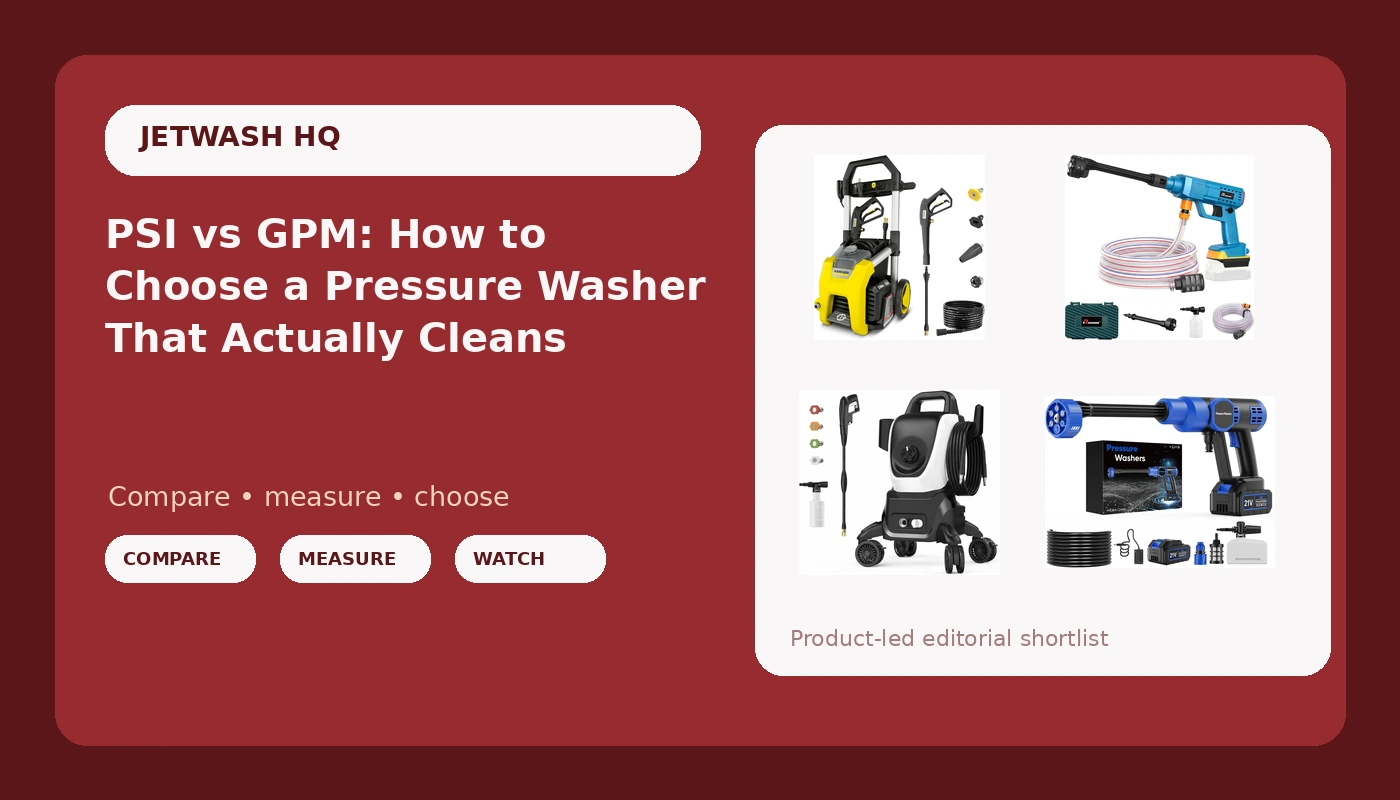
For the four units here: the Kärcher Pressure Washer K1700 is the plug-in pick for cars, siding, and patios, with a detergent tank and three nozzles in the box. The Cordless Pressure Washer for DEWALT 20V MAX Battery is for anyone already invested in that battery platform. The Pressure Washer, 3800 Max PSI, 2.4 GPM is the wheeled machine for big flat surfaces, and it ships with a foam cannon. The 5000 PSI Cordless Pressure Washer with 4.0Ah Battery is the battery-powered option for work that happens away from an outlet. Peak PSI ratings on any box are not the same as working pressure, so read the flow number alongside them.
Four useful options
| Model | Best fit | What stands out |
|---|---|---|
| Kärcher Pressure Washer K1700 | Cars, siding, patios, and light home jobs | CETA certified, three spray nozzles, onboard detergent tank, 1.2 max GPM |
| Cordless Pressure Washer for DEWALT 20V MAX Battery | Owners already on the DEWALT 20V MAX platform | Runs on the battery platform instead of a cord |
| Pressure Washer, 3800 Max PSI, 2.4 GPM | Large driveways and flat surfaces | 2.4 GPM flow, four-wheel mobility, foam cannon included |
| 5000 PSI Cordless Pressure Washer with 4.0Ah Battery | Cordless jobs away from power | Battery-powered, 4.0Ah battery included |
The plug-in all-rounder: Kärcher Pressure Washer K1700
The trade-off is flow. The listing states 1.2 max GPM, and "max" is doing real work in that sentence. That is a modest flow rate, so this is a machine you use deliberately: one panel of siding at a time, one wheel at a time, letting the nozzle and the detergent do the work rather than trying to blast a whole driveway in a single pass. Where it earns its place is the soap tank, because a washer that can draw its own detergent saves you from the spray-bottle-and-bucket routine on every car wash. For anyone whose jobs are a car, a walkway, and some patio furniture, that combination is more useful than a bigger pressure number.
The battery-platform pick: Cordless Pressure Washer for DEWALT 20V MAX Battery
Be honest about what a cordless unit like this is for. It is not the machine you buy to strip a two-car driveway. It is the machine you grab to knock the road film off a bumper, rinse a bike, spray down patio cushions, or hit the wheel wells before a wash. Because the listing is built around the battery platform, confirm what is included before you order and check whether you already have compatible batteries and a charger. The reward for that check is a washer with no cord to trip over and no outlet to hunt for, which is worth more than a spec sheet number on the jobs where it fits.
The wheeled workhorse: Pressure Washer, 3800 Max PSI, 2.4 GPM
The four-wheel base matters more than it sounds like it should. A washer that has to be carried between the front walk and the back fence is a washer that gets used twice a year. One that rolls gets used every time the mood strikes, and the foam cannon shortens the soap step considerably on cars and siding alike. Treat the 3800 figure as a peak rating, not a promise of working pressure at the nozzle, and treat the flow rate as the reason to pick this unit over a smaller one. If your property has a long driveway, a fence line, or a lot of concrete, this is the shape of machine you want.
The high-pressure cordless: 5000 PSI Cordless Pressure Washer with 4.0Ah Battery
A cordless washer solves a specific problem: distance from power. If your driveway is fine but your back fence, boat trailer, or second-story siding is nowhere near an outlet, a battery machine removes the extension cord from the equation entirely. What it does not do is replace a corded or gas unit for heavy stripping work, because battery-powered washers trade sustained output for portability. Read the flow rate and the working pressure, not just the peak number, and judge it on the jobs where you genuinely have no outlet. On those jobs, this machine has no competition from anything with a cord.
Prices and availability may change. Product images, names, and retailer links are matched to verified listings. No current price, rating, stock status, or measured result is stated here without current evidence.
What PSI and GPM actually do
PSI, pounds per square inch, measures how hard the water hits. GPM, gallons per minute, measures how much water hits. Cleaning happens when both work together, and flow does more of the heavy lifting than most shoppers expect. A wide, moving sheet of water at a decent flow rate lifts and carries grit away. A narrow, high-pressure pencil stream concentrates force into a small area, which is useful for stripping paint and terrible for cleaning a deck evenly.
This is why "max PSI" and "peak PSI" labels deserve scrutiny. Peak ratings describe the highest momentary pressure a pump can produce, not the pressure you get at the nozzle while you're actually working. Two machines can both claim 3,000 PSI and behave completely differently because one moves 1.2 GPM and the other moves 2.4 GPM. When you compare units, put the flow number side by side first, then use pressure as a tiebreaker.
There's a practical ceiling on pressure too. Wood decks, painted siding, asphalt shingles, and car paint all have limits, and exceeding them causes damage that shows up days later as fuzzed grain or stripped clear coat. Flow and the right nozzle get a surface clean without crossing that line.
Nozzles, detergent, hose, and wand
The nozzle is the cheapest performance upgrade on any pressure washer, and the one most people ignore. A 25-degree nozzle handles general rinsing and siding. A 40-degree nozzle is the safe choice for car paint and anything fragile. A 0-degree or turbo nozzle concentrates force and belongs on concrete and brick, not on a vehicle. Soap nozzles run at low pressure specifically so detergent can sit and work instead of being blasted off the surface instantly.
Detergent draw is the second thing to check. A washer that can't pull soap from a tank is a hose with a trigger, and you'll end up with a bucket and a brush instead. Onboard tanks, like the one on the Kärcher unit here, cut that step out entirely. Foam cannons, like the one bundled with the 3800 PSI machine, take it further by coating a surface in clinging foam that dwells long enough to break down road film and mildew.
Hose and wand quality decide whether you enjoy using the thing. A stiff hose that kinks every few feet will have you cursing by the third pass, and a wand that feels like a toy transmits every vibration into your wrist. Neither shows up on a spec sheet, and both matter more than another 200 PSI.
- Identify the hardest surface you'll clean and how often you'll clean it.
- Find the flow rate in GPM, and treat any peak PSI figure as a ceiling rather than a promise.
- Check whether the machine draws detergent on its own or needs a separate foam setup.
- Confirm which nozzles ship in the box and what each one is safe on.
- Decide whether you need an outlet, a battery platform, or a rolling chassis for the way you actually work.
Practical guidance before you buy
- Match the nozzle to the surface before you touch the trigger, and never put a narrow stream on car paint.
- Rinse a panel, soap it, let the detergent dwell, then rinse again. Pressure alone doesn't remove road film.
- Keep the spray moving. Holding a nozzle in one spot is how driveways get stripes and siding gets gouged.
- If you own DEWALT 20V MAX batteries already, price the cordless option against the batteries you'd otherwise buy.
- For a long driveway or fence line, prioritize wheels and flow rate over a bigger pressure number.
Which option should you choose?
Choose the Kärcher Pressure Washer K1700 when your jobs are a car, some siding, and a patio, and you want a corded machine with a detergent tank and three nozzles in the box. Choose the Cordless Pressure Washer for DEWALT 20V MAX Battery when you're already on that battery platform and want fast rinses without a cord. Choose the Pressure Washer, 3800 Max PSI, 2.4 GPM when you have a lot of flat concrete and want wheels, real flow, and a foam cannon. Choose the 5000 PSI Cordless Pressure Washer with 4.0Ah Battery when the job is far from any outlet and portability beats sustained output.
A caveat worth repeating: peak PSI figures are not working pressure, and no spec sheet substitutes for knowing what surface you're cleaning. Buy for flow and nozzles, and confirm what's included in each listing before ordering.
The bottom line
The pressure washer PSI vs GPM question has a consistent answer. Flow rate cleans, pressure is the feeling, and the nozzle decides which surfaces you can safely touch. A modest machine with a good nozzle and a working detergent system will out-clean a bigger one with the wrong setup every time. Pick the unit that matches your surfaces, your outlets, and your patience for dragging equipment around, then spend your remaining attention on nozzles and technique. That's where the visible difference actually comes from.